Swaying palms
Posted: November 20, 2013 Filed under: Uncategorized | Tags: Buddah quotes on holding a grudge, Buddha quotes, forgiveness, holding a grudge bad for your health, Lewis B Smedes, physical effects of holding a grudge, psychological effects of holding a grudge, swaying palm tree pose, the Bhagavad Gita, the Bhagavad Gita yoga is a journey quote, yoga, yoga poses 10 CommentsToday in yoga class, my instructor had us do the Swaying Palm Tree pose. It’s not one of my favorites because it’s not very challenging for me, but I appreciate what it brings to the table: it strengthens joints; stretches ligaments, side abdominal muscles, back and spine; improves balance; and increases mental focus.

tumblr.com
My instructor usually has something to say about each pose, and often mentions during the Swaying Palms pose that we can learn to sway and bend without being broken. Today she said she wanted to focus on forgiveness. Uh oh. That’s something I’m not so great at. Once I get mad, I stay mad — sometimes for years. I have been unforgiving about a certain issue with certain people for a long time, and thanks to my know-it-all yoga instructor, it’s time to change that.
Ms Know-It-All said that when we don’t forgive or sway or bend, we can become brittle and hard, and that we can sway without becoming uprooted and we can bend without foregoing our principles. Great. I can’t argue with that. It became clear that I needed to pay attention. I needed to listen to what the universe was telling me, even if it’s something I don’t want to hear. One of my favorite things about yoga is that it makes me think about things I don’t want to think about and it makes me hear things I don’t want to hear. The Bhagavad Gita said, “Yoga is the journey of the self, through the self, to the self.”
I definitely did not want to think about forgiveness today, but the yoga gods had other ideas.
My instructor cautioned us againstthinking that forgiveness means forgetting. She said that few people can go from suffering an injustice, whatever that may be, to forgiving and forgetting easily. It’s a process. A journey. A journey through the self, in my case.
She then asked us to consider the price we pay for holding a grudge, for refusing to forgive.
It’s big. Holding a grudge can cause stress and toxins to accumulate in our bodies. It can raise blood pressure, impair the immune system, encourage stress hormones, and increase inflammation. It can also contribute to anxiety and depression.
The last thing I need is more stress, toxins, and inflammation in my life. Perhaps it’s time.
Time to let go of the anger and injustice. Time to move away from heartache and toward happiness.
Noted ethicist and theologian Lewis B. Smedes was an expert on forgiveness. He asked, “Will we let our pain hang on to our hearts where it will eat away our joy?” He’s the expert, and according to him, we don’t need to excuse the wrong, or even stop feeling angry about it, to forgive the wrongdoer. We just need to change the memory of our past into a hope for our future.
Like the Buddha said, “Holding a grudge is like drinking poison and waiting for the other person to die.” There are plenty of things I like to drink; poison is not one of them. I’m setting it aside and beginning the process.
Twinnies
Posted: November 19, 2013 Filed under: breast cancer | Tags: autologous fat transfer, breast cancer in young women, DIEP, DIEP flap reconstruction, identical twins, identical twins with breast cancer, Kelly McCarthy, Kristen Maurer, the Big Dig 4 CommentsAs if one case of breast cancer isn’t enough, how about two cases?

dailymail.co.uk
Identical twin sisters Kelly McCarthy and Kristen Maurer from Indiana share a lot of things — including breast cancer. The 34-year-old sisters saw first-hand how devastating cancer is when their mother died from colon cancer last year. Like so many struck by breast cancer, the sisters had no family history of the disease.
Apparently it’s not all that unusual, though, for identical twins to develop the same cancer, because they have the exact same genetic makeup. In addition, twins also have a mirror effect, with one twin getting cancer in one breast, and the other twin getting it in the other breast. McCarthy and Maurer were no different in this regard.
Their treatment was similarly influenced by each other: McCarthy was diagnosed first, with triple-negative breast cancer in her right breast, while 9 months pregnant. A week later, her baby was born, and shortly thereafter she started chemo & radiation, then had a mastectomy. Because of her sister’s diagnosis, Maurer got tested and found early-stage cancer in her left breast and had a bilateral mastectomy with tissue expanders and then implants.
McCarthy’s reconstruction was a bit different: instead of going the more common route of tissue expanders to implant, she decided on a second mastectomy on the “unaffected” breast and flap reconstruction of both breasts. The problem was, she didn’t have enough fat & tissue to create two new breasts. I had a similar experience, sorta. Well, minus the identical twin sister, but sorta. I had extra fat before my DIEP reconstruction, aka The Big Dig, just not enough in my belly, the main harvesting site for DIEP surgery. Instead of having a twin sister donate her excess fat, I had to gain weight so that there would be enough excess in my belly. I went on the All-Butter-Lots-of-Cheese-Bottomless-Beer-Mug diet and packed on 12 pounds. Sadly, not all of it went to my belly (the rest I happen to be sitting upon as I type).
The worst part of the forced weight gain? No, it’s not the leftover junk in my trunk or the persistent craving for beer. It was the “Grab the Fat” game I had to play, more than once, with my plastic surgeons to determine whether my fat was fatty enough. Egads, I’d almost forgotten about the “Grab the Fat” game. I wrote about in this post,
“I thought I’d plumbed the depths of humiliation with the ‘grab the fat’ game we played more than once in preparation for reconstruction. In this game, the doc asked me to drop my drawers so he could grab my belly fat and determine if it was plump enough and plentiful enough to construct a new set of knockers. In a modified game of Twister, he had me sit, stand, and lean over to see just how much fat I had around my middle. Not once, but twice.
Humiliating doesn’t quite cover it.
But today, it was total humiliation, all humiliation all the time. I was basically splayed out like a deboned chicken on the exam table while he searched and plotted. Ladies and gents, just imagine your least favorite body parts being put under the microscope so to speak. Just consider for a moment being asked to stand up, sit down, and contort your body in the absolute least-flattering ways so that the softest, flabbiest, most-despised parts of your body are on full display. And then have those parts analyzed and calculated to determine just how fatty they are. We go to such lengths to de-emphasize these body parts, yet mine were being trotted out like the prize-winning hog at the state fair.”
McCarthy was fortunate enough to skip the “Grab the Fat” portion of the DIEP journey, but her sister probably endured it, because she donated her belly fat & tissue so that her twin could get reconstruction via DIEP surgery. Maurer underwent abdominal surgery — not a tummy tuck, people, because there’s no free lunch in breast cancer — to harvest the goods for her sister’s other breast.
How awesome is that??
Like most twins, McCarthy and Maurer share a close bond. But now, McCarthy said, “I feel closer. Her tissue is over my heart.”
But did it really save her life?
Posted: November 14, 2013 Filed under: breast cancer | Tags: 2012 mammogram study, Amy Robach, do mammograms save lives?, Dr Susan Love, GMA Goes Pink, Good Morning America, New England Journal of Medicine, on-air mammogram 11 CommentsAmy Robach, an anchor on Good Morning America, underwent a bilateral mastectomy today because she was diagnosed with breast cancer following a live, on-air mammogram last month. She credits that mammogram with saving her life.
Robach is a 40-year-old mother who lives an active, healthy lifestyle and has no family history of breast cancer. Her diagnosis came as a tremendous shock because she had no symptoms or reason to think she was anything other than the picture of health. She wants to fight her cancer as aggressively as possible. I know exactly how she feels. I too was 40 years old when I was diagnosed. My kids were 8 and 10. I lead an active, healthy lifestyle. I opted for a “scorched Earth” attack on my cancer.
I’m in no way challenging her decisions or judging her motivations, because hers are the same mine were. At the time I was diagnosed, my one and only goal was to rid my body of the cancer so that I could spare my kids the horror of watching their mom die before her time. I was willing to take the most aggressive road in exchange for a cancer-free life.
What I am challenging, however, is the rampant, panacea-esque assumption that routine mammograms save lives. Everyone loves a “feel good” story, and no cause stirs up quite as much “feel good” stuff as breast cancer. Wrapped in a pink ribbon, glitzed and glammed to high heaven and jacked-up as feminine and pretty, breast cancer is the cancer. All the cool celebrities are getting it, and everyone loves to hear that more “awareness” and more screenings mean more lives saved. We hear much of celebs being brave in the face of a breast cancer diagnosis, yet we learn little of whether their cancer warranted the treatment they chose.
While the “mammograms save lives” story makes people feel good and likely sells a whole lot of airtime, it’s not exactly true. But we want to believe it, despite scientific evidence telling us otherwise. While the evidence is sound, how many women opt out of a mammogram because they know that the routine screening has little to no impact on mortality? Conversely, how many women are diagnosed with relatively harmless breast cancer yet choose the most aggressive treatment? I know one such woman, for she is me. I am her. I knew my form of breast cancer was not terribly threatening, and I was provided all the stats & facts & figures and options to support that. Yet my gut instinct was to scorch that Earth.
A 2012 New England Journal of Medicine study looked into whether screening mammograms has had an impact on breast cancer mortality. After culling through 30 years of statistics, the conclusion: screening mammograms increase the cases of early-stage breast cancers that are detected, but that detection of advanced breast cancers has not changed.
Because the number of cases of advanced-stage breast cancer has not changed in 30 years of routine screenings, researchers concluded that mammograms are not successful in saving lives. Studies in the United Kingdom, the Netherlands, Italy, Switzerland, Norway, and Australia have come to the same conclusion. One thing that has changed during the last 3 decades: increased diagnoses and surgeries.
This Nautilus article echoes the 2012 NEJM study. About Robach’s on-air mammo, author Amos Zeeburg says:
“The [Good Morning America] episode was presented as a triumph of medical science, an even more compelling push to get tested: Robach had no idea she was in grave danger, the screen had saved her life, and it might do the same for any woman watching. [Robach said] ‘If I got the mammogram on air, and if it saved one life, then it’s all worth it. It never occurred to me that life would be mine.’ It’s an inspiring conclusion, and it certainly makes for great TV, but the show’s lesson about screening mammograms is highly misleading. In a world of limited medical resources, it may even be harmful.”
So what’s a woman to do? Our doctors recommend a baseline mammogram annually starting at age 40. Celebs implore us to get our mammograms. Every October there’s enough “awareness” to scare the bejeezus out of a normally rational woman. Every time we turn around, someone else we know — in real life or from TV — is diagnosed with breast cancer, and everyone believes that early detection saves lives.
Nautilus author Zeeburg says: “The big problem with screening is that it tends to find cancers that are not very dangerous—’indolent’ ones that don’t grow quickly, will never metastasize to other organs, and might even go away on their own—while missing the truly deadly ones, which grow and spread too fast to get caught in any case. ”
Noted breast cancer docs agree.
Dr Susan Love said, “I really don’t think we should be routinely screening women under 50. There’s no data showing it works.”
And for women younger than 50 who follow the rules and get a yearly mammogram, Dr Love says “It’s radiation without much benefit.” She notes that most European countries recommend screening every other year, and their breast cancer mortality rates are no higher than ours.
Dr Silvia Formenti, head of radiation oncology at NYU’s Langone Medical Center said the emphasis on mammograms for everyone might have given the public the impression that screening could prevent cancer. “It’s a giant misconception,” she said. Furthermore, she’s not a fan of overtreating indolent cancers but worries about the diagnoses “turn them into cancer patients and erodes their peace of mind forever. We take away the innocence of being healthy and not having to worry about cancer. The psychological cost of becoming a cancer patient is underrated.”
Amen, sister.
But all these dissenting voices don’t clear up the question women face regarding mammograms. After my OB-GYN felt a teeny-tiny lump, she sent me for a diagnostic mammogram, which led to a couple of biopsies and then diagnosis. My cancer was determined to be indolent, yet I still chose the scorched-Earth option. Maybe I wouldn’t have reacted as surely and as strongly had I not watched my mom die of cancer and if I didn’t feel a gigantic, never-ending void in my life after she died. But how much does the constant barrage we receive about early detection saving lives contribute to such sure and strong decisions about our course of treatment? I went into my bilateral mastectomy eyes wide open and perhaps too well-informed about what I was getting myself into (absent the post-mastectomy infection that ended up being waaaaaay more perilous than the actual cancer). I went in feeling 100 percent certain about my decision. Yet now I wonder: what would have been the risk of just watching that teeny-tiny lump and seeing what, if anything, changed from year to year? How risky is it to live with a teeny-tiny lump of indolent breast cancer for years?
How many of us would be willing to play those odds if we weren’t barraged with messages about mammograms saving lives?
I don’t know the answer. I can’t say if I would have changed anything about my scorched-Earth policy; hindsight is perfect, after all. But I do wonder how much the “early detection” and “mammograms save lives” rhetoric contributes to the decisions we do make when facing down the pink beast.
I think Zeeburg says it best: “The surprising inefficiency of mammograms doesn’t mean they need to end, but that they should be reasonably evaluated, not treated as our divine shield against cancer, administered to everyone with breasts, and paired unquestioningly with the most aggressive treatments available.”
Screw you, Lulu
Posted: November 8, 2013 Filed under: Uncategorized | Tags: Ahtleta, Bloomberg TV, Chip Wilson, Lululemon, Lululemon discrimination, Lululemon founder, Lululemon yoga pants, Lululemon yoga pants see-through 9 CommentsLululemon and founder Chip Wilson can suck it.
Instead of the peace and zen that should emanate from a yoga-clothing supplier, Wilson is spewing hate and showing his ignorance. If his company’s damn clothes weren’t so damn overpriced, I’d be tempted to burn my Lulu outfits in the front yard.
I will admit I like Lulu’s clothes, despite the crazy-high prices: they’re cute, different, and stylish (says the woman who started playing tennis because she liked the outfits). They’re made from fabrics that stand up to a real workout (except for that one batch of see-through yoga pants, that is).
In attempting to explain the problem with the recalled yoga pants, Wilson created a couple of new yoga poses, which I don’t expect to see in my yoga class: Foot In Mouth and Flaming Douchebag. During an interview with Bloomberg TV, instead of taking responsibility for the faulty pants, Wilson blamed the women who wear them — and shell out $98 for each pair — for being too fat.
Yes, you read that right.
Wilson blames his customer base for being too fat.
“Some women’s bodies just don’t work for it.” I’m assuming the “it” he so uneloquently refers to is the pants. I would expect someone with a net worth of nearly $3 billion to be a bit more articulate, but I am picky that way.
When pressed to elaborate on the women’s bodies that “just don’t work,” Wilson added, “They don’t work for some women’s bodies. It’s really about the rubbing through the thighs, how much pressure is there over a period of time.”
What???
In an effort to clarify this insane suggestion, the Bloomberg TV reporter asked Wilson if Lululemon yoga pants are something that every woman, regardless of size, can wear. He said, “I think they can, I just think it’s how you use them.”
Wait — how we use them? How we use the yoga pants? Maybe like, for yoga?
The yoga pants are see-through — even though they cost 100 clams a pair — and this jackass is blaming the customer? And trying to throw up a loophole that questions how we might “use” yoga pants? Come on, man.

googleimages.com
It gets better. Or worse, actually.
As part of his raving lunacy, Wilson offered this:
“Breast cancer also came into prominence in the 1990s. Ultimately, I suggest this was due to the number of cigarette-smoking power women who were on the pill (initial concentrations of hormones in the pill were very high) and taking on the stress previously left to men in the working world.”
What???
While he clearly has a history of blaming the victim, Wilson can’t be serious about the causes of breast cancer. I can’t get past his choice of words describing breast cancer as something that “came into prominence.” Sadly, breast cancer is not like a desperate celebrity seeking its 15 minutes of fame; it’s here for the long haul. And it’s been around a lot longer than the 1990s. Idiot.
On the Lululemon blog, Wilson wrote a post elaborating his ass-hatty ideas and blathering on in moronic fashion, then summarizes by dropping this little gem: “lululemon was formed because female education levels, breast cancer, yoga/athletics and the desire to dress feminine came together all at one time. lululemon saw the opportunity to make the best technologically advanced components for [this] market in the 1990s.”
Sooooo, this genius created Lululemon because of women’s education, breast cancer, sports/fitness, and wanting to look pretty? Like a perfect storm, these mythical female elements of the universe converged to form a $10 billion company, and Wilson has women — fat, power-hungry, cigarette-smoking, birth-control-popping, breast-cancer having, vain women — to thank for his fame & fortune. Except, instead of thanking us, he somehow manages to blame and alienate us.
Screw you, Lululemon. I’m going to the Athleta store; I need some new yoga pants.
Lou
Posted: November 8, 2013 Filed under: Uncategorized | Tags: death, Laurie Anderson, life is beautiful, Lou Reed, Lou Reed and Laurie Anderson, Lou Reed death, meditation, peaceful death, peaceful death at home 2 Comments“I have never seen an expression as full of wonder as Lou’s as he died. His hands were doing the water-flowing 21-form of tai chi. His eyes were wide open. I was holding in my arms the person I loved the most in the world, and talking to him as he died. His heart stopped. He wasn’t afraid. I had gotten to walk with him to the end of the world. Life – so beautiful, painful and dazzling – does not get better than that. And death? I believe that the purpose of death is the release of love. At the moment, I have only the greatest happiness and I am so proud of the way he lived and died, of his incredible power and grace.I’m sure he will come to me in my dreams and will seem to be alive again. And I am suddenly standing here by myself stunned and grateful. How strange, exciting and miraculous that we can change each other so much, love each other so much through our words and music and our real lives.”
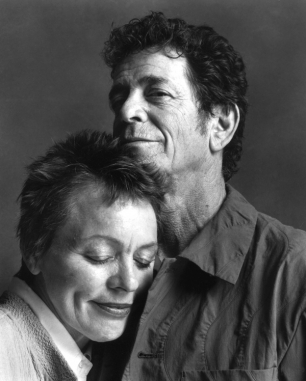
rollingstone.com
THIS is breast cancer awareness, people
Posted: October 24, 2013 Filed under: breast cancer, cancer fatigue | Tags: breast cancer awareness, breast cancer awareness month, breast cancer in young women, David Jay, NFL goes pink, NFL's A Crucial Catch, pinktober, pinkwashing, psychological effects of breast cancer 16 CommentsThis. 
Not this. 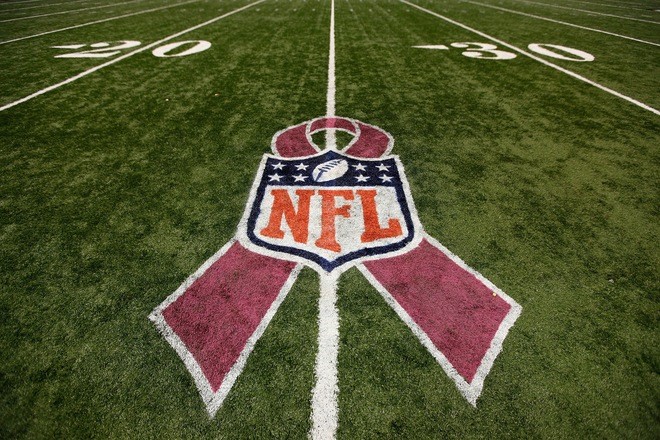
This. 
This is breast cancer awareness.
The SCAR Project is in town. My town. I went yesterday. What an experience.
I was dilly-dallying around about going and trying to convince myself that I am too busy to take time out of my jam-packed schedule. Truth is, I was a little nervous about going. I was nervous about seeing the incredibly powerful images and then confronting the emotions they would inevitable bring to the surface. I’m 3 1/2 years out from my diagnosis, yet I know that at any given moment, cancer can upend my “new normal” and bring me to my knees.
I suspected that seeing The SCAR Project images, full-size and in person, would upend me and bring me to my knees. They did.
I’ve seen the images online and in my copy of The SCAR Project book, one of my most-treasured gifts (thank you, Trevor). The book is available on Amazon.com; click here to order your copy.
Seeing them in person, however, is a completely different experience.
The exhibit is housed in a small gallery in the heart of Houston. On my short walk to the gallery I passed this lovely shrine in someone’s front yard.
I certainly hope I didn’t offend by snapping a quick photo. I don’t see things like this in the ‘burbs where I live.
Nestled into a quaint neighborhood surrounded by bustling businesses, Gremillion & Co Fine Art, Inc., is spartanly understated. The lush greenery surrounding the modern-but-not-out-there building and the pieces of sculpture flanking the gallery speak to the idea of popping inside for a quick fill of art in the middle of the day. 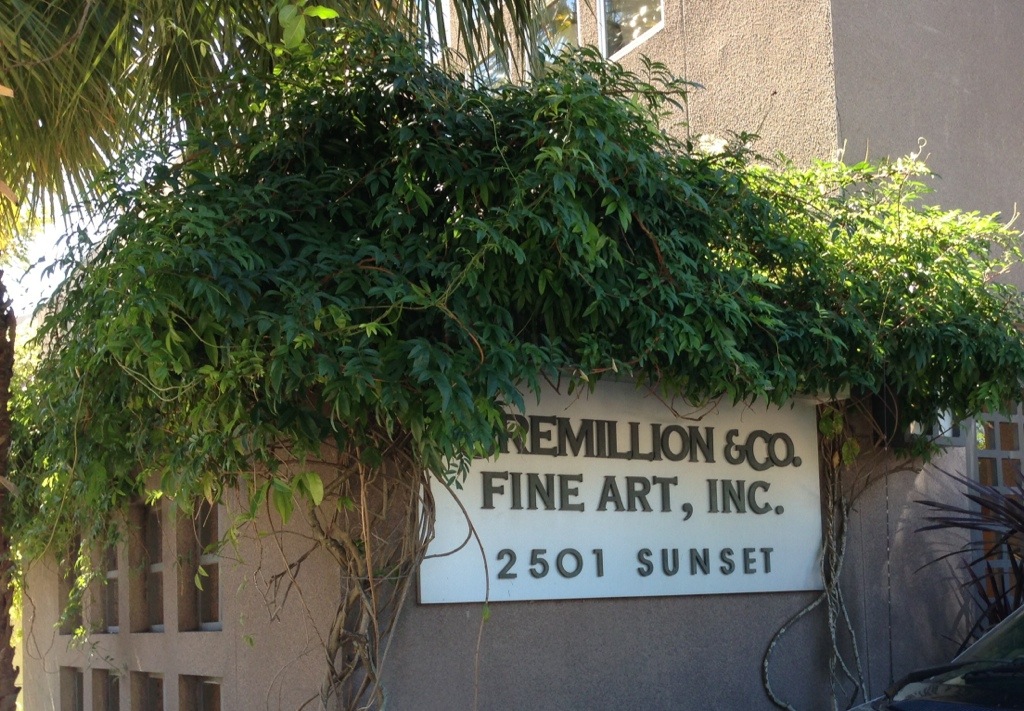
I gotta come back in the spring and see this wisteria in bloom.
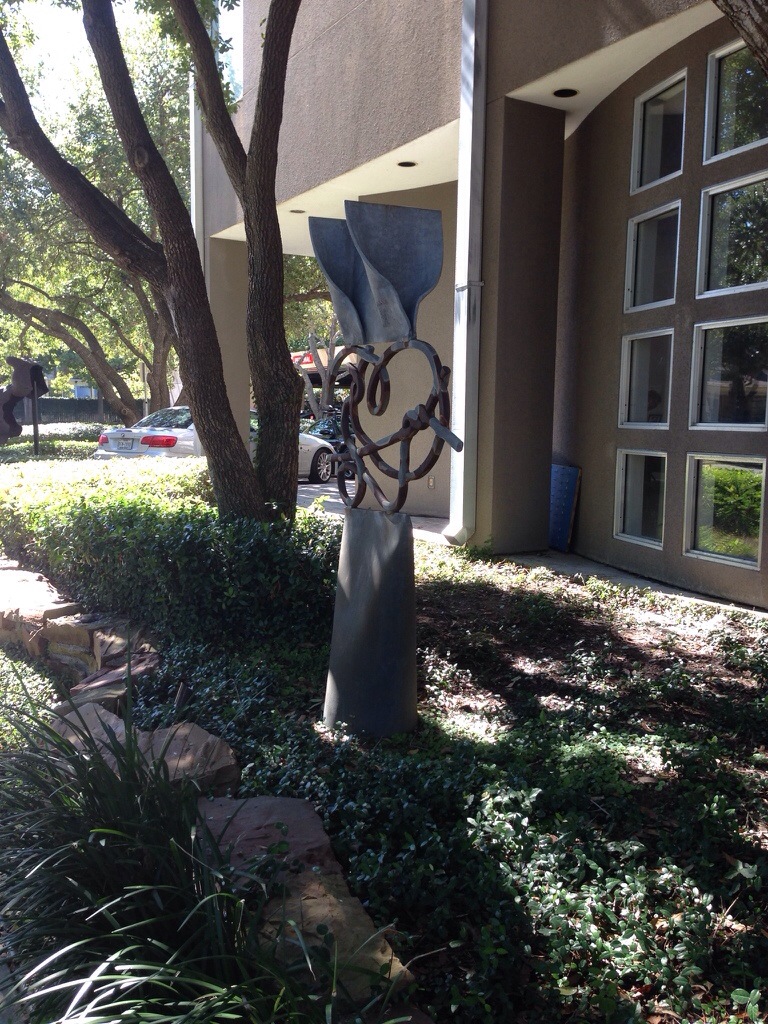 Some of the sculptures surrounding the building.
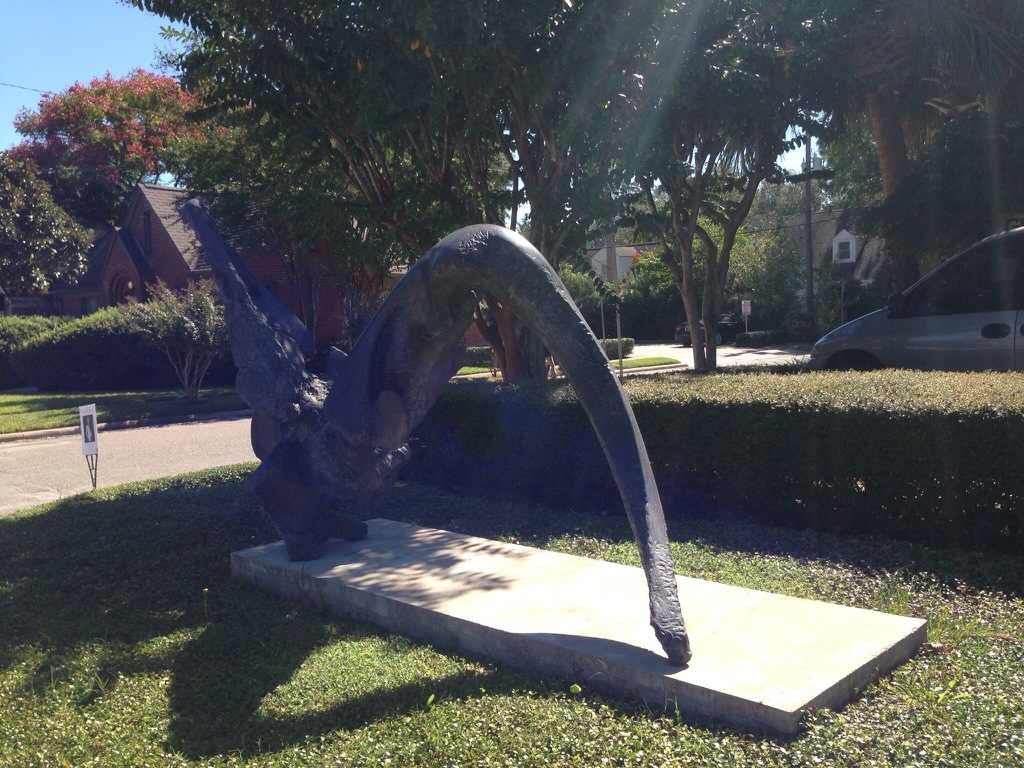
This gate leads into a little courtyard to the side of the gallery; a serene spot in the middle of the city. 
Enough stalling. Time to go inside.
There’s a sign on the gallery door that requests that visitors keep their conversations to a minimum and in a whisper because of the gripping, emotional response people have had to the photographs. While some not so intimately acquainted with the beast that is breast cancer might find this intriguing and perhaps even titillating, it did not have that effect on me. I felt certain my initial misgivings about witnessing the photos were true.
A small table filled with programs and copies of The SCAR Project book stands in the entrance. A cut-out window just behind revealed a man eating lunch, and I realized that man was David Jay, founder and photographer of The SCAR Project. I asked the docent if that was indeed him, and she nodded. I told her that I’m a survivor who greatly admires his work. She said, I thought you might be a survivor.
How did she know? What caused her to suspect? Perhaps the majority of visitors to the exhibit are. Or perhaps she read the fear and trepidation in my eyes. Either way, she smiled sympathetically and stepped away. Next thing I know, David Jay is standing right beside me, saying hello. Wow. I told him how much I admire his work and how grateful I am for him telling the real story. Not the “prettied-up, pink ribbon” story. He nodded and said, “That’s why the subtitle of this project is ‘Breast Cancer Is Not a Pink Ribbon.'” Amen, brother.
In the exhibit program, Jay is quoted as saying, “Still, through all of this, there is beauty. Soul. Courage. These are the things which cannot be taken away.”
Jay told me that he never envisioned working on this project, but that after a friend was diagnosed, the project was born. His mission: to show what breast cancer really looks like, especially in young women; to fundraise for research; and most importantly, to empower the women who have been affected and to hopefully allow them to see the beauty, strength, and resilience in the aftermath.
“For as long as I can remember, I have struggled with body-image issues. Losing my breasts and developing thick, red scars across my chest only made matters worse. I could not bear to look at myself in the mirror. I hope that being a part of The SCAR Project will help me to see something beautiful for a change. Maybe it will help me appreciate my body….It has, after all, created and sustained two new lives; it has fought cancer and won. It’s time I started giving it, and myself, much deserved respect. Maybe if my scars were viewed as art, it would help me to heal.” — Gabrielle, age 30
“The most important part of being photographed was that it made me feel beautiful. It was an opportunity for me to stand tall and strong with my scars and redefine my beauty for myself.” — Emily, age 32
“My challenge has been and continues to be to accept the sorrow, focus on the joy, and remember to share both with the ones I love. Survival is about more than breasts: it is about courage, strength, and the many other attributes that make a woman beautiful.” — Jill F, age 28
Barbie, age 36, served 18 years in the U.S. military before being diagnosed with breast cancer. 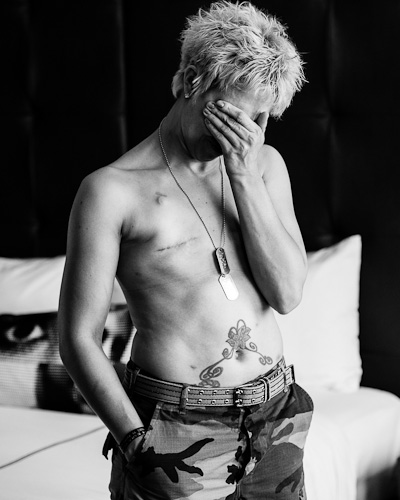
In her SCAR Project bio, she says that “a weapon, a FLAK jacket, and a Kevlar helmet didn’t protect from THIS enemy.” She goes on to say that “I am not going to ever get over breast cancer or move past it. I will love with it for the rest of my life. Remission is not a cure.”
Not surprisingly, scars are a recurrent theme among the women featured. “My scars are powerful lines that point to hope, faith, and love.” — Candice, age 30
“Our scars are there to remind us of the times in our lives that are important to remember and they paint a story of not just survival, but of living.” — Eliza, age 22
Some of the quotes by the women featured are so sad, yet so true:
“Cancer does not discriminate; it doesn’t care who you are.” — Jessica D, age 22
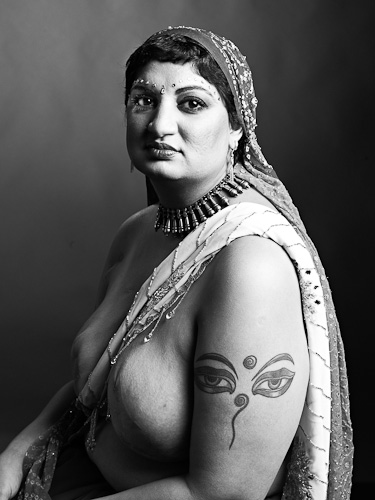 “An East-Indian girl, I was a mother to a toddler who fed from cancerous breasts for 20 months. A wife to a husband who left because he feared what my cancer would do to his life. A sister to a man who didn’t know what to say, so said nothing.” — Sona, age 36
 “Cancer took so many things from me, but the one thing I may never get over losing is my sense of security. Blood work and tumor markers allow me to live my life in 18-month intervals, but cancer is an unpredictable beast.” — Toni, age 28
“I lost all of my hair, looked like ET, got my boob hacked off along with 9 lymph nodes, got zapped by so much radiation my skin burned and bled, and will need to cut open my stomach and relocate my fat and muscles to my chest. I think sometimes I am so good at putting on a pretty face and acting all put-together that people don’t realize the extent of everything that breast cancer survivors go through. My scars and words are only half the story. They don’t show the emotional and private struggles that are continuously present.” — Vanessa, age 25
Something else Vanessa said really resonated with me: “I’ve never wanted to be the center of attention, or to be regarded as ‘special’ or ‘brave.’ I don’t need to be pitied or felt sorry for. In life, there’s a beautiful balance of happiness and sadness, awareness and unawareness, acceptance and rejection, blessings and misfortunes. These dualities are the moments that define life.”
Not all of The SCAR Project women survived. David Jay tells the story of Jennifer, age 27, who could not travel to New York for her photo shoot because her cancer had spread to her liver. She wanted to do it, though, and asked Jay if his studio had wheelchair access because she could no longer walk up the stairs. Jay told her, “Just come, I’ll carry you up the stairs if I have to.” She never made it to New York.
Each of the women featured in The SCAR Project has an important story to tell. Each has experienced things that profoundly and permanently changed them. Each faced the terrifying reality of cancer at a young age.
This wall of images represents each woman’s story and each woman’s struggles. It is moving beyond words. Not just for those of us diagnosed with the disease, but for all of us as human beings.
As I left the exhibit, I saw David Jay outside, on his cell phone. I waved to him as I walked past to my car. Pulling out of the garage, I thought, I should ask him to sign my program. But I didn’t want to interrupt his phone call. What to do? What to do? Interrupt him. Ask him.
So I did. 
For more information, go to http://www.thescarproject.org. Follow The SCAR Project on Facebook and Twitter (@thescarproject). Watch the Emmy-winning documentary Baring It All and purchase The SCAR Project book.
Worst idea ever
Posted: October 15, 2013 Filed under: Uncategorized | Tags: breast cancer awareness month, Lace Up for the Cure, New Balance, pinktober 9 CommentsI saw this ad in the Sunday paper.

Please. No.
Just no.
Pinktober is sucky enough for those of us who are unwillingly on Team Pink. One month is bad enough.
No.
My sweet mama
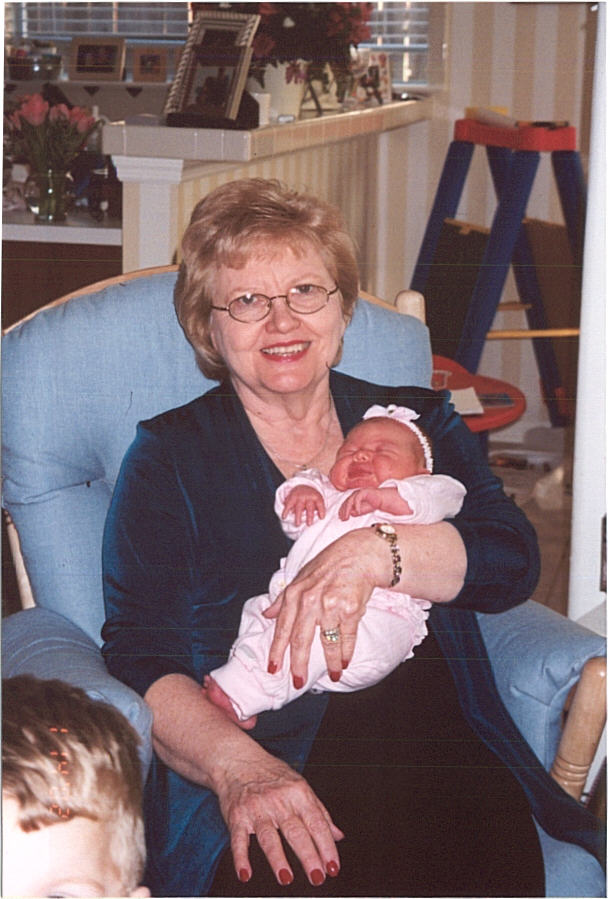
Posted: October 13, 2013 Filed under: Uncategorized 13 CommentsMy mom died today.
Eight years ago today.
In some ways it seems like just yesterday. It some ways, it seems like I never even knew her. At all. I can’t really remember the sound of her voice. When I try to recollect her voice, I hear the sound of her when she was sick, and it was not her, not the real her. I miss the sound of her laugh. She had a great laugh. It was genuine and from the heart. From the belly.
I miss her so much.
And yet, I feel like I don’t remember her at all. It’s as if she was never here at all.
She was awesome. So awesome. And she would want to spank me with the wooden spoon for being so unhappy and ungrateful for what I do have and for cussing so much.
Some times, I really hate those whose moms are still alive. I hate those whose moms are still healthy. If you have a mom, and she’s alive, I hate you. If you have a mom, and she’s healthy, I hate you.
Maybe that makes me small & petty & hateful. I can allow for that and I don’t care . It’s not rational, and I know that. It’s not logical, yet I don’t give 2 shits. You did nothing wrong, yet I feel the way I feel. I hate you. Could not care less. I hate you nonetheless. Even if you & your mama don’t have all that great a relationship and even if she drives you crazy or she’s distant or she’s not what you want or expect or need…I don’t care. I still hate you. Because she’s here. And mine is not. And that makes me hate you. All of you.
 That’s what cancer does.
I hate cancer.
I fucking hate cancer.
T-rage
Posted: September 26, 2013 Filed under: cancer fatigue, drugs | Tags: anxiety, ATLAS study of tamoxifen, ATLAS trial, road rage, roid rage, side effects of tamoxifen, steroid rage, tamoxifen, Tamoxifen side effects 22 CommentsI have a new Tamoxifen side-effect to add to my long list: T-rage.
T-rage joins an unpleasant cast of characters that feature starring roles in my daily existence. These characters take turns on center stage and compete for screen time. They jostle and nudge each other in their attempts to take over for real.
Who are these characters? The cast list is long, so bear with me. I’ll save the newest, T-rage, for last. These characters are all sponsored by my frenemy Tamoxifen. It’s my frenemy because it’s alternatively saves my life while also making me miserable. That life it is busy saving is increasingly becoming one not worth living.
Anxiety: because once you’ve faced down cancer, you need heightened worry and fretting, right?

googleimages.com
Bone pain: an ache so constant it only changes with the inexplicable flares that come along. Pain so acute I swear I can see my bones under my skin, because the pain illuminates them. I’d say I’m like a skeleton, except I’m not because of the extra weight that literally weighs me down, thanks to my frenemy Tamoxifen. If only I were a joyful, dancing skeleton.

paperspencils.com
Joint pain: while I don’t envision the joints beneath my skin the way I do my bones, they hurt. A lot. Most of the time. And I don’t even want to think about Tamoxifen’s contribution to my bad knee. 
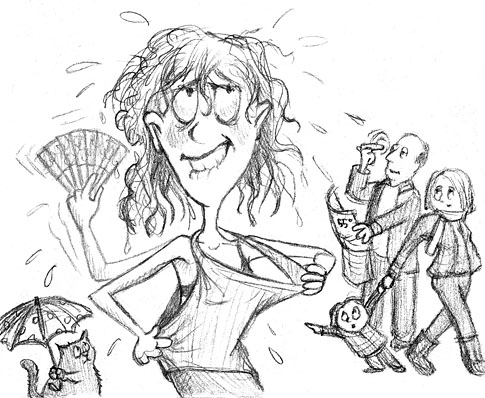
Hot flashes: because living in Houston–land of eternal summer and omnipresent humidity–isn’t enough to keep one drenched in sweat.

medulous.com
Sweat, sweat, and more sweat. Like the clown car at the circus, the sweat just keeps coming.
drybabe.com
Dry skin: Why can’t all that sweat moisturize?

googleimages.com
Brown spots on my face: I’m aging at a quick clip. Not pretty on a banana, not pretty on me. 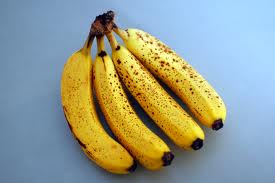
Thinning hair: To go along with the dry skin and brown spots. Pretty. Real pretty.

yourfitnesspoint.com
Peach fuzz: there’s hair where I don’t want it while that on my head is withering. By then end of my proposed 10-year course of this damn drug, I’ll have a full beard and a bald head.
Mental fogginess: huh? What was I going to say?

butyoudontlooksick.com
Trouble concentrating: Ditto.
Sleeplessness: because the previous characters don’t wreak enough havoc, now there’s no escaping them.
soberfornow.wordpress.com
Fatigue. Crushing fatigue. As in, each of my limbs feels as if it weighs 50 pounds. As in, it’s a Herculean effort to get off the couch. As in, I’m not rested after a full night’s sleep. As in, this bites.

trialx.com
Irritability. Major irritability. Sometimes I can barely stand myself. It is ugly.

googleimages.com
And, introducing irritability’s next-of-kin: T-rage.
You’re heard of ‘roid rage and road rage, and now T-rage. It’s similar to the other rages, in which something — in this case, Tamoxifen — causes a major-league reaction to a minor provocation. The sight of a Toyota Camry ahead of me in traffic (I hate Camrys). The guy conducting a shouting match on his cell phone in the middle of the grocery store (does anyone want to hear him squabbling with the unfortunate soul on the other end of that conversation?). The lady in the grocery store who leaves her cart in the middle of the aisle then gives me a go-to-hell look when I say “excuse me.” The asshat in the middle of the parking lot waiting for the person loading their groceries to pull out rather than picking another space. There are a hundred parking spots, but he’s gotta have that one. It’s a wonder I got out of the store without someone filing assault charges.
The T-rage sends me into certifiable-crazy mode in an instant. It’s not enough to just get around the Camry in traffic; I want to ram it. I’m not satisfied with shooting the cell-phone combatant a dirty look; I want to yank the phone out of his hand and shove it so far up an orifice he’d need it surgically removed. I’m not at all content to say “excuse me” to the inconsiderate grocery shopper in a shitty tone; I want to push her down and run over her repeatedly with her ill-placed cart. I don’t want to just shake my head at the fool holding up traffic in the parking lot while he waits for that close spot; I want to hurl my gallon of organic milk through his windshield.
Don’t even get me started on the moron in the mini van at middle-school pick-up yesterday who thinks the “No parking” sign doesn’t apply to her. No longer content to roll down my window and politely (or rudely) ask her not to park there, with T-rage, I want to do mean and horrible things to her.
I’ve got the T-rage. Real bad.
This. Is. Not. Good.
I know full good and well that I would not do well in prison. I’m much too fond of my own personal space, unlimited moisturizer, and fresh produce. Oh, and alcohol. Some inmates want a cake with a file or a shiv baked inside; I’d need my visitors to smuggle in booze.
Since prison is not a viable option, I need to get a grip on this T-rage. I need to figure out how to get through my day without murderous thoughts about the neighbors who can’t be bothered to pick up the crap-tastic freebie newspapers littering their driveways. The sight of so many neglected second-rate publications should not incite such violence. And yet, it does.
There are tips for dealing with road rage, and I’d suggest the best way to avoid ‘roid rage is to simply not take steroids. But I’ve not found any helpful tips on avoiding the T-rage. I’m gonna have to look for a 12-step program. Right after I punch someone.
Signs of life
Posted: September 12, 2013 Filed under: Uncategorized | Tags: 9/11 Memorial, Freedom Tower, September 11, terrorist attacks, The Memo, The Survivor Tree, World Trade Center 4 Comments Yesterday I wrote about the anniversary of the September 11 terrorist attacks and my friend M, who I met through this little blog, sent me this photo. It’s the new Freedom Tower, built on the site on which the former World Trade Center stood. M and her son visited New York City this summer and happened upon this beautiful convergence of the financial district skyline and the new building as the sun was setting. The result: a stunning light shining from the new tower.
Looking at the play of light suffuses me with warmth, and it calls to mind the visual my yoga teacher uses while instructing us to concentrate on our breath. She says to imagine our slow, long, belly-tightening exhale as a plume of breath exiting through a small hole in the top of our heads. A concentrated ridding of toxins and stale air. That’s what I think of when I see M’s photo: out with ruin, in with new life. Signs of life.
The Freedom Tower stands 1,776 feet tall and, according to the Lower Manhattan Development Corporation,”serves as a beacon of freedom, and demonstrates the resolve of the United States, and the people of New York City.”
Surrounding the tower is the Reflecting Absence memorial, which pays tribute to the 2,986 men and women who died on that terrible day. I visited the memorial in February while on a girls’ trip with my bestie Yvonne, and I still haven’t found the words to describe the experience. It was a brutally cold, insanely windy day — I think the temperature was 27 degrees, which is this Texan’s version of hell — but the discomfort the weather provided seemed fitting as I began my trek toward the memorial. I walked from our Times Square hotel to Lower Manhattan, freezing my tail off the entire way. This idyllic shot of Central Park blanketed in snow looks tranquil, but within that tranquility were some mighty cold temps. 
As I reached the Financial District, I noticed an increased police presence around the memorial — a sad reminder of the lasting effects of the terrorist attacks. Ditto the incredibly long process of getting through security to enter the memorial.
The memorial contains two giant pools of cascading water, each set where the Twin Towers used to be. The walls of water are the largest man-made waterfalls in the United States, and the deep, dark pit in their centers are an incredibly powerful symbol. The brochure from the memorial says that the pools are intended to be “a reminder of the Twin Towers and of the unprecedented loss of life from an attack on our soil.”

The names of those killed that day in New York City, Pennsylvania, and at the Pentagon are inscribed onto waist-level granite surrounding the pools. The six victims of the 1993 World Trade Center bombing are included as well. Seeing all the names is powerful, especially upon the realization that the names stretch all the way around the massive pools. Seeing multiple references to unborn children is crushingly sad.
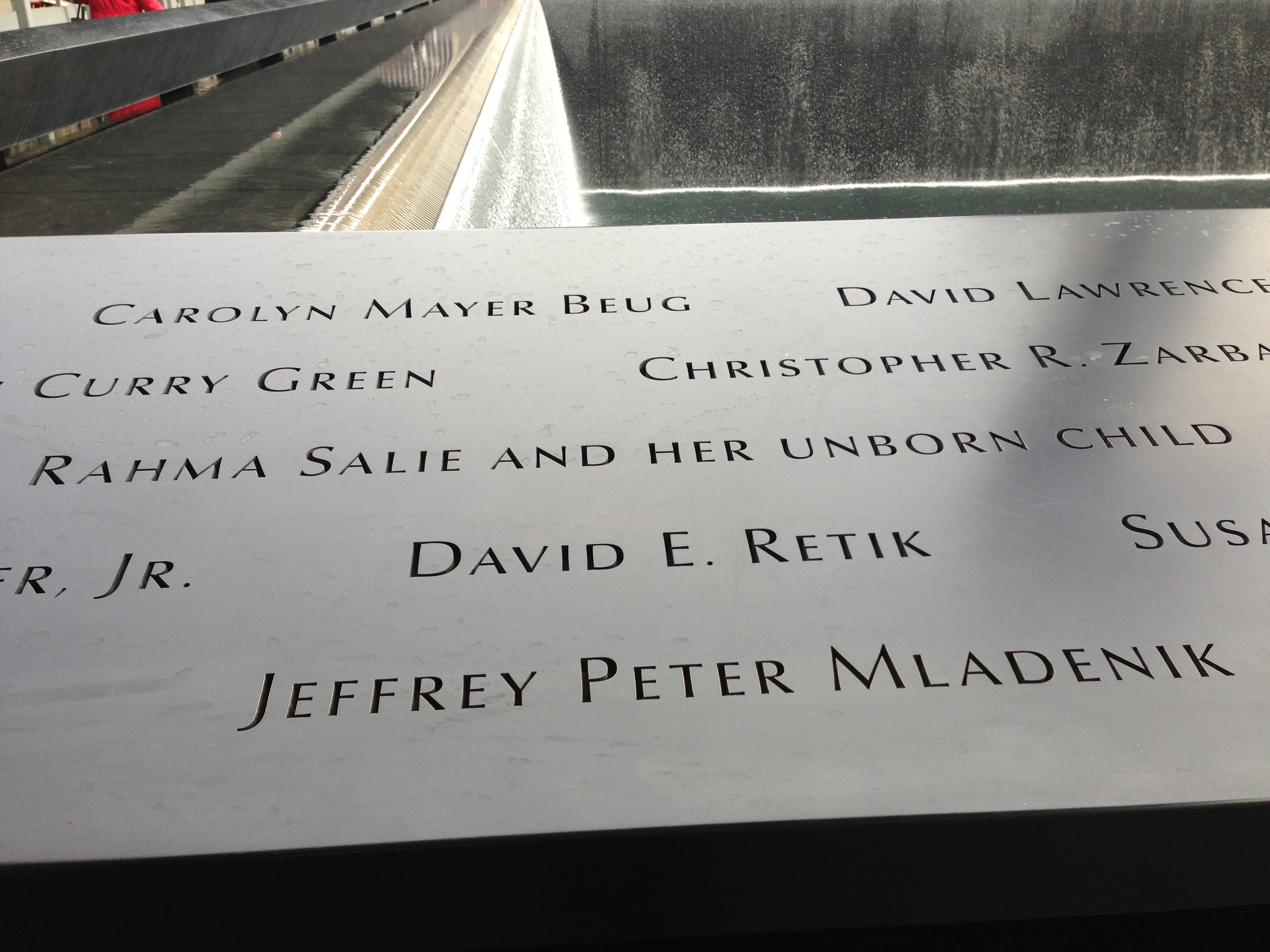
I wonder if the friends and families of those who perished gain some smidgen of comfort from seeing and touching the names. I wonder if those friends and families are at all buoyed by the fact that random people like me, who never knew their loved ones, are moved so deeply by seeing those names etched into the panels.
I also wonder why we need signs such as the one pictured below. Do people really have to be told not to scratch or sit on the panels containing the names?

And do people need to be told not to throw anything into the pools? Were I to see someone scratching, sitting or throwing things in this sacred place, I’d be sorely tempted to push them into one of the pools. 
A shot of the Freedom Tower while still under construction.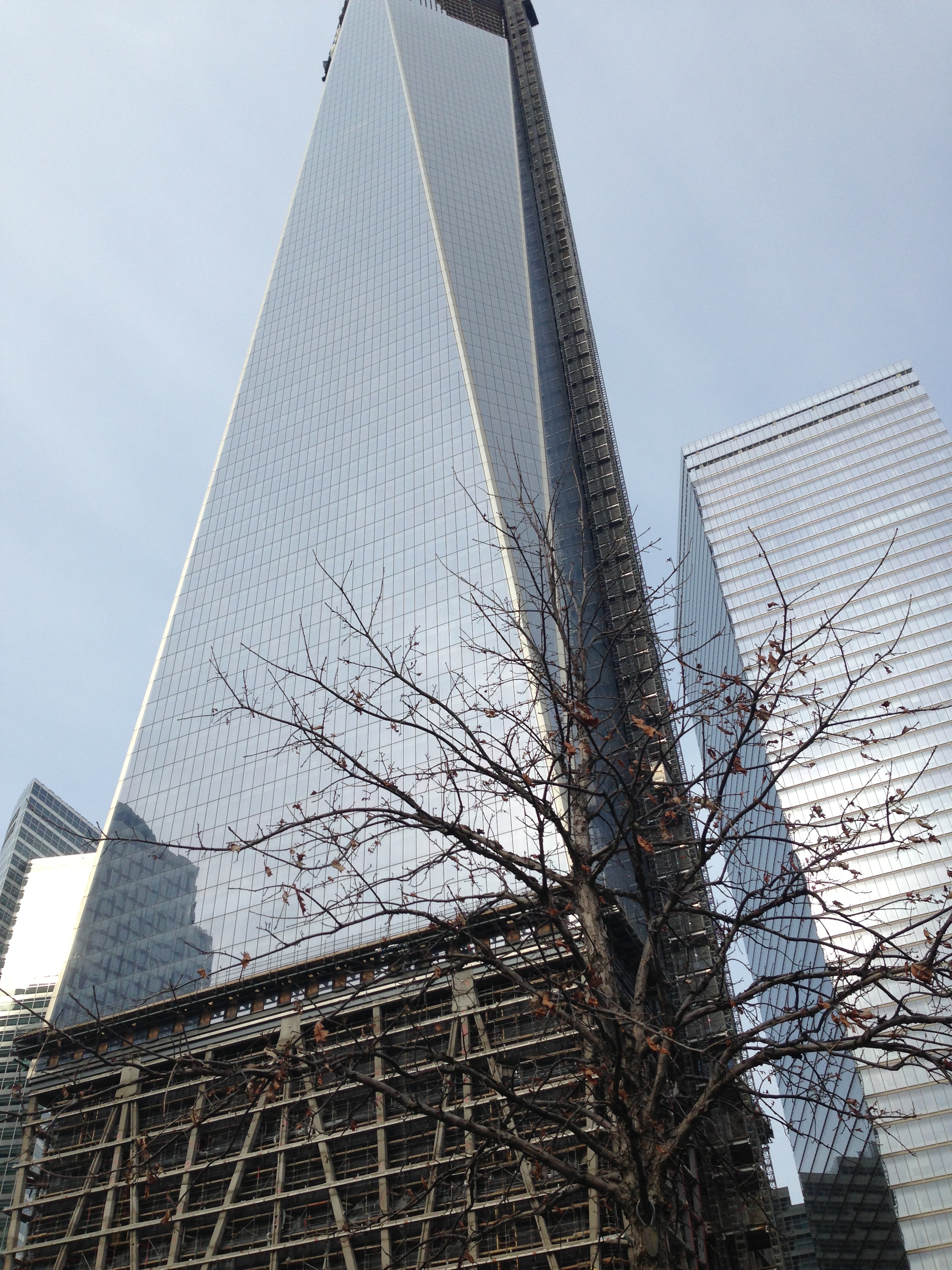
The Survivor Tree, pictured below, is yet another symbolic piece of the memorial. (Apologies to the unnamed tourists who ended up in my photos.)

According to the memorial’s blog, The Memo, this tree endured the terrorist attack at the World Trade Center. A few weeks after the attack, the blackened, leafless tree was discovered in the rubble in the plaza of the World Trade Center. The ornamental pear tree was originally planted in the 1970s between buildings in the World Trade Center complex. Before September 11, the tree was tall and full. When it was uncovered after the attack, it was an 8-foot-tall stump with broken roots. “The tree is a testament to our ability to endure,” Mayor Michael Bloomberg said. After the attack, the tree was nursed back to health at a nursery in the Bronx, where caretaker Richie Cabo said “It looked like a wounded soldier. When I first saw it, I thought it was unlikely it would survive.”
By the spring of 2002, though, the tree showed signs of life, and Cabo knew the Survivor Tree would survive. “It represents all of us,” said Cabo. and the then-8-foot-tall stump with broken roots is now a 30-foot tall thing of beauty and is a popular site at the memorial.

Like most of us, the Survivor Tree has faced hard times and has seen better days. Uprooted and damaged, yet showing signs of life.
As I left the memorial on that frigid day in February, I took one last look at the Survivor Tree and smiled as I noticed the tightly-closed buds forming on the branches. While it was still too cold and too early in the year for those buds to open and unfurl their renewal, they were there. Showing signs of life.
Leaving the memorial, the wind whipped in between the Financial District’s buildings. The sun dipped out of sight, and the temperature seemed to drop even lower. My feet hurt from my cross-town walk, and my face ached from being the only part of my body exposed to the cold. But my heart was warmed by the Survivor Tree, and by this random tourist in her chicken hat.


 The Pink Underbelly