Yesterday I bid farewell to my uterus, cervix, ovaries and Fallopian tubes. They are gone, baby gone. Well, actually they’re in lab somewhere in the Medical Center, undergoing testing. Hopefully no evil this way comes.
The surgery was easier than I expected (although anything will be, compared to what I’ve endured in the past). As usual, the care was exceptional at The Methodist Hospital. Its slogan is “Leading Medicine,” and those folks practice what they preach.
I was on the labor & delivery floor, which was nice and quiet and had the added bonus of allowing me to peep at the newborns in the nursery as my IV pole and I walked laps around the floor.
One tiny complication (you didn’t really think I’d get through surgery without one, did you?!). Last night my blood pressure dropped and stayed low — 80s over 50s — all night. I must admit, I felt kinda puny. Watching those numbers hover so low as they checked me every two hours was a bit worrisome, but after two bags of IV fluid and a few more laps around the floor, it was back to normal this morning. I was back home barely 24 hours after checking in for surgery.
I’m feeling a bit smug, I must say, after the nurse told me another patient had the exact same surgery as I and she’s nowhere near ready to go home. She didn’t even want to get out of bed, while I was slipping on my flip-flops and packing up my bag to get outta there. To each his own.
I told my family that if team Greece won its game against Costa Rica in the World Cup last week, I would make pastachio. While the Greek boys lost the game, once the word “pastachio” entered my teenage boy’s brain, the deal was sealed.
If you’ve never been lucky enough to eat this dish, you need to get yourself to a Greek restaurant or find yourself a nice YaYa to invite you over, pronto. It’s been called the Greek lasagna, but most Greeks scoff at that comparison; as if lasagna compares.
Here’s the blueprint: long, tubular pasta layered with a meat sauce simmered in tomato sauce and spices, topped with not one but two bechamel sauces — one thin and one thick — and not one but two layers of ground Romano cheese. Bake it until it comes together to form a version of heaven on Earth.
My sweet mama was not Greek, but she was clever, and she ingratiated herself into the hearts of the Greek ladies I grew up with and learned how to cook like they did. Greek ladies can be rather exacting when it comes to their cooking, and most would not welcome a “white” woman into the fold. My mom, however, was famous for breaking through such barriers. She learned to cook with the best of them.
She was also famous for transcribing her recipes in a kooky way. The most widely repeated example is her recipe for chicken crepes (yes, homemade crepes) that contain no chicken. Good luck pulling that one off, amateurs.
Her pastichio recipe isn’t missing any key ingredients (as far as I know), but it is light on descriptions and specific instructions. As in: “Prepare the thin sauce by melting the butter and adding the flour when it’s time.” Ok, over what kind of heat? Medium? High? And what exactly does “when it’s time” mean? And how does one know when the “thin” sauce is thickened enough to add the egg? It is a “thin” sauce, after all.
Details, details.
My mom taught me how to make pastichio, and while it’s a foolproof way to win friends and influence people, it’s also a lot of work. A lot. Really a lot. I don’t take on pastichio on a whim. But seeing Team Greece in the World Cup inspired me (and my #1 son pestered me). But mainly I was inspired. It had nothing to do with this Or this
 Or this
 Or this
 And it certainly had nothing to do with this
 Right.
Back to the recipe.
For the food that my son, my pride & joy, asked me to make.
Yeah, that.
To start, I make the meat sauce. I brown grass-fed, antibiotic-free ground beef with a large chopped onion and 3 minced garlic cloves until the meat is cooked through and the onion is tender. Then I add tomato paste, oregano, basil, salt, pepper, and a pinch of ground cinnamon, along with 2 cups of water. Some pastichio purists do not add the cinnamon but prefer to sprinkle the very top of the dish with ground nutmeg. I do it the way my sweet mama taught me, though, and she used cinnamon. Let that simmer until the flavors are melded and the liquid is absorbed. 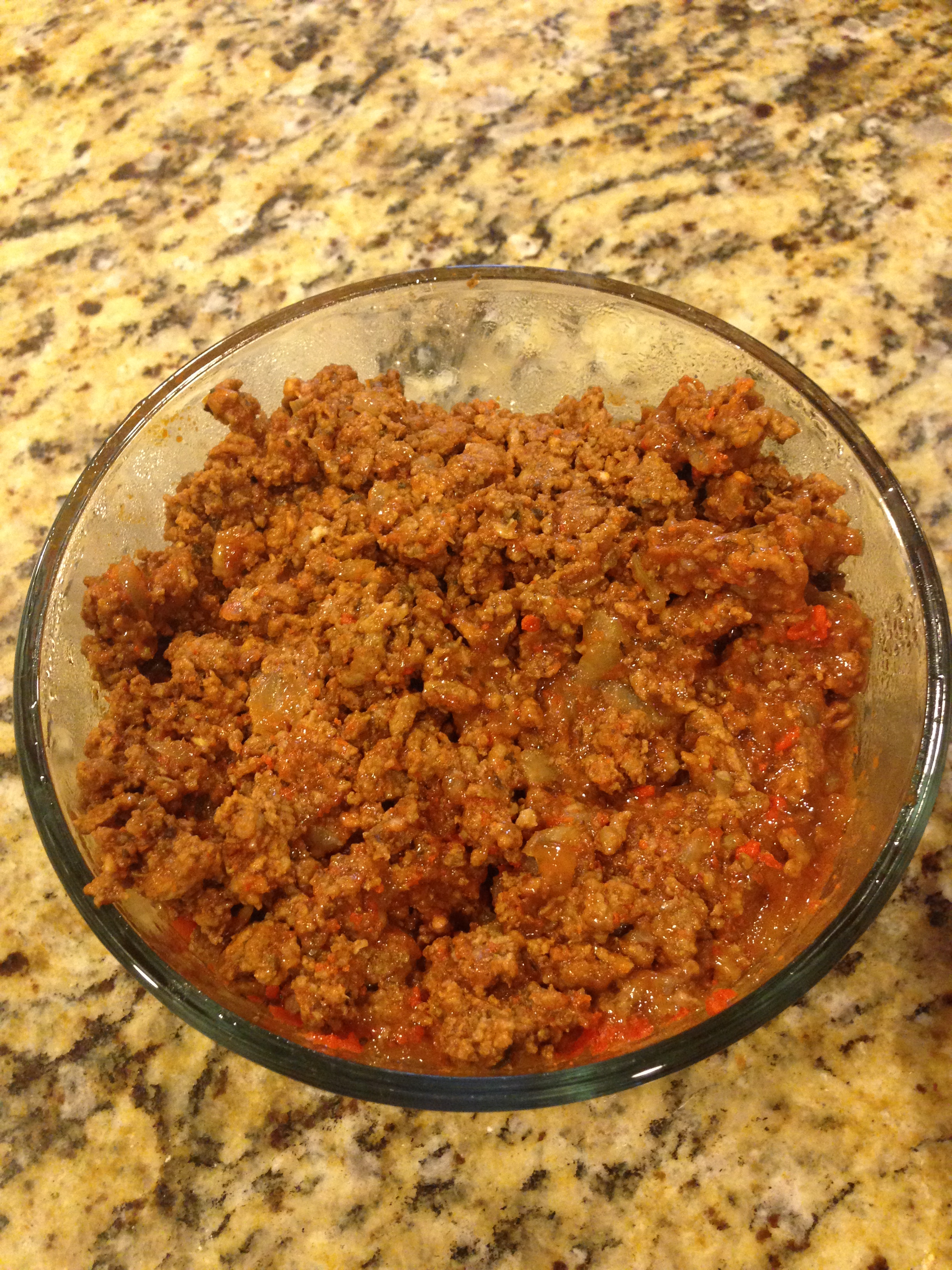
Next boil the pasta. Then make the sauces. The “thin” sauce, as my sweet mama called it, is butter, flour, milk and an egg. I will always remember watching her make the roux and her telling me that you know when the roux is done by the way it smells: nutty and browned. Whatever that smells like, I thought, but now I know. I just know. After the roux is sufficiently nutty & brown smelling, in goes the milk and you whisk like your life depends on it. No lumps! No scorching! Don’t even think about turning away or mixing yourself a cocktail. Whisk! Whisk! 
Once the “thin” sauce has thickened (again, you’ll just know when it’s thick enough, even though it’s a thin sauce, she used to say), temper the egg and again whisk, whisk, whisk, then whisk some more. No curdling! No clumping!
When the “thin” sauce is done and the pasta has cooked, start assembling: cooked pasta in a buttered casserole dish, then top with the “thin” sauce. Top that with copious amounts of Romano cheese. When in doubt, add more cheese. 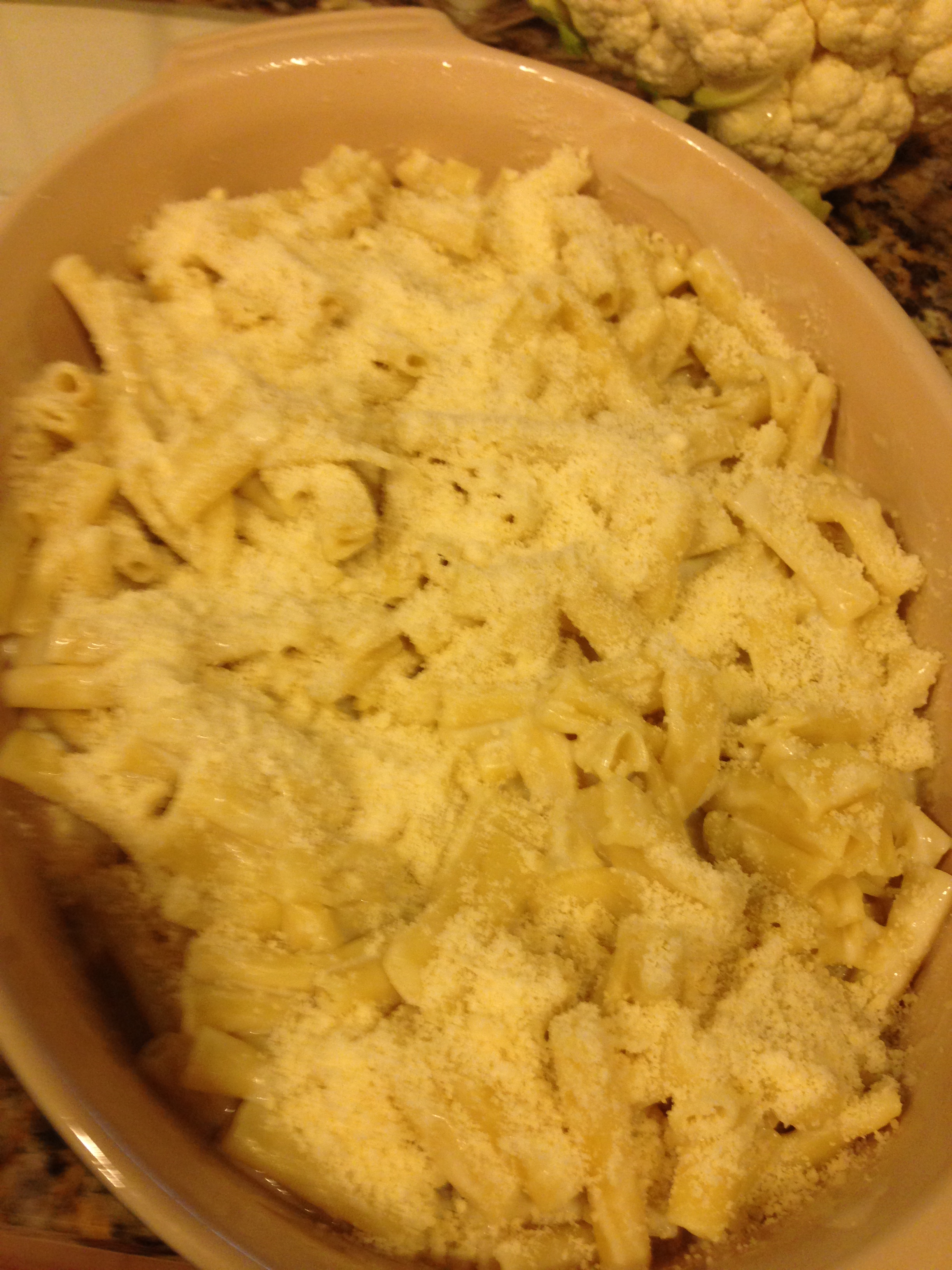
Then get back to the stove to make the “thick” sauce. Same ingredients as the “thin” sauce but different proportions. Ditto the Olympic whisking. I always wonder why every Greek lady I ever met had bat-wing arms, even with all that whisking. You’d think they’d have Michelle Obama arms, but they probably ate the finished product and didn’t pump iron. I’m in pretty good shape and pump iron regularly, yet this Olympic whisking wears me out. I seriously need a cocktail (maybe two) when it’s done.
So, once the “thick” sauce is done and you’ve had a cocktail (or two), it’s time to add the meat sauce to the pasta/”thin” sauce/cheese layer. Spread it on thick and pat it down lovingly. There is a lot of love in Greek food.
I was so tired from all the whisking, I forgot to take a photo of the meat layer lovingly patted into place, so imagine it in your mind. While you do that, I’m mixing another cocktail.
Meat sauce lovingly in place means it’s time for the “thick” sauce. But before you put it on top of the meat sauce, whisk in more cheese. Yes, more cheese. And yes, more whisking. Which means yes, more cocktails.
So, “thick” sauce is made even thicker with more cheese and is glopped on top of the meat layer.
(I’m pretty sure my sweet mama never glopped a single thing in her kitchen, but that’s how it goes down in mine.)
Once the “thick” sauce is in place, sprinkle the top with more cheese. Then add a little more. You can never have too much.
It now looks like this: 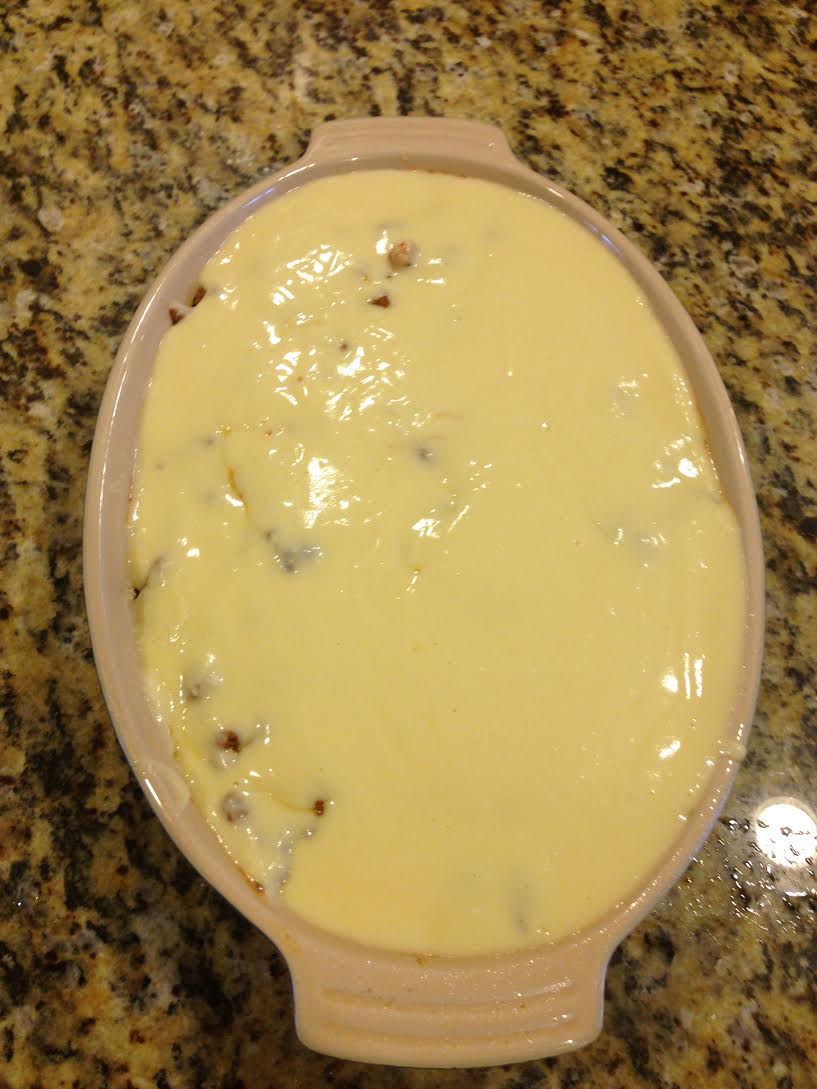
And here’s where I get in big trouble. Here’s where I risk having my Greek heritage revoked.
I make a small pan of meatless pastichio. 
There. I confessed. The secret is out.
If you’ve seen the movie “My Big Fat Greek Wedding,” you know what I mean. My Greek relatives shake their head and cluck their tongues at my meatless ways.
It’s ok. Really. It is. I may not eat meat, but I make good cocktails.
Once the pastichio is assembled (whether meaty or meat-free), there’s one more step, and this is one I cannot abide. Another reason for having my heritage revoked I’m sure, but I just can’t do it. The final step is to spread melted butter over the top of the “thick” sauce and the last layer of cheese. Can’t do it. Even though I burned at least 3,000 calories just from the whisking, I can’t do it.
Into the oven it goes, sans butter, to begin its final transformation from simple ingredients to food of the Gods. The Greek Gods. 
Yiamas! (cheers!)
This post is not going to make you feel good. It will not mince words. It will not play devil’s advocate. The topic hits home on a very sensitive subject for me, and I’m not in the mood to play nice. Forewarned is forearmed.
Proceed at your own risk.
The American College of Physicians has released a recommendation that advises women to forego their annual pelvic exam because such exams cause “emotional distress, pain, and embarrassment.” As the ACP’s former president, Dr Sandra Adamson Fryhofer, stated, “The pelvic exam has become a yearly ritual, but I think it’s something women don’t necessarily look forward to. A lot of women dread it.”
The ACP also says that in non-pregnant, asymptomatic women with no known cancer risk, pelvic exams don’t often detect disease or save lives, and that the exams do more harm than good. Pap smears are still recommended, however, because they do in fact detect cervical cancer. It’s the “no known cancer risk” part that really galls me. How do we know what our risks are if we can skip out on unpleasant tests?
Despite the ACP’s “feel-good” stance, the American College of Obstetricians and Gynecologists continues to recommend pelvic exams and says that eliminating the exam would mean “providing women with less comprehensive care.” In addition, the ACOG recognizes that many women don’t mention symptoms in their nether-regions until a doctor finds an abnormality, and that many women receive peace of mind from knowing that everything is normal below the belt.
Gynecologists agree that pelvic exams are not good tools for screening for ovarian cancer, which is notoriously difficult to diagnose. But, they say, experienced physicians can use pelvic exams to find other problems, such as noncancerous fibroids, and to identify changes linked to urinary incontinence and sexual dysfunction. And equally importantly, to establish a baseline of normality so that a change is easier to detect.
Dr Barbara Levy, vice president for health policy for ACOG says, “Not everything we do in life can be studied in a randomized trial powered to find a scientifically valid answer one way or another. I’m not sure there’s evidence to support most of what we do on physical exams. Lack of evidence does not mean lack of value.”
Anyone who has ever undergone a pelvic exam knows it’s not pleasant. No doubt. But guess what’s also unpleasant? And dreadful? Reproductive cancers. And if doctor’s groups are recommending women be spared from unpleasant exams today, who’s to say that similar recommendations against other unpleasant screenings won’t follow? Residents of cancerland, raise your hand if you find routine visits to your oncologist unpleasant. Raise your hand if those visits and the requisite exams produce anxiety. Now let’s have a show of hands for those who find the frequent port flushes to be unpleasant and painful. But we do them anyway, don’t we? We suck it up and get it done, despite the anxiety and the fear and the pain.
My sweet mama was one of those who didn’t like to go to the doctor and who put off going as long as humanly possible. She was tougher than a $2 steak, but she didn’t like to go to the doctor and would find any excuse to skip it. In fact, when she was being eaten alive by ovarian cancer and had a belly so distended she looked 6-months’ pregnant, and when she had raging “tumor fever” from the unwavering progression of her disease, she still didn’t want to go to the doctor.
She would have loved to hear recommendations like that of the ACP, saying “Don’t worry about it. Don’t put yourself through any unnecessary discomfort — physical or emotional.” And I would love for her disease to have been caught sooner, and to have her still here, still with me. Instead, I have a hole in my life and a missing piece in my heart. I have no patience for recommendations and doctors who say it’s ok to skip out on tests/screenings/visits/checkups because they’re no fun.
IMHO, the ACP’s latest recommendation is akin to the “everyone’s a winner” mentality that pervades our society. Here we stand, handing out trophies to both winners and losers and telling women that it’s ok to skip an unpleasant exam. We’re inundated with messages that we “deserve” more — whether it be a house we can’t afford or a luxury item we don’t need — and we forget that life is sometimes unpleasant. Certain aspects of life can be painful. It’s not all smooth-sailing. In a whacked-out effort to avoid hurting anyone’s feelings, we lean too far the other direction. Instead of building ourselves up, these misguided efforts have the opposite effect: eroding self-esteem, self-worth, and self-confidence by failing to learn how to weather storms. 
Here’s my take on the latest Disney film, but first a disclaimer: I hate Disney films.
Now, before you boo me and flame me and hate me, let me clarify. I hate that Disney films have traditionally relied on the death of the main character’s mother to build the character arc that defines the movie.
Dealing with the death of someone significant (in my case, my sweet mama) sucks. It really sucks. Going to the movies or employing other forms of escapism should distance one from that suckiness, not magnify it, and I’ve been smacked in the face by Disney’s tired mechanism again and again. However, my favorite girl wanted to see Maleficent and she wanted me to go with her, so I girded my heart against Disney’s mean mechanism and took my girl to the movies.
Sufficiently girded, I was crazy-curious about those cheekbones the makeup artists gave the titular character.

googleimages.com
Yowza. That bone structure is sharp. And somewhat distracting.
And those lips.

glamour.com
That lipstick.

maccosmetics.com
Those wings.

gooleimages.com
I am enough intrigued by Maleficent’s messages to look past Disney’s transgressions upon my heart. Most intriguing in this case is the idea that the bad guy (or in this case, the bad girl) isn’t always bad. Or perhaps has good reason to be bad. The line between good and evil is blurred. And while that may be troubling, it’s realistic.
It’s not just realistic, it’s also updated and reflective of modern life, not “once upon a time.” The fairy tale transcends a bedtime story to be indicative of real life. Aren’t we in essence creatures who endeavor to be “good” and do the “right thing” even though forces beyond us sometimes conspire against us? Or is it just me? My instinct when someone cuts in front of me in line is to tap them on the back and tell them to get the hell behind me, to take their turn. Instead, I smile sweetly and gently point out that I believe I was there first. Why, just yesterday while waiting for new tires I saw not one but two different people look at the sign on the door to the work area — the one in big, red letters that says DO NOT ENTER WORK AREA. FOR COSTCO TIRE CENTER EMPLOYEES ONLY — and open the door. They stopped to read the sign, then tried to enter the work area anyway. My first thought was to ask them if (a) they truly do not understand the sign; or (b) if they truly think the sign and its message do not apply to them; or (c) if they truly are so important and pressed for time that they cannot wait for the tire-center employee to leave the perilous work area and come to the safety of the lobby area to serve them. However, I chose none of those options; I minded my own business and let the tire-center employee deal with it. I want to be polite and nonviolent, yet the idiots around me present a challenge. I want to be “good” but have lots of reasons to be bad. I want to be nice, but life gets in the way.
Maleficent knows what I mean. She feels my pain. She’s a sweet, orphaned fairy (gorgeously portrayed as a young fairy by Isobel Molloy) who has yet to grow into those cheekbones (but early on masters the art of choosing the right shade of red for her lips) and who smiles a hugely charming smile as she frolics with her woodland-creature friends.

googleimages.com
Our sweet orphaned fairy goes about her business in the Moors and meets a boy who becomes her friend but later betrays her. He drugs her and takes something precious from her (and no, you did not imagine the hints of rufies and date rape here). His betrayal creates the proverbial woman scorned. As the movie’s narrator points out, the antagonist and the protagonist are one and the same. That blurred line between good and evil reappears.
While Maleficent appears to be a bitter, resentful she-beast hell bent on extracting revenge from the man who wronged her, we could also ask, what about that man? What is his role in her transformation? Is his lust for power and his drive for the throne a cautionary tale about the repercussions of overwhelming greed and hunger for power?
I think so. But I digress.
Whether the woman scorned was born or made into the role of the villain is irrelevant in the face of the idea that maybe, just maybe, we all have a touch of both good and bad in us.
And maybe, just maybe, it’s ok to root for a female bad-guy as we’ve longed rooted for the male versions. They may be bad, but we sympathize with them. We kinda identify with them. Who among us has not been wronged or hurt by someone we love? That’s not to say I want to hang out with Hannibal Lecter or that I condone his predilections, but there are aspects of him that are intriguing, interesting. He’s smart and funny and pretty damn dignified for a man in a scary-looking metal mask. He’s also quite kind to Clarice. I despise him but am intrigued by him. Blurred lines.
Many messages are at work here: that things aren’t always as they seem. People (and fairies) are complicated. Unchecked power and greed lead to ruin. And perhaps more importantly, that the dichotomy between good and evil is not so black and white. Blurred lines.
I read two articles this week that have stuck with me. Both are about cancer, and living with it. One might think that being four years out from the cancer “journey” that I would have “put it behind me,” but as those of us in Cancerland know, that is a misnomer. As the distance between us and cancer becomes greater, the instances of cancer smacking us in the face become fewer, but they are never gone. The opportunities to be bitch-slapped by the beast are plentiful. We reside in the “middle stage” of the cancer “journey,” as author Susan Gubar says.
Gubar is an English professor and ovarian-cancer club member. Her writing cuts to the chase and speaks to the very essence of my soul, a trait I greatly admire (and sometimes covet). To wit:
“But for some of us, there is a middle stage in this journey. Because of advances in cancer research and the efforts of dedicated oncologists, a large population today deals with disease kept in abeyance. The cancer has returned and has been controlled, but it will never go away completely. Like me, these people cope with cancer that is treatable for some unforeseeable amount of time. Chronic cancer means you will die from it — unless you are first hit by the proverbial bus — but not now, not necessarily soon.
The word “chronic” resides between the category of cured and the category of terminal. It refers to disease that is not spreading, malignancy that can be arrested but not eradicated. At times, the term may seem incommensurate with repetitive and arduous regimens aimed at an (eventually) fatal disease. For unlike diabetes or asthma, cancer does not respond predictably to treatment.”
Cancer does not respond predictably to treatment.
True dat. The unpredictability of the beast gives it tentacles with potential to bitch-slap us at any time. Those tentacles may float benignly under the surface, or they may reach out and grab us sight-unseen.

nettiehorn.com
Gubar writes of us Cancerland residents: “No matter how grateful these patients are for their continuing existence, it requires not the spurt of sprinters but the stamina and sometimes the loneliness of long distance runners. When repetitive and arduous regimens weary the spirit, it may be impossible to value the preciousness of life, to visualize one’s harmony with the universe, to attain loving kindness, to stay positive, to greet each day as a prized gift.”
This, my friends, sums up the conundrum those of us in Cancerland face: Yes, I am happy to be alive. But dammit, living under the cloud of unpredictability is hard. It’s stressful. It’s lonely. It’s scary. It’s rife with bitch-slaps.
Article #2 is by Lani Horn, who blogs about her cancer “journey” here. She wrote a piece that was picked up by Time magazine online about the movie The Fault in Our Stars and how it represents cancer patients. Having read the book but not seen the movie yet, I was intrigued by her take on how the movie would portray the reality of cancer patients. Or, as she more deftly puts it,”Is cancer simply a storytelling device — shorthand for eliciting sympathy and turning up the heat on the issues in a character’s life — or do the filmmakers take it seriously as a situation to explore? This question sorts the cancersploitation from real cancer art.”
Horn explains that people who watch movies that deal with cancer are in two distinct categories: “outsiders, wanting to understand an experience beyond our own, or insiders, coming to see our own lives reflected.”
She and I are in the latter group. Unfortunately. Horn makes it very clear that “the world looks different after you have spent time pinned to the mat by death. The gaps between reality and representation are no longer theoretical. They are contentious.”
Oh, but to reside in the land of theoretical gaps between reality and representation. To never worry about being bitch-slapped by a tentacle.
Horn asks: “So what does it mean to use cancer as a backdrop to a story? To be sure, a prolonged or terminal cancer experience is a crucible of one’s character, as well as the characters of those around you. The fractures in our relationships break or heal under the strain of mortal threat. Cancer is an economical dramatic device.”
Yes, cancer certainly is dramatic. And unpredictable. And bitch-slappy.
As anyone who has faced long-term illness or disease will tell you, wading through the medical bills can be a full-time job.
Luckily, I don’t have nearly as many bills to wade through these days. However, in Cancerland, the next expensive test and big bill can be — and usually is — right around the corner. The latest for me was a vaginal ultrasound in March to determine if my ovaries are up to no good after coming off tamoxifen. Yes, that’s right, a vaginal ultrasound. Don’t be jealous. It’s yet another perk for those of us in Cancerland.
I struggled long and hard with tamoxifen. I’ve written about my complicated relationship with the drug many times; most recently about the T-rage I had been experiencing. Like poor Bruce Banner, I was one Hulk smash away from wrecking something for good, and I didn’t like that. I also had serious bone pain that got worse instead of better. I felt as if I were aging at a scary-fast pace. While the bone pain and aging were unpleasant, they weren’t deal-breakers. The T-rage, however, was a deal-breaker.
The T-rage was bad, really bad, but even worse is the increased risk of uterine cancer. For someone with a complicated family history of reproductive cancers, uterine cancer isn’t something I’m willing to risk. I’m not looking for a three-peat here; melanoma in 2006 and breast cancer in 2010 are more than enough for me. Throw in tamoxifen’s potential to cause liver as well and I’m downright spooked (with my affinity for champagne, my liver is likely limping along as it is. No need to tax it any more than my bubbly habit already does.)
I broke up with tamoxifen last fall. After three years, the side-effects were piling up like cars on Houston’s Southwest Freeway during rush hour. As much as I would have loved to have made it to the 5-year mark with Tamoxifen, it was unlikely; even more unlikely was being on the drug for 10 years, as is the current recommendation for pre-menopausal women.
Whether to continue taking the drug was a very difficult decision, and one with which I struggled. In the end, it came down to quality of life. Cancer and its far-reaching tentacles had already taken so much from me; I wasn’t willing to give up the slight hold I had on my sanity. It is a very personal decision. Much like the decisions that go along with surgery options and adjuvant treatments, what’s right for me might not be what’s best for the next person in Cancerland.
I’m far from alone in my decision to stop taking tamoxifen, however. This study of nearly 9,000 women with early-stage breast cancer revealed that only 49 percent made it all the way through five years. Younger women were more likely to quit their treatment, perhaps because of the far-reaching side-effects that come along with the drug.
As nasty as tamoxifen can be, just stopping it doesn’t mean the trouble ends. Because the estrogen my ovaries produce is no longer blocked by tamoxifen, the potential for that estrogen to feed hungry cancer cells is once again a very real possibility. The next-best option is having my ovaries removed, hence, the ultrasound in March that kicked off the latest round of harassment by my insurance company.
Yes, I am grateful to have health insurance and I am very sympathetic toward cancer patients who do not. The one thing that can make cancer more crap-tastic is to have to worry about going broke because of it. Being stressed about money is no fun. Add in all the hype about stress contributing to cancer, and the crap-tastic scenario becomes even crappier.
As was the phone call I received last week from the hospital where I had the vaginal ultrasound to determine what, if anything, was going on in my possibly ill-behaving netherregion. Here’s how it went down:
Her: “Hello, this is YaddaYadda So-and-So with the hospital you had your ultrasound at on March 20, 2014. I’m calling to collect the $508.40 you owe for that ultrasound.”
Me: (silently, to myself: Do not correct her horrible grammar. Let.It. Go. “at on” is not the worst thing a person can say. Even a person trying to collect money.) “Oh, hi YaddaYadda So-and-So.”
Her: “How are you today?”
Me: “Feeling like I’m about to become $508 poorer.”
Her: (silence)
Me: “hello?”
Her: “Yes, I am calling to collect $508.40.”
Me: “I have no idea to what you are referring. I have not received a bill for my portion of the ultrasound.”
Her: “So you did have an ultrasound on March 20, 2014?”
Me: “Apparently so, otherwise I cannot fathom why we would be having this conversation.”
Her: (more silence)
Her: “When can we expect payment for this unpaid service?”
Me: “When can I expect to see a bill for this service?”
Her: “It will be mailed out this weekend.”
Me: “So, you’re calling me to ask me to pay a bill that I have yet to receive?”
Her: “Yes ma’am. What kind of payment can you give me today?”
Me: “How about we wait on that? Maybe until I actually receive a bill?”
Her: “Ok, but when can we expect to receive your payment?”
Me: “Ummm, how about after I receive a bill?”
Her: “When do you think that will be?”
Me: “Am I being punked? Is this conversation for real?”
Her: (silence)
Me: “Here’s how it’s going to work: once I get a bill I will review the bill. Then I will check with my insurance company. Then I will pay whatever I owe. However, nothing is going to happen until I get a bill.”
Her: “Ok. Thank you for choosing our hospital. Is there anything else I can help you with?”
Me: “I’m not sure you’ve helped me with anything yet, so “anything else” is not likely. But thanks for asking”
Her: “Good-bye.”
The very next day, I get another call from another person in the billing department at my hospital. She, too, wanted to know when they can expect the $508.40 I owe. I told her, quite gently, that I have yet to receive a bill and that I had a conversation to the same effect yesterday, with her colleague. She seemed as dismayed as her colleague that I wasn’t ready to fork over $508.40 for a service for which I’d yet to see a bill.
Two days later, still no bill, but yet another phone call from yet another person in the billing department. I told her that she was the third person to call about a bill I had yet to see. I asked her to please put a note in my file that says Do Not Call Me Until the Bill Has Been Mailed. And Then Wait a Couple More Days to Give Me Time to Go to the Mailbox and to Read Over the Bill.
At this point, my patience had worn rather thin.
After doing some investigating with my insurance company, I learned that the claim had yet to be filed. I duly called the billing office of the hospital to report my finding. I left a voice message stating my business; I suppose all the billing representatives were busy on other lines, cold-calling customers asking for payments for bills not yet process, mailed, or received. I felt comfortable ignoring the two voice mails the billing department left me while I waited for the bill to arrive.
Today I got a call from yet another billing representative, telling me that they got my voice mail and were calling me back to take my payment. Here’s how that convo went:
Her: “Yes, I’m wondering how you’d like to pay the $508.40 owed on your account.”
Me: “You mean the $508.40 about which I left a voice mail, saying I checked with my insurance company and no claim for that service on that day by this hospital has been submitted?”
Her: “Yes ma’am. How would you like to pay?”
Me: (silence)
Her: “May I place you on hold, to verify that the claim has been processed?”
Me: “You call me, then want to put me on hold? So you can check to see if there’s a reason for you to have called me?”
Her: “Uh, yes. Ma’am.”
Me: (sigh) “Ok.”
Her: “Ma’am, we show that your insurance company just submitted payment for $1249.10 today. They just paid today.”
Me: “Ok. Great. So we’re done here?”
Her: “Um, I think so, but let me double check. May I place you on hold?”
Me: (sigh) “Ok.”
Her: “Yes ma’am, your insurance company paid the $1249.10. Today. They paid today. Just now. I don’t see that you owe any deductible. But, um. How would you like to pay your portion?”
Me: “My portion of what? You just said I don’t owe any deductible.”
Her: “Um, that’s right. I don’t think you owe anything at all”
Me: “So we’re done here?”
Her: ” Yes. Is there anything else I can help you with today?”
Me: (sigh)
Here’s what I want to know: does the hospital make such phone calls soliciting payment on purpose, hoping the recipient of the call will just pay whatever amount they’re told, right there over the phone? Or is the billing process complicated enough to warrant the kind of confusion that results in a customer receiving multiple phone calls asking for payment for a bill that’s yet to be received?
Or was I being punked?

Yesterday I turned 45. I’m on the far side of middle-aged and am four years into life after cancer. Whatever that means. I suppose I don’t have any idea what life after cancer means, other than the fact that nothing is ever the same afterward. In honor of growing another year older, I decided to read a “young adult” book, to see if I still knew what is young, hip, and/or cool. I had read several glowing reviews of The Fault in Our Stars by John Green. Despite those glowing reviews, I initially resisted reading this book, because I didn’t want to read a book about teenagers with cancer.
But that’s the thing about The Fault in Our Stars. It’s not about kids with cancer. The main characters, Hazel and Gus, have cancer, but the book is about so much more than their respective diseases.
I wondered how Green could write so convincingly and wrenchingly about the role that cancer does play in the book, if he had not been touched by disease himself. So I read an interview with him and learned that he worked as a chaplain in a children’s hospital and met lots of sick kids. In that interview he said, “When I was at the hospital, I met all of these young people who, yes, they were sick, but they were also many other things. They were funny and angry and sad, and they had all of the emotions that any other human has, all the desire, all the wishes. And that was what really resonated with me.”
That resonates with me, too, because it’s true. People who have had or currently do have cancer certainly have the same emotions, desires, and wishes as any other human. However, those emotions are often sent into overdrive, as we must confront things we aren’t prepared for or would rather not face.
Those desires are often perilous because of the uncertainty of our fate. As Gus so eloquently expresses it, “Almost everyone is obsessed with leaving a mark upon the world. Bequeathing a legacy. Outlasting death. We all want to be remembered. That’s what bothers me most, is being another unremembered casualty in the ancient and inglorious war against disease.”
Those wishes play a big part in the book, as the characters are forced to learn a hard truth at a very early age: That life is not fair. Or, as Gus puts it, “The world is not a wish-granting factory.” In the interview I read, Green spoke to the idea of the world not being a wish-granting factory:
“I think cancer in many ways to those of us alive today is similar to what tuberculosis was like in the 19th century. It’s so unfair: It takes the young, it takes the old. Sometimes you live, sometimes you die. And it’s very difficult to make sense of the reasons why it may go one way or another. It’s very, very difficult to imagine it as anything other than just cruel and cold and capricious. And that makes it difficult to imagine the universe as anything other than cold and capricious. And I wanted to be honest about that, because I wanted them to have to face, in the most desperate way, that overwhelming question, as T.S. Eliot called it, of how we’re going to organize our lives and what they’re going to mean.”
Hazel and Gus confront the capriciousness of whichGreen speaks. Gus talks about receiving an 85 percent chance of surviving his cancer: “I know those are great odds, but I kept thinking it was a game of Russian roulette. I was going to have to go through hell for six months or a year and then at the end, it still might not work.” Hazel points out that being her situation was completely different: as a Stage IV cancer patient, her “final chapter was written upon diagnosis. Gus, like most cancer survivors, lived with uncertainty.” I had never before considered that a Stage IV patient might view herself as having a more certain future.
Hazel describes a scene that was very familiar to me during the multiple hospitalizations I had from the post-mastectomy infection: “The first thing they do is ask you to rate your pain on a scale of one to ten. I’ve been asked this question hundreds of times over the years and remember once early on when I couldn’t get my breath and it felt like my chest was on fire, flames licking the inside of my ribs fighting for a way to burn out of my body. A nurse asked me about the pain and I couldn’t even speak so I held up nine fingers. Later, after they’d given me something [for the pain], the nurse said, ‘You know how I know you’re a fighter? You called a ten a nine.’ But that wasn’t quite right. I called it a nine because I was saving my ten.”
Saving my ten.
Another quote that really resonated with me is this:
“Pain is like fabric; the thicker it is, the more it’s worth.”
While that is true, it’s also true that the more it’s worth, the more it costs. That’s why I’m saving my ten. 
David Walmer was a fertility specialist at Duke University who went on a mission trip to Haiti in the early 1990s. While there, he was shocked to learn of the high rate of cervical cancer among Haitian women. A disease that is highly preventable was killing some 250,000 women a year in developing nations, and Haiti led the world in deaths from cervical cancer. Walmer knew he had to get involved.
Walmer returned to work in North Carolina and learned everything he could about cervical cancer, mainly that it can be detected for a decade before becoming untreatable. Detection is easy because unlike many cancers, it grows in a visible spot: on the outside of the cervix. Routine screening via Pap smears is the norm; before Pap smears became the de facto screening tool, cervical cancer killed more women than any other form of cancer. Since the adoption of Pap smears, the death rate from cervical cancer has dropped by 70 percent. The CDC reports that in 2010 in the United States, 11,818 women were diagnosed with cervical cancer. Of those, less than 4,000 cases were fatal. Compare that to the CDC’s breast cancer stats for the same year: 206,966 women and 2,039 men were diagnosed with breast cancer. Of those, 40,996 women and 439 men died from breast cancer. Therein lies the inherent value of a highly visible cancer
If a Pap smear detects abnormal cells, the next step is to examine the cervix via a special magnifying lens called a colposcope. Walmer realized that outfitting underdeveloped nations with colposcopes could make all the difference in preventing cervical cancer deaths, but that getting colposcopes into the hands of doctors in those nations would be unrealistic because of cost, size, and dependence on electricity. Undeterred, he opted to get creative.
He realized that a common surgical tool — the loupe — could provide magnification without electricity. To provide the contrast needed to detect suspicious cellular activity on the cervix, Walmer bought a Halogen bike headlamp and a green filter for a camera and began to tinker.
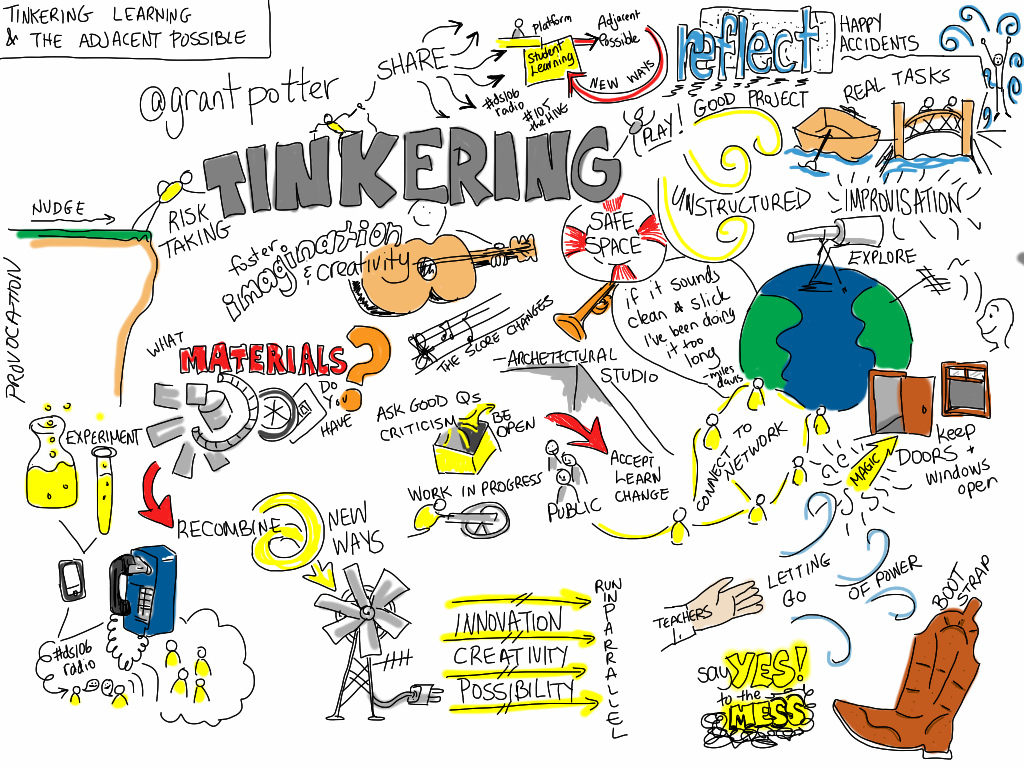
Giulia Forsythe
A colleague at Duke who taught biomedical engineering got wind of Walmer’s pet project and lent some muscle: namely students in his Engineering World Health club. One of those students, Theo Tam, recruited four other students to work on Walmer’s portable colposcope. These four young men were some of the brightest minds in the sciences and engineering student world, yet they were freaked out by the prospect of working on something so closely tied to the most intimate part of female anatomy. Tam says the other guys were willing to take on a multitude of projects designed to improve medical conditions in third-world countries, but not the portable colposcope. “Anything but the V-word,” Tam says. “Imagine the horror.”
Tam also got creative, and convinced the guys to get involved with the parts of Walmer’s project not related to “the V-word”: marketing, finance, and other “safe” parts. Once they got past the horrifying idea of the female body part, the guys got to work. They assembled a prototype colposcope using lenses from a $2 pair of reading glasses, magnification from a $10 pair of binoculars, and lights from a $16 battery-powered LED. The first portable colposcope, named the CerviScope, was born. After a few more tweaks, it was ready to go. With help from a grant from an investment bank, the CerviScope was ready for mass production.
Walmer created a nonprofit, called Family Health Ministries, from his North Carolina home, to get the CerviScope into healthcare facilities in impoverished countries. FHM’s goal is to screen for and prevent cervical cancer. An integral part of achieving that goal is advocating for the HPV vaccine. The American Cancer Society also advocates for the HPV vaccine; read more about it here. The CDC provides compelling evidence for the HPV vaccine: A 2013 study shows that in the 8 years since the vaccine’s introduction, the virus has decreased 56 percent among girls ages 14 to 19. CDC Director Tom Frieden estimates that two-thirds of American girls aged 13 to 17 have not been vaccinated, and that the 2013 study proves that “the HPV vaccine works well, and the report should be a wake-up call to our nation to protect the next generation by increasing HPV vaccination rates.” Frieden warns that the low vaccination rates in the United States will equate to 50,000 new cases of cervical cases; cases that would be prevented with the vaccine.
There are many take-away messages from David Walmer’s story. That easily-visible cancers are much preferred to those that burrow deep into the body’s nooks & crannies. That even the most brilliant scientific male minds are rendered powerless by the female honey pot. That one finds one’s calling in the most unlikely places. And that tinkering definitely pays off. In a very big way.
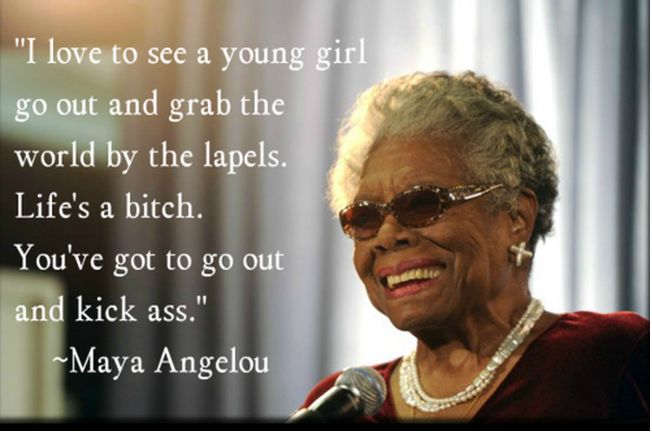
Maya Angelou is dead. The world has lost a phenomenal woman. 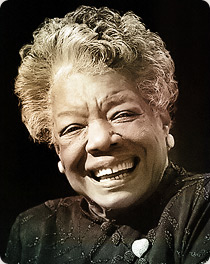
Many tributes will be recited, many glasses will be raised, and we will mourn this phenomenal woman. Much will be said and memories will be traded about this phenomenal woman. Lovers of well-crafted poems and admirers of carefully honed words will re-read the vast catalog of work produced by this phenomenal woman.
Maya Angelou’s dear friend Oprah Winfrey offered this statement: “What stands out to me most about Maya Angelou is not what she has done or written or spoken, it’s how she lived her life. She moved through the world with unshakeable calm, confidence and a fierce grace.”
Fierce grace. Only a phenomenal woman can move in that way.
Although her pedigree was short, her accomplishments were long: she was San Francisco’s first female and first black streetcar conductor. She was a singer, a dancer, a novelist, a succesful single mom, an actress, a civil rights activist, a poet, a teacher, a playwright, a university professor, and a holder of 30 honorary doctoral degrees. She was nominated for a Pulitzer and a Tony and three Grammys. She was awarded the Presidential Medal of Freedom. She was a bad-ass.
This phenomenal woman spoke from the heart and did not mince words. Her friend James Baldwin paid her a high compliment when he said that she could hold both her liquor and her positions.
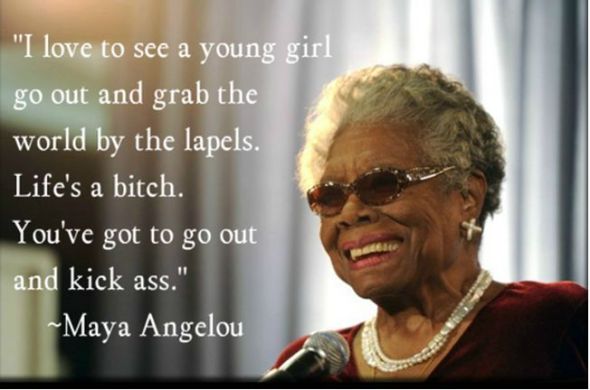
Two of Maya Angelou’s quotes ran through my head often while I was enduring the shit-storm that is cancer: “We may encounter many defeats, but we must not be defeated.” And “You may not control all the events that happen to you, but you can decide not to be reduced by them.” She came to know the truth in those profound statements from the earliest days, when she was raped by her mother’s boyfriend at age 7. Yes, you read that right: age 7. Seven. An incident she described as “a breaking and entering when even the senses are torn apart.” Yet this phenomenal woman would not be broken by it. Instead, she wrote I Know Why the Caged Bird Sings, which won the National Book Award in 1970 and was on the NYT bestseller list for two years. “The caged bird sings with a fearful trill, of things unknown but longed for still.”
Despite her early, unimaginable hardship, this phenomenal woman lived to teach and to give. She said, “I’ve learned that you shouldn’t go through life with a catcher’s mitt on both hands; you need to be able to throw something back.”
I for one am immeasurably grateful for all she threw back.
She refused to be discouraged by the many obstacles standing in the way of a young black woman in the South in the early days of civil rights. In her poem “Still I Rise,” she challenged and persevered:
Does my sassiness upset you?
Why are you beset with gloom?
‘Cause I walk like I’ve got oil wells
Pumping in my living room.
Just like moons and like suns,
With the certainty of tides,
Just like hopes springing high,
Still I’ll Rise.
You may shoot me with your words,
You may cut me with your eyes,
You may kill me with your hatefulness,
But still, like air, I’ll rise.
My all-time favorite Maya Angelou poem is “Phenomenal Woman.” It’s too good to excerpt, so here it is, in its entirety. If I ruled the world, I would make it required reading for every girl and women on this earth, in hopes of it curing insecurity and self-doubt. I would require every male on this earth to memorize this poem, in hopes of eradicating crimes against women, both emotional and physical.
Phenomenal WomanPretty women wonder where my secret lies.I’m not cute or built to suit a fashion model’s sizeBut when I start to tell them,They think I’m telling lies.I say,It’s in the reach of my arms,The span of my hips,The stride of my step,The curl of my lips.I’m a womanPhenomenally.Phenomenal woman,That’s me.I walk into a roomJust as cool as you please,And to a man,The fellows stand orFall down on their knees.Then they swarm around me,A hive of honey bees.I say,It’s the fire in my eyes,And the flash of my teeth,The swing in my waist,And the joy in my feet.I’m a womanPhenomenally.Phenomenal woman,That’s me.Men themselves have wondered
What they see in me.
They try so muchBut they can’t touchMy inner mystery.When I try to show them,They say they still can’t see.I say,It’s in the arch of my back,The sun of my smile,The ride of my breasts,The grace of my style.I’m a womanPhenomenally.Phenomenal woman,That’s me.Now you understand
Just why my head’s not bowed.I don’t shout or jump aboutOr have to talk real loud.When you see me passing,It ought to make you proud.I say,It’s in the click of my heels,The bend of my hair,the palm of my hand,The need for my care.’Cause I’m a womanPhenomenally.Phenomenal woman,That’s me.
There’s no one reason for my blogging hiatus. Once we got settled into the new house, I could have resumed blogging. I thought about it many times, and even bookmarked several articles as good potential blog fodder. Fodder or no, my heart has not been in it. I’m a believer in this statement by Gandhi:

google images
If something is truly important, that’s what we do. That which is most important is what we make happen. So as much as I have thought about blogging, I haven’t made it happen. A recent conversation with a dear friend helped me realize that I miss blogging, and that it provides a necessary outlet for thoughts, fears, and ideas. And venting.
A few weeks ago, I realized that the anniversary of my cancer diagnosis was approaching. Yesterday was the fourth anniversary of my bilateral mastectomy.
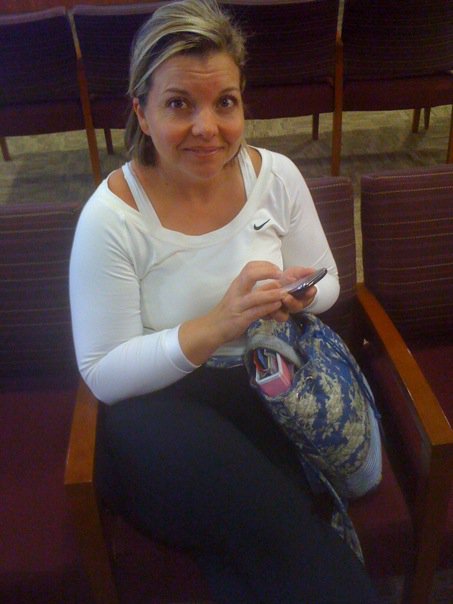
mastectomy day — hooray!
Four years a survivor. Somehow that doesn’t have quite the emotional “oomph” as Twelve Years a Slave, yet we mark the events in our lives — both positive and negative — in years, and we celebrate or commemorate anniversaries.
I’m not sure how I feel about another year of survivorship. It’s a prickly issue, and one in which the face of a very public disease gives way to a very personal struggle. The obvious-seeming emotion about surviving cancer would be relief, to be glad it’s gone. But here’s the prickly part: it’s never really gone. Instead, it’s the monkey on my back that manifests in every twinge or symptom that might possibly signal a recurrence; a random bone ache is surely a sign of mets. It’s the generalized anxiety about if or when recurrence will strike. It’s the niggling thoughts in the dark of night about the presence of micromets in the area formerly known as my breasts. It’s the questioning of every decision made along this “cancer journey.” Did I do enough? How much is enough?
Does it ever get easier, this uneasy survivorhood? Perhaps. Like grief, it becomes less raw, less all-consuming. But it doesn’t go away. As I’ve written about before, it’s never over. While some like to celebrate the anniversaries of survivorhood, I’m leaning more toward ignoring them, to not calling attention to them in hopes of not jinxing myself. It’s a personal choice, with no right or wrong status. I notice the dates as they approach, but instead of stopping to acknowledge them and the myriad emotions they evoke, I keep my eyes on the horizon.

Illustration by David Benbow
 The Pink Underbelly