Instead of bitchin’ & moanin’
Posted: March 28, 2011 Filed under: breast cancer, drugs, infection | Tags: breast cancer, cancer battle, hospital, infection, infectious disease, IV antibiotics, JP drains, micrometastesis, port-a-cath, Power Port, stress, Tamoxifenoncologist 17 CommentsMy first instinct when I sat down at the computer today was to bitch & moan about the fact that I’m rapidly approaching one month post-reconstruction and I still have the 2 JP drains, one on each hip.
Have I mentioned how much I detest and despise these drains? While I understand their importance, and I’m a big supporter of fluid being outside instead of inside my battered body, I detest and despise the drains.
Because of the latest flare-up, i.e., the MRSA infection, the drains will stay for the foreseeable future. It’s a vicious cycle: I probably got the infection from the drains, but the drains have to stay until the infection clears. As long as I’m on IV antibiotics, I need the drains, and as long as I have the drains, I need the IV abx. Twisted, huh?
I’m starting week 2 of House Arrest, and this week isn’t any easier than last. The idea is that if I lay low and do next to nothing, the fluid levels will decrease and I can get the drains removed. But now with the MRSA, the drains need to stay, because if there is infected fluid, it’s gotta come out. Nothing makes me more nervous than infected fluid sitting around making mischief on my insides. I had a crazy idea this weekend: since the drains are staying anyway, why not get some things done around the house? Well, because increased activity means increased fluid levels, and then I’ll be stuck with the drains even longer, that’s why.
Instead of bitching & moaning ad nauseum about drains and House Arrest, I need to find another topic. My quick run-down of all the positive things about this situation left me uninspired. The usual suspects in my list of “bright sides” seems stale and failed to provide me with the literary verve I need.
But then I remembered my port-a-cath. Yes, the port! That’s a bright spot on this barren landscape of bad news topped by rotten luck. And what a story, too: I thought I needed it for chemo, then I didn’t need it for chemo, and had some trouble with it once I got it, but then ended up needing it for so much more! And voila, the topic du jour.
 I used to hate my port. I hated that I had to have it in my life at all. I hated that getting it meant yet another surgery and all the hospital stuff that I detest. At first, it was red and angry and painful, and looked just plain awful. At the risk of sounding like a xenophobe, my body clearly doesn’t like foreign things. First the tissue expander got infected, then the skin around the port got hot and red and big-time uncomfortable. The port made it clear from Day One, on June 25th, that this was not going to be an easy co-existence. The port caused me to spend a Saturday in the ER (Good golly, have I not spent enough time in the hospital already?). Thank goodness there was a “Deadliest Catch” marathon on TV that day, or I would have been fit to be tied.
Questions keep coming in about the port, and after I mentioned it in yesterday’s post, I guess I incited the curiosity again. Here’s Wikipedia’s definition of a port: a small medical appliance that is installed beneath the skin. A catheter connects the port to a vein. Under the skin, the port has a septum through which drugs can be injected and blood samples can be drawn many times, usually with less discomfort for the patient than a more typical “needle stick”.
I agree with all of that, except for the period being outside of the quotation marks around needle stick at the end of the sentence. The period should be inside the quote marks. Other than that, it’s all good.
While there are lots of different ports, I got the Power Port. I didn’t express a choice, didn’t think about it, but trusted Dr Dempsey to choose the right one for me. I was still healing from that damned infection that showed up after the mastectomy, and wasn’t thinking about which port was best for me. I got the port because the most respected oncologist in my area said I needed chemo, then a another highly-recommended oncologist seconded that opinion, so I was going to do chemo. Long story short, my lymph nodes were clear and my margins were good, but I had micrometasteses, which essentially are cancer cells that are floating freely and not organizing into tumors. Some oncologists consider micromets to be node positive, meaning the lymph nodes are affected, and some oncologists consider them node negative, meaning they have not traveled to the lymph nodes. Some crazy patients, especially those who watched their sweet, irreplaceable mama die from cancer, think the micromets may not be organized, but need to be blasted with chemo anyway.
Yes, that was me.
Statistically, my case was contraindicated with chemo, but I’ve never been a numbers person, and I admit that my initial pro-chemo decision was based on emotion, not statistics or science. I was still reeling from losing my mom, and sure didn’t want my kids to have to suffer that terrible fate. Who am I kidding saying “I was still reeling” — I AM still reeling and probably will be for the rest of my life. Stupid cancer.
So I reacted emotionally and, driven by fear, decided to do chemo. I had done my due diligence by consulting two vastly different oncologists (one old and established who is super conservative; the other younger than me and quite current on the latest & greatest research, and also highly recommended by a friend in health care. Both doctors based their pro-chemo recommendation on the fact that I was 40 years old and healthy, and able to handle the chemo. Or so we thought.). I wasn’t thrilled with starting chemo — who is? — but was prepared.
Then the mycobacterium entered my life, and 11 months later, is still a huge part of it. The only good thing I can say about the myco is that being sick, sick, sick in the hospital with a post-surgical infection disqualified me for chemo. I was too sick to start it, and my body certainly wouldn’t have withstood it well. In the meantime, we crunched the numbers again, consulted a third oncologist, and I came down off my emotional decision-making high horse and saw that the numbers really didn’t bear it out. Chemo for me would result in a very marginal increase in survival rate. If the fortunes had not granted me that one small favor, and I had needed chemo but was too sick from the mycobacterium to start it, I would have been a basket case. Much more of a basket case than I already was, that is.
Talk about a blessing in disguise. While I was reeling from and healing from the infection, Dr Dempsey suggested I consult a third oncologist, because maybe chemo wasn’t what I needed. She never thought so, neither did Trevor, and neither did oncologist #3. My cancer happened to be slow & lazy, which is the best kind of cancer to have. Except for the nonexistent kind, that is. So no chemo, just Tamoxifen for 5 years. But I’d already gotten the port.
Nobody ever accused me of sitting on my hands.
The Power Port comes with a handy, dandy patient pack. When I got home from the procedure to insert the port under my skin and into the vein, I laughed at the handy, dandy patient pack. It seemed so stupid, and to me typified the excess and waste that’s prevalent in the pharmaceutic and medical-device business.

There was a pamphlet full of meaningless prose written to allay any fears I might have about the port (like the fact that it’s sewn into the jugular vein. Hello???) and make me feel warm & fuzzy about the little device. It also included a jelly-type bracelet that I guess they expect port people to wear, along with an ID badge with the serial number of my particular device. Why I would ever need this I couldn’t fathom, so I pitched it all. If you were hoping I’d give you the snazzy jelly bracelet, too bad. You missed out.
My favorite part was the list of bragging points:
“Lightweight for patient comfort.” “Reduced artifact.” “Easily identifiable.” “Power injectable.” “Titanium port body.”
Oooooh, fancy.
Despite the goofy marketing, I have to admit that having a port is highly advantageous if you have wimpy veins. And I do have wimpy veins. At first blush, they seem perfectly competent and cooperative, but once the needle pierces the skin, they flop around like fish out of water, making it hard to pin them down (no pun intended).
After multiple hospitalizations for the blasted infection, though, that port came in handy. And it was crucial during the courses of IV antibiotics I have had at home. And it was supposed to be quite handy in my reconstruction, because the anesthesia, antibiotics, and pain killers (lots and lots of pain killers) can flow through the port instead of an IV in the crook of my arm. However, the port was in the way during the Big Dig, and so the Drs S decided not to use it during surgery, even though it had been accessed, and they put an IV in anyway. At least I was asleep for that.
I don’t hate the port anymore.
It still kinda creeps me out, but I don’t hate it. I shiver a little when I think about the fact that it’s sewn into a vein, and not just any vein but the jugular vein. That’s super creepy. I don’t like that the 3 little nubs on the port’s septum are visible through my skin, and if I turn a certain way, the nubs really protrude. I guess that makes it easy for the nurses who access the port, but it looks weird and reminds me that it’s sewn into the jugular. Sometimes it gets crunched when I’m sleeping on my left side, but I’m still not allowed to sleep on my side since the reconstruction, so never mind.
Several people have asked me why I still have the port and when I’m going to get it out. The answer is not until the infection is gone for good. And no, I don’t know how long it will take. Almost a year into it, I still don’t know. I stopped asking, and you should too.
The main downside to keeping the port is that when it’s not being used, there’s some maintenance required. No big deal, just a trip to see the oncology nurses every 6 weeks. Every visit reminds me how fortunate I am, and that my cancer business could have been even more serious. The infection is plenty serious, but at least the cancer side of things was pretty straightforward.
 So the port maintenance goes something like this: the nurse puts a sterile drape around the port site and tells me not to look down or breathe on it. She scrubs the top of the skin on top of the port real well with iodine. It’s cold, and the sensation of the iodine-dipped wand passing repeatedly over the port is disconcerting. The smell of the iodine is gross and reminds me of post-infection wound care, without a single happy memory to be found.
After rigorous cleaning, the nurse jabs a short but very thick butterfly needle through the port’s septum, using the three raised nubs to guide her. Every time I’ve had it done, which had been lots, the nurse has essentially told me to brace myself for a really big stick. They do not exaggerate. The Power Port website says, “For most patients, there is only a mild pricking sensation felt during needle insertion. Frequently, the sensation of the needle insertion decreases over time.”
Lies. All lies.
Sorry if the photo sicks you out, but if I have to endure the “mild pricking sensation,” surely you can manage to peep at the picture.
Once the super-thick needle is in, the nurse attaches it to a thin tube that she can then attach a syringe to and inject whatever needs to be injected: chemo drugs, antibiotic, pain killers (yes, bring on the pain killers!) some contrast dye for certain scans, or in the case of port maintenance, saline and heparin.
After I’d had this process done several times, one of the chemo nurses asked me if I had used the numbing cream before that day’s appointment. Numbing cream?? What numbing cream? No one had ever mentioned that before.
Well guess what–there’s a numbing cream. Lidocaine and Lanocaine and some other caine all whipped up in a prescription cream that will make the port maintenance so much more pleasant. Yes, please. It does help (when I remember to apply it before my maintenance appointments), and Macy and her friend Ella both used it on their earlobes when they got their ears pierced.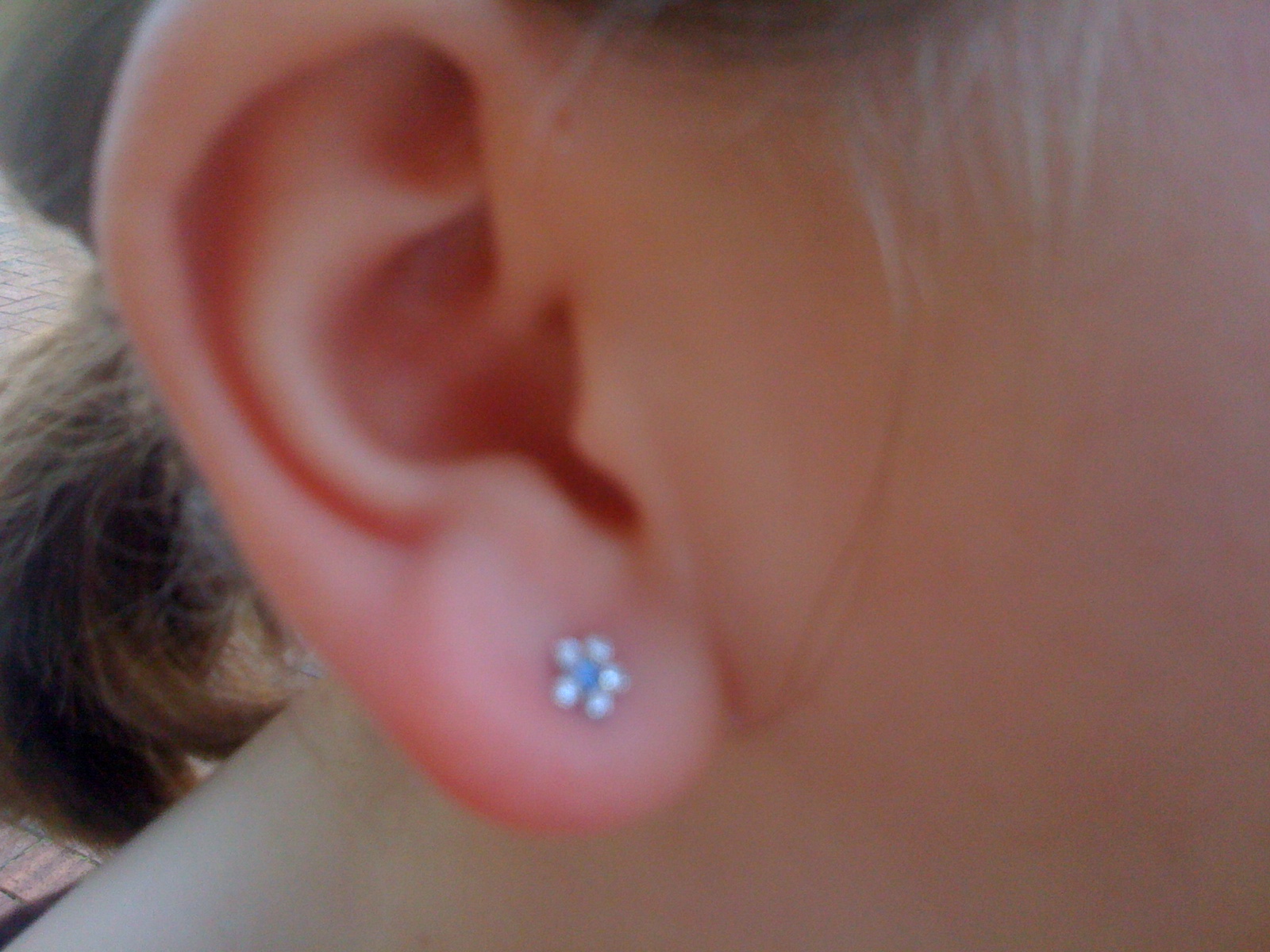
So every 6 weeks I get the port flushed–sometimes with and sometimes without the numbing cream. No big whoop, although one day it bled quite a bit after the needle came out, and made a bloody spot on my most favorite white hoody that remains even after multiple bleachings. Perhaps it’s a symbol of what I’ve been through, and of how much I can endure. It’s a reminder not to whitewash the bad stuff, to leave a hint of the gore around to bear witness to the hard times and rough road that one must travel, sometimes precariously, sometimes fast and sometimes slowly, to get to the other side.
When you suspect MRSA…
Posted: March 27, 2011 Filed under: breast cancer, drugs, infection | Tags: AstraZeneca, breast cancer, butterfly needle, cancer battle, CCSI, cefapim, Cubicin, infection, infectious disease, IV drugs at home, jugular vein, life before cancer diagnosis, MRSA, post-mastectomy, Power Port, shopping, Vancomycin 6 CommentsI was just looking at some info online about Cubicin, my poorly named but hopefully awesome new antibiotic. The heading of the website caught my eye: When you suspect MRSA cSSSI or bactermia—use CUBICIN first!
Well, in my usual headstrong style, I did not use Cubicin first. I like to rebel that way. It’s not much, but it’s all I’ve got these days.
But now I am on Cubicin, because we not only suspect MRSA, we know it, and I’m back to playing by the rules and toeing the line. For now, anyway.
I’ve learned some things. That’s one thing I will say about this “cancer journey” — the education never stops. Just when I think I’ve got it all figured out and have “been there, done that” something new pops up and presents a whole new learning curve.
If someone had asked me last year if I could see myself administering IV drugs to myself at home, I’d have said nope, you’re whacked, there’s no way that’s happening.
And yet, here I am, administering IV drugs to myself at home.
If someone had asked me last year if I could envision a breast cancer diagnosis, a bilateral mastectomy, nearly a month in the hospital, and not one but two teams of infectious disease doctors working to keep a wily infection and its friend MRSA at bay, I would have asked what they’ve been smoking.
Yet here I am, looking at that very scenario.
Life is funny that way. And by funny I mean peculiar, because let’s be honest: there’s nothing funny about any of the things I just listed.
AstraZeneca markets this drug in the US. I’m not sure if Cubicin is the US name for the drug, but whoever named it must have been having an off day. It’s in the daptomycin family, which means precious little except that it adds another notch to my belt. If I were to list all the different antibiotics I’ve been on since May of last year, this post would stretch on and on. Suffice to say I’ve had just about all of them, from Azithromycin to Zyvox, in this long and winding road.
One thing on Cubicin’s website made me laugh: “CUBICIN (daptomycin) is indicated for complicated skin and skin structure infections (CCSI).” Yep, this is complicated all right. I don’t seem to know how to do this any other way. My friend Laura, the transplant nurse, laughs and says, “Nothing about your case has been textbook, my friend.” True, so true.
Cubicin’s website lists the requisite claims of awesomeness along with limitations and warnings. It’s not indicated to treat pneumonia, if you were wondering, nor is it effective for the treatment of left-sided infective endocarditis due to S. aureus. I’m not exactly sure what that ailment is, but I’m sure glad I don’t have it. I do, however, have a problem with the website’s use of “due to” in that construction. Any monkey knows it should be “because of” as “due to” is a temporal phrase to denote time or expectation, not causation. Man, it bugs me when they get that one wrong.
Moving on.
While poorly named and with a glaring grammatical error on its website, Cubicin does have a lot going for it. Namely, the list of side effects is miraculously short. I’ve become well-versed in side effects of multiple drugs (again, part of the education I never knew I’d be getting and really would be just fine not ever receiving).
The worst side effects seem to be anaphylaxis and pneumonia, but other than that, we’re looking at muscle weakness (great, since I can’t exercise anyway why not speed up the atrophy?), peripheral neuropathy, and diarrhea. So if I don’t have an allergic reaction and get pneumonia from this drug, I’ll have weak muscles, some numbness, and be in the bathroom a lot.
That’s a very short list.
There are two things about this drug that are fantastic. Well, three things if you count the very short list of potential side effects.
It is administered once a day, not twice, and it doesn’t require an IV pole from which to hang. This means I’m tethered (literally) to it half as often and while tethered, have complete mobility. Last time I had IV drugs at home, they hung from a pole and I was forever getting tangled up as I tried to move from room to room with them.
I can forgive the less-than-exciting name for Cubicin.
Some of you have asked how this all works, so I’ll tell you. I’ve always wanted to answer viewer mail like David Letterman used to do (maybe he still does, but I don’t stay up late enough to watch him.). Here’s the deal: I have a needle in my port-a-cath that stays in for the duration of the IV therapy. If IV therapy lasts longer than 7 days, the nurses have to change the needle, so they yank it out and re-puncture me with a fresh one.
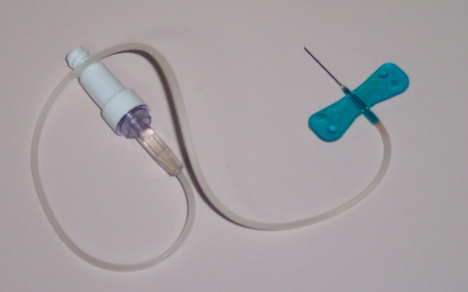 Not that I’m complaining, but the needle is rather fat, as it has to pierce not just my skin but also the plastic membrane of the top of the port. They call it a butterfly needle, but let me tell you, there’s nothing gentle or fleeting about it. I’ve had my port poked many, many times during this “cancer journey” and in fact, when it’s not in use, it must be flushed every 6 weeks, so off I go to the oncologist’s office to have the infusion nurses prep me like a HAZ-MAT victim, jab the butterfly through my skin, flush everything then yank the needle and patch me up with gauze and tape.
 While I don’t mind going to Dr Darcourt’s office for port maintenance (it’s close, parking’s free, and he’s cute), I now understand why Dr Grimes wanted me to come to his office to get started on this round of IV drugs. That said, I will continue to assert that Dr Darcourt’s infusion nurses are better with the stick. Dr Grimes’s infusion nurse, she of the “oh, at least you get new boobs” comment, has a bit of the palsy and visibly shakes. So Shakey comes at me with the butterfly needle, and all I can think is please please please let her get it on the first try, and where is that cocktail waitress, anyway??
Ok, back to business. The port looks like this, but of course it’s under my skin. The thick white tube on the right is sewn into my jugular vein, and the purple part on the left lies just under my skin on the left side under my collarbone. And yes, you did read that right: the port’s tubing is sewn into the jugular vein. That’s how it can empty all the various drugs and dyes into the big gun for distribution throughout my body. When you’ve got an important distribution job to do, the jugular is your guy. Creepy, yes, but very effective and efficient.
So the port is under the skin tied into the jugular, the needle pierces both skin and port membrane, and a thin tubing is attached to the needle with a clamp and a connector cap that attaches to the bag of medicine. It’s maybe 8 inches long, and when I’m not using it, I tuck it in my shirt and go on about my day.
My supplies look like this: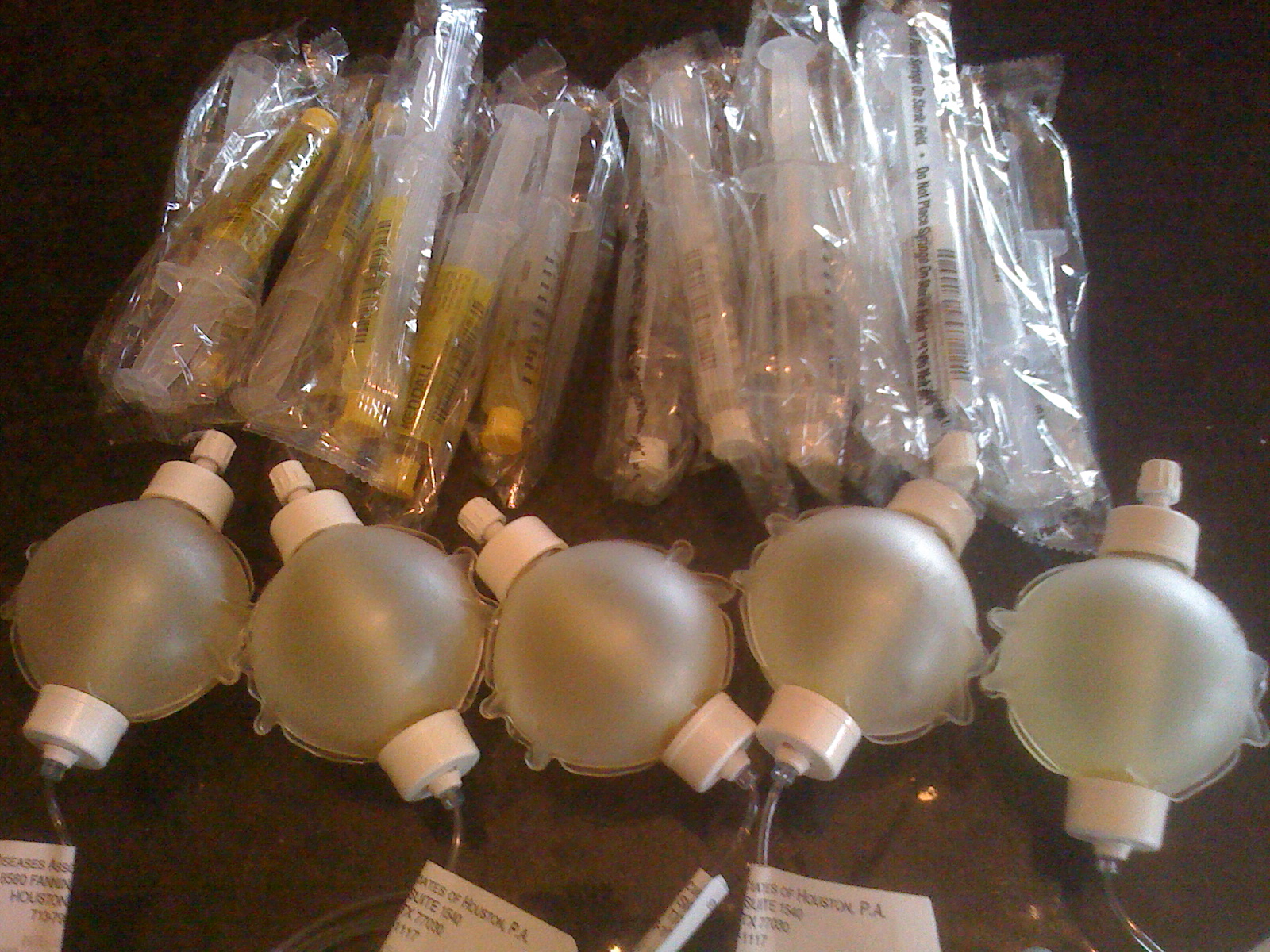
Flashback to this past summer, when I had the first round of IV antibiotics at home. The supplies looked like this: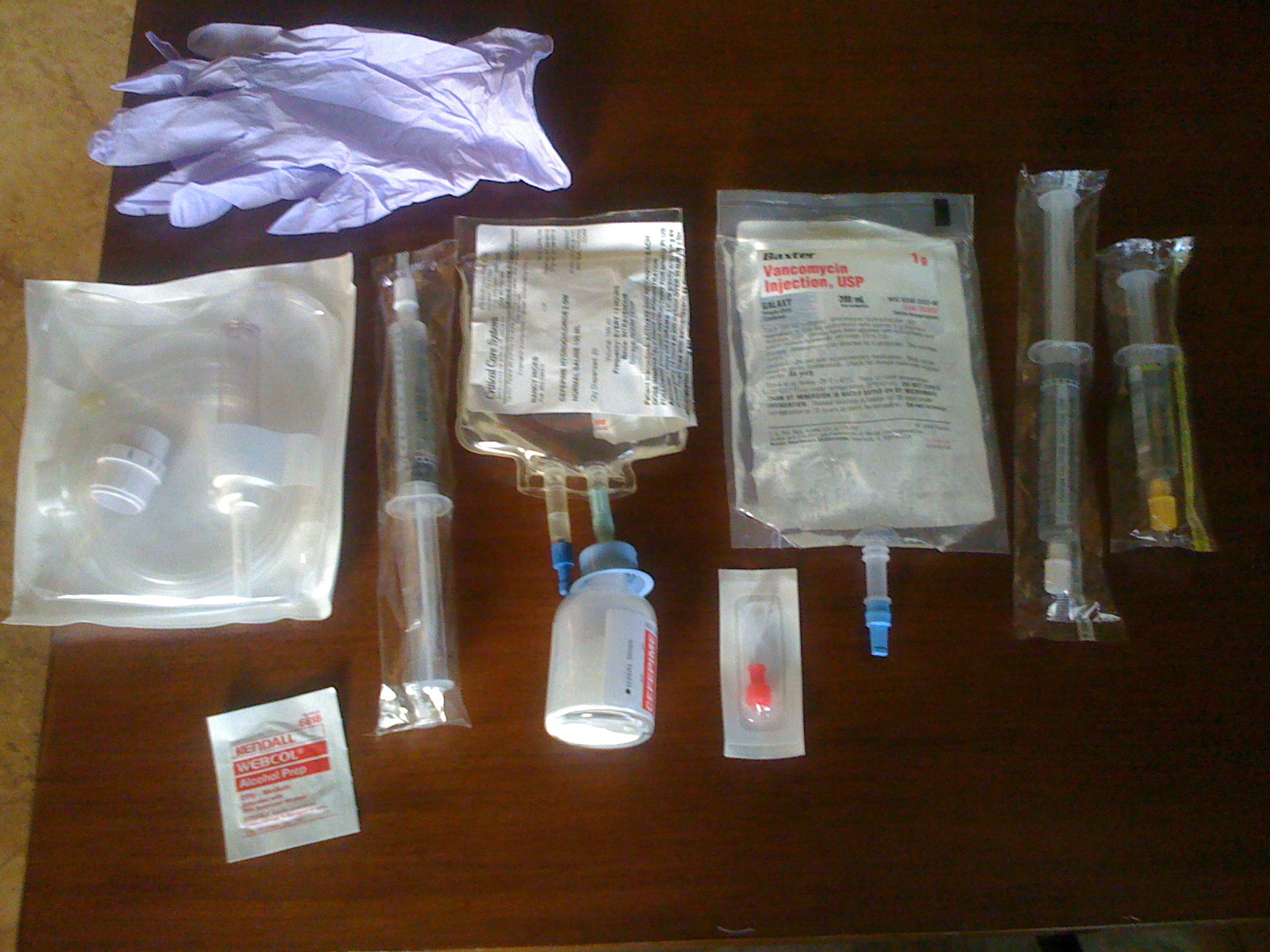
Much more complicated. I prefer the current version; downsizing is good.
The round balls in the new supplies photo are the “bags” of Cubicin, and I have saline syringes and heparin flushes. Gotta flush the port with saline before and after the drug infuses, to keep everything flowing, then shoot in the heparin after the infusion, to prevent any blood clots in the port’s nooks & crannies or in the tubing or God forbid in my body. The heparin is considered a lock, to keep the clots out.
 Here’s the “bag” of Cubicin as it starts infusing. It’s chubby and round with a rod down the middle that helps indicate when the drug is all gone.
I can hold it in the palm of my hand while it’s attached to my tubing and while it flows into my veins. I can set it in my lap and read my book, or take it with me to drive carpool. If I didn’t still have the dreaded JP drains and were carrying my normal purse instead of the sling bag, I could stick it in my purse and tuck the thin tubing aside and go shopping. Sigh. That’s another life. Never mind.
This drug infuses in half an hour. Once a day. I think I’m in love. Last time I did vancomycin and cefapim via IV, it took nearly 4 hours to infuse twice a day, and I was stuck with the IV pole. This is way better, despite the utter lack of shopping. 
As it infuses, the bag starts to collapse and the rod on the inside becomes more prominent. One of the infectious disease nurses said that while the drug is plentiful, the rod looks pregnant, and as the drug depletes, the rod gets its figure back. Too bad the figure-reclaiming doesn’t work that fast in real life.
If you’re wondering how this little bag of wonders works without gravity (i.e., hanging from a pole), I can tell you: it’s pressure-driven. Ingenious. It also has a 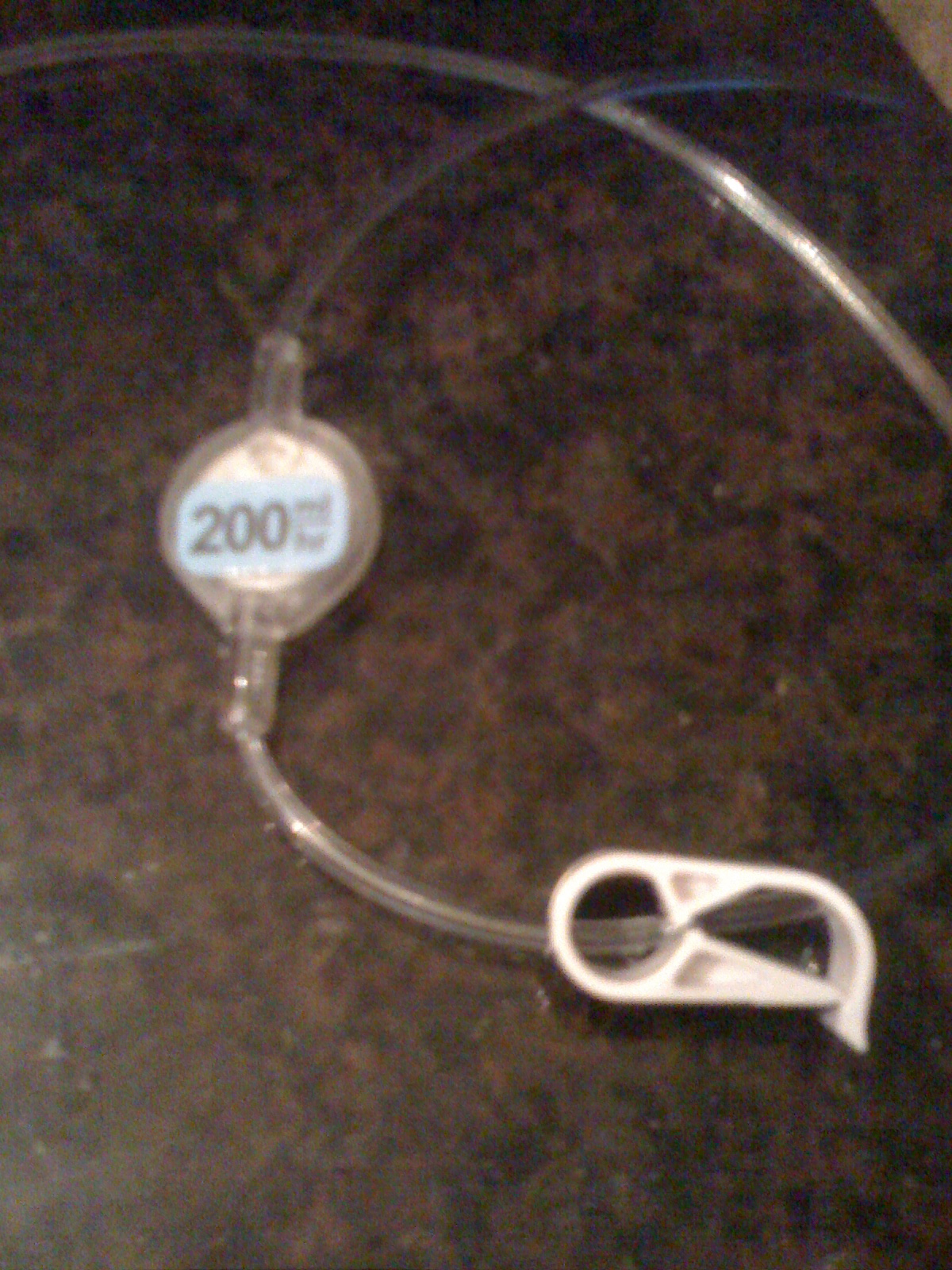 filter on the tubing that prevents any air bubbles from traveling through the tubing and entering my bloodstream. Last time around, we were warned against air bubbles as if they were the devil incarnate, and I stared at the drugs coursing through the tubing, waiting for my heart to explode, and not from happiness.
One day, when this “cancer journey” is finally over (it will end one day, right? right??), I can envision my heart being so filled with happiness that it might explode. One day.
1 week ago today…
Posted: March 9, 2011 Filed under: breast cancer, drugs, food, infection, Surgery | Tags: breast cancer, cancer battle, DIEP, hospital, Houston, ICU, infection, margaritas, mastectomy, Methodist Hospital, microsurgery, morphine, new boobs, plastic surgery, reconstruction, recovery, surgery, Texas, Texas Medical Center, Vera Bradley 11 CommentsI was out cold in the OR, having unspeakably nasty things done to my body to restore the damage wreaked by the post-mastectomy infection. Whew!
The first couple of days of week 1 are pretty hazy, thanks to my BFF morphine. Love that stuff. But my BFF knows its proper place, and we have short but infrequent get-togethers. This time around, my BFF gave me a terrible headache, which was quite rude, so I bid adieu to the pain pump as fast as I could.
Let’s start from the beginning. Or as much of it as I can remember. Readers, feel free to chime in when you notice I’ve left something out. We got to the Medical Center on time (6 a.m.) and I got right into my pre-surgery room. My beautiful gown and compression stockings were waiting for me, but I waited until the very last minute to don them. After some precursory steps, like accessing my port for the administration of the really gooood drugs, a gaggle of white coats entered the room.
Dr Spiegel led the way, with her PA Jenn next, followed by their resident, Dr McNight, then my favorite plastic surgeon. He was the only guy in the room. Yahoo, girl power! He had a cool wooden box in his hand and when I asked if it was a present for me he gave me one of his looks. Someday he’ll appreciate my humor. Inside the box was not a present, but his loupes, which sadly he didn’t offer to model. I’d love to see him in a pair of goofy glasses.
 Dr Spiegel and Jenn started marking my belly and I’m so mad I didn’t think to take a photo because it was cool. They used a blue sharpie for arteries, a red sharpie for blood vessels, and a black sharpie for incision lines. Lots of arrows and lines later, there was a roadmap of sorts. Very cool. At one point, Dr Spiegel wasn’t happy with an incision mark so she had Dr McNight scrub it off my belly with alcohol and re-do it with the black marker.
After that it was time to head to the OR, and they must have given me a cocktail in the pre-surgery room, because I don’t recall anything after the sharpie party. When I woke up, some 8 hours later, I felt pretty good…but it was because I was wrapped in the loving embrace of some big-time anesthesia. Dr Ashmore, my hand-picked anesthesiologist, did a fantastic job of putting me to sleep, and more importantly, waking me back up. It was good and restful.
I’m not too sure about whether I was in a recovery room or went straight to the ICU, but once I got to ICU I recall that it was HOT. And I’m a Texas girl, so I know about some heat. The docs had warned me that the room would be warm, to help my newly transplanted blood vessels learn to regulate themselves in their new northern home. But wow, was it hot. Between the high temp, the two heaters, and the squeezing of the compression hose, I was roasting. I tried to be nice about it, and I think I only lost it once, when I begged one of the ICU nurses, probably Carol, to please please please just crack the door and let some AC in. Just for a second. She declined my request.
I spent the night in ICU, but thankfully the flaps, aka former belly skin & fat that were magically transformed into breasts, behaved and there was no drama (other than me begging Carol to crack the door, turn down one heater, turn up the thermostat or bring me a gallon-sized frozen margarita). The flaps had to be checked every hour, yes every hour, with a hand-held doppler. There were (until yesterday) some wires stitched on top of my chest that somehow transmitted audible sound of the blood rushing through my newly transplanted blood vessels through the doppler. It sounded a lot like a fetal heart monitor. And we heard it a lot. My flaps were cooperative, and the nurses were able to hear the blood rushing almost instantly after putting the doppler onto my chest. One nurse told me that sometimes it took 20 minutes to find the sound. I started to panic after a few seconds of not hearing it, so can’t imagine the size margarita I would need if it took 20 minutes to register.
The ICU room had a wall of windows with mini blinds, and the nurse was right outside the door at a desk looking into my room if not attending to her one other patient. Some people might think that would make you feel very safe and catered to, but it made it hard to sneak anything by her because she was always watching. If she wasn’t watching, somebody else was walking by. It was a constant parade of doctors, residents, nurses, PCAs and other people peeping into my room.
I got released from ICU after some really delicious jello and a contraband peanut butter & jelly sandwich (liquid diet…pffft) into a regular room on the 8th floor of Dunn Tower. Lovely view out the window of the heart of the Texas Medical Center, and more importantly, no heaters. It wasn’t exactly chilly in the new room, but so much better than the ICU room. Nevertheless, I did beg to have the tight, scratchy, hot compression stockings removed. Those nurses were not swayed by my shameless begging.
Apparently the docs were pretty pleased with their handiwork, and if you missed Trevor’s and Amy’s guest blogs while I was too loopy to post, go back and take a peek. Long story short, the flaps were cooperating, the morphine headache abated, some regular food arrived, and life rolled on. At some point they moved the flap checks to every two hours instead of hourly, which was mighty nice. It’s amazing how your perspective changes in a situation like that. After umpteen hours with no food, a simple PB&J was a delicacy. After being awake most of the night, a short cat-nap seemed a decadent luxury.
I’m sure I said some goofy stuff and probably offended someone at some point with my off-color humor. Apparently I channeled my mom, too, telling my friend Laura who works at Methodist and who visited me several times a day, “Thanks for dropping by.” Every time she came by. I was just being mannerly and didn’t realize I’d seen her a few hours previous.
There are conflicting reports on how the turf war between the Drs S played out. All parties are being quite cagey on the details of who did what part of the surgery, and like a good murder mystery, we may never know who real killer was. I have my suspicion, but even asking point-blank hasn’t garnered an answer, so we may have to label that information “permanently classified.”
I did get to skate out of the hospital a few days ahead of schedule, and even though I received impeccable care, I couldn’t wait to get out of there. Coming home is always sweet, but never as sweet as when I’m leaving a hospital room.
I have more mobility than I did after the mastectomy, but not as much as I’d like. The first few times I had to get up without using my arms but relying on my legs and abs, the hip-to-hip incision on my tummy protested mightily. But it got better every time, and now I do it almost without thinking about it. Almost. I still can’t walk completely upright because the incision is still very tight, but I’m not quite the Quasimodo I was in the hospital. I get a bit straighter every day.
I came home with 6 JP drains this time, and had to upgrade my VB sling bag to a bigger VB bag that could accommodate the drain party. I knew from last time around that 4 drains fit nicely, with a little extra room for my Blistex, some folding money, and a teeny ziplock bag of pills, should they be necessary. Six drains would have burst my handy little bag right open. Wonder how many drains this lady is toting in her VB bags?
I had my first real shower today, not counting the seated variety the hospital offers. Again, it’s the little things we take for granted. I’m down to just 2 drains and back to my sling bag, thanks to Jenn removing the 4 drains up top yesterday. She gave me a good report; everything looks good and is healing nicely. 
While I feel a whole lot better and am ready to get back to normal, my handlers think one week post-op is a bit premature to jump right back into the day-in, day-out routine. I am trying to take it easy. I’m resigned to the fact that I’m back to one outing a day for a while, and sadly, a doctor’s appointment counts as an outing. Yesterday I had a small entourage escort me to see Jenn, and we had a bite of lunch (sans margaritas) beforehand.  The handlers insisted on snapping a photo of this maiden voyage, and there was some talk of me earning a margarita for every device I had removed at the subsequent appointment. Between the two doppler wires and the 4 JP drains, somebody owes me 6 margaritas. No salt.
Although I complain about going to the med center, there’s always something interesting to see along the way. Getting out of the suburbs is a good thing, and there’s a whole ‘nother way of life in this big city of ours. Last time I was at the med center for some testing, I saw this car and had to take a picture, to show Macy. I knew this car would appeal to her:
 She loved the polka dots and said she’d like to have that car, then she saw the back and said forget it. Fickle.
Yesterday on the way home from the med center, I saw this:
and had to snap a picture. Yes, it is a zebra car, complete with a long tail. Gotta love the big city.
Leavin’ on a jet plane
Posted: March 1, 2011 Filed under: breast cancer, drugs, food, infection, kids, tennis | Tags: breast cancer, cake, cancer battle, consent forms, DIEP, family, Hibiclens, hospital, infection, Janis Joplin, John Denver, kids, Leaving on a jet plane, margaritas, new boobs, pastichio, plastic surgery, reconstruction, recovery, sweet notes from sweet girls, tennis 20 Comments I’m not really leaving on a plane and my bag isn’t packed yet, but as I ready myself, my home, my kids, & my life for the next round of surgery, I find the lyrics to that song running through my head. Peter, Paul & Mary; Janis Joplin; and John Denver all recorded versions of this sappy little love song, with its catchy yet insidious chorus that will get stuck in your head for half the day if you’re not careful. It’s meant to be an ode for lovers, and I’m usually immune to sappy stuff and odes, but with the big surgery rapidly approaching, I must be going soft because this goofy tune is reminding me how hard it is to leave my family, endure a nasty procedure, and be cooped up in a hospital room. I am a terrible patient. No truer words have been written.
I have written a lot about what a terrible patient I am. Not that I won’t do what needs to be done to get to where I need to be in this “cancer journey” but that I hate every minute of it. I’ve also written my fair amount of scathing posts lately about stupid things people say, so I won’t go there now, but suffice to say if you were planning on telling me that at least I’ll be getting some rest, or to enjoy being waited on, you can skip it. I don’t like to rest and I really don’t like having someone wait on me. As a determined two-year-old might say, “Me do it.”
As terrible as I am as a patient, though, I’m ready. I’m at the point in which I’ve prepared all I can, and whatever doesn’t get done will just have to wait. I’ve been a busy little bee lately, feathering my nest and gearing up for what I know will be a hideously gross surgery followed by a long recovery. This process is akin to getting ready for vacation: at first the list of things to do seems miles long, then time ticks on and the list is whittled, and then you become exhausted from and sick to death of all the prep and can’t wait to just get going. While I’m not exactly going on vacation (!), I am done with all the prep and ready to just get going.
I still haven’t watched the video consultation that explains and illustrates the surgery I’m having tomorrow. Maybe I’ll just use my imagination. You know it’s a big deal with you get 12 pages of pre-op instructions, followed by a 3-page alphabetized list of medicines to avoid.
One of my instructions is to shower with Hibiclens, an antimicrobial wash, for 3 days prior to surgery. No problem. You know what a germaphobe I am. Some of the other text from the informed consent section of the paperwork made me laugh out loud, especially the parts about who’s not really a good candidate for this surgery: women who require more complex breast reconstruction (what’s more complex than this surgery??). Women who are good candidates are those who have inadequate chest wall tissue (me); those who have concerns about breast implants or tissue expanders (I wasn’t too concerned but my body apparently is); and those who may have contracted a post-surgical infection. Yep, that’s me.
The literature then goes on to explain that infection is very unusual after surgery. Yeah, maybe for some people. And that patients must inform the doctor if she has any other infections, “such as ingrown toenail, insect bite or urinary infection.” A bug bite? Really??Oh, mercy, if only it were that simple. How I would love to say I have an ingrown toenail instead of a mycobacterium fortuitum.
There’s also a lot of scolding in the section on bleeding: “Increased activity too soon after surgery can lead to increased change of bleeding and additional surgery. It is important to follow all postoperative instructions and limit exercise and strenuous activity for the instructed time.” Yeah, yeah. Blah, blah, blah.
Yesterday was a near-perfect day: I had a few hours at home to get things in order, then on to Beauty Envy to get the hot new shellac manicure. It’s supposed to last a couple or three weeks without chipping; we shall see. I’m not going to be doing any manual labor anytime soon, so the prognosis is good. Got my toes done, too, which is always nice. Even though my toenails are short as can be, they still take a mighty beating from tennis, but they are pink and shiny now. After the nails extravaganza, it was off to lunch to enjoy the sunshine and margaritas in the company of some first-rate girlfriends–a trifecta for sure. You can have your acai berries and super elixirs; for me, there’s nothing more fortifying than the sun on my face and a drink in my hand with my friends.
Today will be equally good with my last tennis drill of the season, then lunch with whichever members of the team are game for a little noontime tippling. I also gotta make a quick belated birthday meal for my dad, who recently turned 75 but looks a decade younger, easily (I’m hoping it’s genetic, but not very optimistic). I’m whipping up pastichio (Greek lasagna) and a pineapple upside-down cake, two of his favorites. He’ll be ferrying the kids to and fro and keeping up with Macy’s near-constant stream of chatter, so he’ll need a good meal. 
Speaking of Macy, she’s at it again: leaving me a note to find when I least expect it but am most likely to need a little pick-me-up. She’s a little apprehensive about me going back for more surgery, but the long summer of me and revolving hospital door must have toughened her up because instead of being sad she’s curious (which hospital? how long will you be there? can we come visit?) and stoic.
 She needs a little work on the spelling (I assume that “Your asomest chid” means “Your awesome-est child”) and “Hopefuley” she will keep writing without regard for menial details like spelling. Most important is the message: if Macy says this is my last surgery, then I can go into it with a clear mind and a happy heart.
Apropos
Posted: February 28, 2011 Filed under: breast cancer, drugs, infection | Tags: 200 Days of Dread, Afrika Korps, breast cancer, cancer battle, hospital, Jim Adler, lawsuit, Mariah Carey, mastectomy, Nancy Brinker, new boobs, pink ribbons, plastic surgeon, plastic surgery, post-mastectomy, Promise Me, reconstruction, Rommell, Super Bowl ads, Super Bowl XLV, Susan G. Komen Foundation, Women's Health and Cancer Rights Act of 1998 6 Comments Two pieces of news today, all contained in one handy-dandy post. First, this comic made me laugh, even though it’s not applicable to me since I need both sides. Luckily, I don’t have to save up for one or both sides. Thanks to the Women’s Health and Cancer Rights Act of 1998, it’s covered.
So for those litigious souls out there who’ve pestered me to “make sure the doctor/hospital/insurance company/orderly/mammogram technician/parking booth attendant/janitor pays to clean up the mess that infection caused,” you can rest assured that I’m getting what’s owed me, so to speak.
Yes, people have actually said that to me. That I need to make sure somebody else pays for what happened to me.
Cha-ching.
If only it were that easy. Or if only I were that shallow, or had the energy to try and create a lawsuit, then all my troubles would be over.
As if.
I don’t hold anyone responsible for the post-surgery infection any more than I hold the sun responsible for rising each day. Some things just happen. Yes, I know there’s a scientific reason for the sun rising, something to do with the pull of the tides or the rotation of the Earth or some such phenomenon. But that’s not nearly as interesting or titillating as ambulance-chasing lawyers drumming up skeevy lawsuits.
If not for the Women’s Health and Cancer Rights Act, I’d be calling Jim Adler, the “Texas Hammer” real soon. The “tough, smart lawyer.” I bet he could get me top-dollar for my medical misfortune. But I’ll leave him alone for now and let him focus on the important cases, like the nasty 18-wheeler wrecks in the middle of the night.
Thanks to the WHCRA, a federal law says my insurance company has to pay for my reconstruction. The law refers to “mastectomy-related services,” which sounds a lot more exciting than it really is. Wonder if I can campaign to make mani-pedis part of the “mastectomy-related services.”
I first heard about the WHCRA while reading Promise Me, by Nancy Brinker. She’s Susan G. Komen’s little sister, who made the promise to her dying sister in 1981 that launched the global breast cancer awareness movement.
Thankfully, “breast cancer” is now a household term instead of a shameful secret, as it was in the past, and health insurance companies can’t deny the coverage required to fix the problems that breast cancer surgeries and treatment create. I could fill this entire screen with facts & figures, befores and afters, thens and nows, of breast cancer. But instead I’m thinking about the WHCRA.
Because of the WHCRA, I don’t have to worry about whether I can afford to clean up the mess that breast cancer (and its bad-news friend, the post-surgical infection) created. I don’t have to make a t-shirt that says “Will Work for Boobs” or wash dishes at Dr S’s house in exchange for my surgery. As if being diagnosed, going through surgery and dealing with the infection weren’t enough. I’m so glad I don’t have to sing for my supper as well.
The second piece of news is pretty important. Maybe not as important as the WHCRA, but only because that affects a whole lot of women, and this bit of news affects me and me only.
Today, Monday, February 28, 2011 is my 200th day of oral antibiotics.
Yes, you read that right: I have been on oral antibiotics, twice a day every day, for the last 200 days. Bactrim and Minocycline, also known as “these damn drugs,” have been my constant companions for 200 straight days.
I’m not great at math and am too old to waste time trying to get better at things that are useless, and for me, trying to get better at math is useless. It’s just not going to happen. I know I should believe I can fly, touch the sky, be whatever I want to be or some other such drivel as churned out by Mariah Carey and the like, but I don’t believe I can get better at math, and frankly, I really don’t want to get better at it. I’d much rather spend my limited time and energy on other stuff, like playing as much tennis as humanly possible.
But if I were better at math, I would be able to say what percentage of an entire year I’ve already spent on oral antibiotics. Oh, never mind; who cares. Let’s just suffice to say that 200 days is a really, really long time, and if you think otherwise, I don’t want to talk to you. Ever. Or at least until I get off these damn drugs.
If you want to know why I’ve been suffering this cruel & unusual punishment for so long, read this. I just can’t explain it again; I’m too exhausted from trying to do that math and figure the ratio of time spend on these damn drugs verses time not spent on them. Well, here’s the Cliffs Notes version of the story: I got an infection from the tissue expander on the right side after my bilateral mastectomy on May 13, 2010. The infection was (is?) tricky and was hard to diagnose, but we finally learned, in mid-August that it was a mycobacterium fortuitum, which is a wily little bugger that is insidious and hard to kill. The most powerful weapon against this bug is two different antibiotics taken twice a day for a very long time. Like forever.
200 days is a blip in the universe of long-term drug therapy. Every time I feel sorry for myself for still having to take these damn drugs, I remember my infectious disease docs chuckling softly and shaking their heads at my pitiful temper tantrum and infantile whining about why I still need to be on these damn drugs. They tsk-tsk me and handle me with the kid gloves I require of them, then sweetly remind me that many of their patients are on antibiotics for 2 years. 2 years. I’m no math genius, but I’m pretty sure that’s longer than 200 days.
Ok, so a little perspective is good, but still, I feel the need to mark the 200th day of twice-daily drug therapy. Judge me if you must, but consider this: there’s more to taking these damn drugs all this time than meets the eye. Think of the numerous trips to Walgreens to pick up said drugs, along with the other prescriptions I have to take, and the fact that none of them start on the same day, so one of them always needs to be refilled. Thank heavens my sweet oncologist added me to his personal pharmacist’s home delivery service, and now the FedEx man brings these damn drugs right to my front door, all at once. I’m sure they miss me at Walgreens.
There’s the sheer volume of pills I’ve swallowed. Twice a day every day for 200 days is a lot of pills. Again, I’m no math genius, but wow that’s a lot of pills.
There’s also the stress of remembering to take these damn drugs twice a day every day. It’s such a habit for me now that it will seem strange to not be doing it, when that day comes. Strange, but wonderful, too. I can’t wait. Actually, I can’t even think about it because I don’t want to consider how many days I will have been on these damn drugs by that time. But you know I’m going to be counting, right?
And then there’s the issue of what foods don’t mix with these damn drugs. Can’t eat dairy products for an hour before or two hours after I take these damn drugs, because dairy can inhibit the drugs’ absorption. If I’m going to go to the trouble to take these damn drugs, I certainly want them to get into my system and fight that mycobacterium.
And last but not least, there is the scorched earth tendency of the antibiotics to kill the good bacterium in my tummy, along with the bad bacteria elsewhere. I’ve gotten used to the near-constant morning sickness that comes with 200 days of these damn drugs, but I still dislike it. A lot. When the extreme nausea comes to call, no matter what I eat or don’t eat, whether an hour before or two hours after, I feel rotten. And don’t tell me your hard-luck story of how you had morning sickness every single day of your pregnancy, because at the end of that pregnancy, you got the best prize ever: a baby. Well, depends on the baby, I guess; some of them aren’t such prizes in the early days. Maybe the best prize ever is a puppy. To some people.
So by golly, I’m gonna celebrate having made it through 200 days of these damn drugs.
We highlight a president’s first 100 days in office, with either a favorable or scathing review of the job he’s done thus far. If our country can create a tradition based on a mere 3 months, I am well within my rights to celebrate having survived 200 days of these damn drugs. And since we all know it’s 200 days and counting, with nary an end in sight, I certainly will celebrate this milestone. Right now. Today.
I don’t know if it’s a nationwide tradition, but at my kids’ elementary school, they celebrate the 50th and the 100th days of school. Kindergarten especially makes a big deal out of these milestones, as well they should. Macy invited me to come to one of these celebrations and even talked me into wearing matching poodle skirts for the ’50s theme. And celebrate we did! A lot of those little kindergartners probably don’t know from one day to the next whether they’ll make it in the dog-eat-dog world of all-day school. No naps, no crying allowed, curriculum requirements that increase every year; it’s a jungle in there. That’s why they make a point to celebrate the milestones along the way, like the 50th and the 100th day. Why isn’t there a celebration for the 200th day of school, like there is for my 200th day of these damn drugs? Because the kids only go to school 180 days total each school year. So I’ve been on these damn drugs longer than the number of school days in an entire calendar year. Egads.
Ya know how we just watched the Super Bowl a few weeks ago? On February 6, to be exact. Well, on July 20th of last year, the media outlets that handle the infamous Super Bowl advertising spots were counting down 200 days until the big game. So in July, they’re thinking about selling ads during the Super Bowl, which won’t be played until February. End of July to first of February. 200 days. Curiously enough, on July 20th of last year, when the media hawkers began the countdown, I was in the hospital, for the second time post-mastectomy, with the infection.
Another significant stretch of 200 consecutive days of anything is the so-called 200 Days of Dread: a period from the spring of 1942 to November 3, 1942 in which Germany’s Afrika Korps under General Rommel marched toward the Suez Canal and Palestine, causing Jewish people there considerable and understandable stress. Not to minimize the significance of this event in World History, but yes, I’ve been on these damn drugs as long as the Afrika Korps threatened the Palestinian Jews.
And guess what? I haven’t missed a single dose of these damn drugs in all of the 200 days. Not one dose. Surely there’s a trophy for that.
Other than the shooting…
Posted: February 15, 2011 Filed under: breast cancer, drugs, food, infection | Tags: breast cancer, cancer diagnosis, champagne, infection, surgery, survivor, tennis 5 Comments With the exception of being diagnosed with breast cancer at age 40, I’ve always had a pretty healthy countenance. Ok, I know that sounds like the old joke, “Other than the shooting, how’d you enjoy the play, Mrs. Lincoln?” And now, with the flu, the joke’s on me.
Being sick, or being diagnosed with cancer, makes one appreciate one’s good health. For schizzle. Again with the annoying cliches, but somehow we don’t know how good we’ve got it, until it’s gone. Whatever “it” may be. In my case, it’s good health.
Even after my diagnosis and surgery and epic battle with the infection, people would universally remark upon how healthy I looked. As if the stereotypical look of a cancer patient or infection warrior has to fit into a preconceived box. I suppose that’s the very essence of stereotyping: it exists for a very legitimate reason, and the reason is that it is true.
Follow me? It makes sense to me, but it may also be the cockamayme ramblings of a fever-induced, Tamiflu-fueled insanity. Temporary, I hope.
I’ve said it before and will say it again: cancer is not a gift. Anyone who thinks it is either (a) doesn’t have it; (b) has it but is whacked-out on narcotics; or (c) is a lying sack of you-know-what. It’s a disease, pure and simple. It’s a malfunction at the cellular level. Something changes in the DNA that alters the way the cells behave. In breast cancer, in particular, BRCA1 and BRCA2 are tumor suppressor genes — they keep cancer tumors from forming. When these genes undergo change, which can happen for a variety of reasons, they no longer cause cells to die at the right time, and cancer is more likely to develop.
I’m not sure how someone can understand that and still think that cancer is a gift. There’s nothing, not one thing, in gene mutation that even hints at slick, shiny wrapping paper and silky bows.
Because I’m a realist, I don’t expect people to bump up against cancer–whether with the bomb being dropped directly over one’s house or simply knowing someone who’s been diagnosed–and drastically change their lifestyles. In my case, my lifestyle didn’t need much changing. I ate healthfully, exercised pretty much every day, played as much tennis as humanly possible, chose organic and turned my nose up at pesticides. Granted, I could have cut down on the volume of champagne I consumed, but I felt like that fell under the “live life to the fullest” category.” Sounds good, right?
So why was I the one to get cancer, while people who treat their bodies much less kindly go on to live long, uncomplicated lives? I have no idea. Was my diagnosis handed down from on high, with some mystery contained therein for me to interpret and then carry out? Doubtful. Was it my destiny to contract this blasted disease and then come out the other side a mouthpiece for the Cause? Maybe, although I’m not there yet. Was it random bad luck, in that the great karma wheel stopped spinning and I was the one in eight? That sounds more likely.
No matter the reason, the disease did come calling, and the infection did set up shop, and my life did change. Some of the change was for the better: I’ve learned a little bit of patience, how to let go (sometimes), I’ve become pretty well-educated in a fascinating topic, I’ve learned how to blog, and I’ve made some new friends.
That’s not all bad.
A cast of characters, minus one
Posted: February 12, 2011 Filed under: breast cancer, drugs | Tags: Antibiotics, cancer recurrence, morning sickness, pill organizer, pinkwashing, prescription drugs, probiotic, steak, tamoxifen, vegetarian, Walgreens 7 Comments I’ve had this snazzy little grouping of prescription drugs on my kitchen counter for months now. Yes, the lids are pink, because my Walgreens had them for the pinkwashing that comes every October for Breast Cancer Awareness Month. Cute, huh?
These are the drugs I take every day, like a little old lady. My old standbys. The usual cast of characters.
There are the two big stars sharing top billing, Bactrim and Minocycline. My darling antibiotics that course throughout my body twice a day, every day to kick some mycobacterium butt. I would be lost without them. Or perhaps I would lose the all-day morning sickness feeling without them, but that’s just wishful thinking. Maybe I’d be dead without them, who knows? There was a time when I was almost sure I was dying from them, but I got over that.
Next we have the Florastor, the one thing that besides coffee that keeps me upright every day. I’m forever indebted to Susan Christopherson for turning me onto this probiotic that helps restore peace and order in one’s digestive system after said system has been under attack by the slash & burn tactics of an antibiotic regime. There have been a few times over the last 6 months of living under this regime in which I’ve either forgotten or willingly neglected the Florastor, and I paid dearly for that mistake. It’s not a prescription, but is kept behind the pharmacy counter for some reason. I don’t have to show my driver’s license to buy it, though, so I guess you can’t make meth out of it.
There’s the Ferrex iron supplement, since I’m a bit anemic and because I need uber-healthy blood vessels to harvest during reconstruction. Because I don’t eat any meat, I need a little help getting my iron; I get some from all the dark, leafy greens I eat, but not as much as my carnivorous friends ingest. My sweet, Peruvian oncologist can’t for the life of himself understand why someone would willingly forego meat. He shakes his head and looks at me a little funny every time it comes up, and he tends to bring it up every time he sees me. I’m done expecting him to compliment me on my plant-based, cancer-fighting diet. It didn’t help much, anyway, so I guess everyone is free to go on ahead and eat a big-ass, nasty, extra-rare steak. Might as well add some fries, or a loaded baked potato. You can see how far the healthy eating thing got me. Harumph.
Then there’s Tamoxifen, my daily cancer-battling bad-ass. It makes sure that there’s no estrogen flowing to feed any remaining cancer cells. While the side effects are troublesome (early menopause, hot flashes, leg cramps, decreased fluid in the joints, to name a few), I like the idea of starving those bastards. Tamoxifen is my first line of defense against recurrence. It makes me feel like I’m doing something every day to keep this beast from re-entering my life. It’s a daily pill that I’ll take for 5 years, then reassess to determine if I should stay on it or switch to another, similar drug.
And today I stopped taking it.
Yikes.
That scares me. More than a little bit. But since Tamoxifen can promote blood clots, it’s counterindicated with surgery. So I stop taking it for 3 weeks and hope that nothing goes haywire with my bloodflow. No clots, no bloodletting, no drama. That sure would be nice for a change.
Although I’m subtracting one prescription from my snazzy little grouping, I still feel like a little old lady whose life revolves around her meds. Ya know the old wisecrack issued when someone asks what time it is, and someone else smarts off, “Why? Ya gotta take a pill?” In my case, the answer is yes, smart ass, more than one pill. So zip it and get me a big glass of water so I can choke these guys down. While my life may seem to revolve around my meds, I refuse–I mean, dig in my heels and refuse–to get a plastic pill organizer. I’m all about accessories, but not that. 
There’s not enough hand sanitizer in the world…
Posted: February 11, 2011 Filed under: drugs, kids | Tags: fever, germs, hand sanitizer, masks, sick 6 CommentsEvery person in my family is sick. But me. 
Trevor has some nagging cough/congestion/fever thing that’s been dragging on for 12 days. Payton has the same thing and has been home from school since Monday. We were already going through a lot of hand sanitizer (when Macy was tiny she insisted it was called “san hanitizer” and half the time I catch myself inadvertently calling it that).
Then last night Macy woke up vomiting at 3 a.m. with fever and sore throat.
Hang on a sec, let me find a mask. Hey, apparently there are lots of fashionable choices. Hooray!
This one is particularly fetching, especially for a guy.
 This one might scare the germs away. I like that idea.
 How about this one? For the pig-lovers in the world. Swine flu? No, thanks.
 Or maybe this one. More scaring, fewer germs.
 This one is kinda nice. Reminds me a bit of Eric Estrada in CHIPS.
 But this one is my favorite. A peaceful, zen germ-fighter.
Hi-yah! I’m going to check into a hotel.
Front-page news
Posted: February 9, 2011 Filed under: breast cancer, drugs, Uncategorized | Tags: breast cancer, breast surgery, cancer diagnosis, Houston Chronicle, infection, lymphedema, mastectomy, MD Anderson, New York Times, radiation, recovery 3 Comments An article on the front page of the Houston Chronicle today says that big changes are in store for the breast surgery required for cancer treatment. A new study from our own local attraction, M.D. Anderson, found that women with early stage breast cancer don’t need to have their lymph nodes removed, even if the nodes are cancerous.
This is big news. Breast surgeons are calling it “practice-changing” and proof of the old adage that “less is more.” Dr Kelly Hunt, surgery professor at Anderson, says, “The study shows that we don’t have to take out huge swaths of tissue, that we can avoid aggressive surgery without any effect on outcome.” Personally, I’m a fan of anything that avoids removing huge swaths of tissue. Ick. Ugh. Yuck. Been there, done that. More than once.
This new study pokes holes in the century-old belief that a surgeon’s job was to cut out every bit of the cancer, and found that removing the lymph nodes didn’t give women any benefit over radiation and drug therapy alone. The prevailing science has been that removing lymph nodes helps prevent the cancer from spreading and/or recurring.
Removing the lymph nodes from the armpit area is a hot mess waiting to happen. You’ve got the cosmetic issue of ending up with a concaved surface. You’ve got the potential for infection (ahem). You’ve got the risk of lymphedema, which is painful swelling in the arm that cannot be cured. Anyone who has ever seen a photo of a limb swollen to multiple times its normal size because of lymphedema knows to fear this condition. I’ve met several breast cancer survivors on the tennis court since I returned to the game post-mastectomy and post-infection, and more than one of them played with a compression sleeve (a form-fitting garment that goes from wrist to shoulder) to stave off lymphedema. Tammy, my dear lymphedema specialist, made me take one of those bloody things home to keep in my drawer, “just in case,” because the really stinky thing about lymphedema — aside from the fact that there’s no cure — is that it can come on at any time. Women have gotten it years after a mastectomy, with no prior symptoms.
If you want all the nitty-gritty details of the study, you can read the New York Times article, which goes into a little more detail than the Chronicle’s story. The Chronicle does get credit for providing more info about Anderson’s role in the study. We like to root for the local team. Seems 100 of the 891 patients in this study were from Anderson, and the researchers originally planned to expand the study to include 1,900 women, but shut down the study before that happened because the results were so overwhelmingly conclusive.
I like overwhelmingly conclusive results. You don’t find a lot of them in medicine. I’ve learned that the hard way in my “cancer journey.” I’m a black & white, just-the-facts-ma’am kind of girl, and I found myself smacking my head against a wall more than once in pursuit of a concrete, yes-or-no type answer. In medicine, precious few of those exist. I suspect that’s why it’s referred to as “practicing” medicine.
In fact, Dr Grimes, my infectious disease doctor, has spoken of practicing the art of medicine as much as the science of medicine. I really like the way that sounds, as if it’s so very civilized and full of aesthetic value. In reality, it’s a balancing act of drug therapy vs side effects; of benefit vs cost; of how far can we push the body yet still maintain the integral strength necessary to fight the disease.
In other words, there is no overwhelmingly conclusive answer. And sometimes the doctors don’t know themselves what the right answer is. That’s why it’s so nice when a study comes along that says, yes, for sure this is the right thing to do.
 I’m super happy about this big news. I hope it lives up to its potential to make life easier for the 200,000 women a year diagnosed with this breast cancer. And I really hope that it’s just a teaser of what big breakthroughs in breast cancer research are yet to come.
Now that I have a surgery date…
Posted: February 2, 2011 Filed under: breast cancer, drugs, infection | Tags: breast cancer, cancer battle, cancer diagnosis, DIEP, hospital, Mubarak, new boobs, plastic surgery, reconstruction, Sarah Palin, surgery, Thumper 5 Comments Now that I have a surgery date, if you feel compelled to join the Greek chorus that’s asking if I really want to have the surgery, don’t.
Just don’t. 
I don’t want to hear it.
I don’t need to hear it. 
Isn’t the fact that I have a surgery date evidence enough of my decision to go forward?

If I didn’t want to have the surgery, would I really have a date? Would I be putting myself through the mental anguish that accompanies such a decision and the days that stretch on between said date and today?
Sometimes I hate people. 
Mainly those who say stupid things, but Sarah Palin & “President” Mubarak are on my list too. If you like either of these idiots, you may want to unsubscribe from this blog, because I will most likely rip on them and their idiot-ness a lot, esp when I’m in a foul mood like I am now. And if ripping on dumbasses makes me feel better, then Katy bar the door because I’m gonna do it. 
So there.
And don’t tell me that people mean well, and sometimes they just don’t know what to say. They can suck it. If it’s that hard to come up with something not stupid to say, then perhaps they should zip it.
But back to the surgery. Reconstruction is a big step. It’s a scary step. It’s a horrifying assault on my already-beleaguered body. If things were different, I wouldn’t be in a hurry to do it. By “things” and “different” I mean the path of destruction left by the blasted mycobacterium.
I hate that myco almost as much as I hate Sarah Palin. Sheesh, just typing her name makes me mad.

Ok, reigning it in.
That darn mycobacterium wrecked things up good. If it was just a question of having a flat chest, I’d be in no hurry for reconstruction. I kinda like my flat chest. It’s simple. It’s low-maintenance. I never have to wonder if people are paying attention to what I’m saying, because they’re certainly not distracted by cleavage (there is none). But thanks to the infection and subsequent tissue excision (gross, I know), it’s a mess that’s gotta be fixed.
And thanks to the infection, I can’t just pop in the implants and go along my merry way. I remember being asked as a kid if I had to do everything the hard way (I was a little stubborn back then). The answer is yes. Yes, I do.
I do not like surgery. Or hospitals. Or hospital gowns.  Or hospital linens (scratchy, so scratchy). Or hospital food. Or the hospital smell. Or needles. Or being an invalid. Or depending on other people. Or waiting on other people to show up and do what they need to do so I can get outta there.
I do like the drugs, though.
But not enough to rush into a big, long, complicated surgery. So while I don’t actually want to have this surgery, I need to, to clean up the leftover infection mess. It’s going to be hard, and the recovery will be long. I won’t see a tennis court for several months. I will once again be at the mercy of other people’s kindness. But I need to do it, so I will. And I will leave you with another mantra from my childhood: If you can’t say anything nice, don’t say anything at all. Thank you, Thumper. Preach it, little rabbit. 
And if you can’t follow Thumper’s advice, and still feel compelled to tell me how dangerous this surgery is, or how complicated, or ask me to think about how it might affect my kids, or any other stupid thing that flies out of people’s mouths, then consider this: 

 The Pink Underbelly