The Big Dig
Posted: February 18, 2011 Filed under: breast cancer, infection | Tags: Barney Frank, Boston, breast cancer, construction, DIEP, ET, haz-mat, I-93, infection, Methodist Hospital, new boobs, nurse practitioner, plastic surgeon, reconstruction, the Big Dig 39 Comments Yesterday was yet another trip to the medical center, for one last pre-op visit to Dr Spiegel before reconstruction. I really need to think of a catchy title for the surgery, something like Boston’s big construction project, the Big Dig. Come to think of it, there are some similarities between the Big Dig and my surgery: both relate to the Central Artery and Tunneling (in fact, the official name of the Big Dig is the CA/T Project). Both are complicated, involve lots of people, and take a mighty long time to complete. But unlike the Big Dig, which replaced the 6-lane elevated Central Artery (I-93) with a 3.5-mile long underground tunnel, my surgery won’t cost $22 billion. Hopefully. My insurance company, which has been mighty nice so far, might just stroke out about that figure.
The Big Dig sounded like a great idea and was intended to be a tremendous boon to an already kick-ass city. But mismanagement, scandal, and skyrocketing costs quickly dominated headlines, and my second-favorite city had a big mess on its hands. Congressman Barney Frank quipped, “Wouldn’t it be cheaper to raise the city than depress the artery?”
Say what you will about Barney, but that’s a good line.
But back to the update on the doctor visit. This was Trevor’s day to meet the lovely Dr Spiegel, her ultra-energetic PA, Jen, and her trusty nurse Sonia. My friend Laura, who is a nurse practitioner in the liver transplant unit at Methodist, met us there, too. Dr Spiegel wanted to brief my caregivers on what to expect post-surgery, and Laura kindly offered to help out. In her white coat and super-stylish glasses, she brought a nice element of professional gravitas to the occasion. She told Dr Spiegel that she’s done some match-making for me and picked out an anesthesiologist she likes and trusts, and Dr Spiegel agrees that Dr Ashmore is the guy for me. Laura and Sonia recognized each other right away, then she and Jen hugged and high-fived, happy to be collaborating on my case. It’s good to have connections.
The visit itself was pretty uneventful. I like uneventful at the doctor’s office. Dr Spiegel went over a few basics with us but since we were pretty much up to speed on everything, there weren’t any new developments. I’m finished with all the pre-op testing (bloodwork, blood donation, x-rays, EKG, CT-scan), and just need to watch the video consultation on Dr Spiegel’s website to get a more detailed overview of the procedure. I’m not saying I’m scared to do that, but after watching a video on youtube of an actual surgery, on an actual person, I’m not in a big hurry. Ick.
The one topic we did need to cover, though, was the infection. I wanted to bring it up in a way that seemed breezy and conversational, as opposed to, “How the sam hell are you going to keep this bloody nightmare from recurring, lady?” I was pretty sure that wouldn’t go over too well.
I’m not the most diplomatic person, and I tend to say what I really think, even if it’s not pretty or may be hard to hear. It’s a blessing and a curse. Believe it or not, I actually do put a lot of thought into what I say and how I say things, but because I’m pretty direct, sometimes things come out a bit, um, harsher than I intend.
Sorta like, “Are you outta your mind??? You’re not really going to wear that are you?” or “Clearly that person has neither friends nor a mirror; why else would one go out in public looking like that???” as opposed to “Have you thought about what to wear?” Those kinds of niceties take a bit of work on my part. My instinct is to just blurt out whatever needs to be said, and let the chips fall where they may. We’re all grown-ups, right?
Right. Except I really don’t want to tick off the nice lady with the very sharp scalpels. That would be bad. So I fumbled around and probably sounded idiotic by saying, Um, so, uh, like, how worried do we need to be about the um, you know, infection? You know, like, um, during the uh, reconstruction?
She smiled knowingly, and if she’d been sitting closer might have patted my hand and said, there there. She reminded me that my case isn’t exactly normal, and I tried not to tell her that “normal” is pejorative and listened to what she had to say.
She has a plan, of course, and it sounds like a good one. Usually, in cases of infection, she would wait to do reconstruction, to be sure the infection is truly gone. But in my case, which again is not normal, we need to get in there sooner rather than later and clean up the mess, i.e., excise the damaged tissue and replace it with some new, fresh meat. And by meat I mean my own flesh. Fresh flesh. Yum.
The plan is to work on the infected side last, and she promised to take her time and wash it all out thoroughly with 6 liters of antibacterial solution. That’s way more than usual. She’ll have separate fields of instruments, and once the instruments touch the infected area, they’ll be classified as contaminated. Remember the scene in the movie ET at the end, when the little guy was dying, and the family home was a warren of plastic sheeting populated by feds in Haz-mat gear? I’m having visions of the Haz-mat suits. But hopefully no aliens. Although I do kinda like the polka-dotted kiddie pools in this scene.
So we’re on track, on schedule, and presumably ready to go. She estimates the surgery will last 8 hours, not 12-15 like I’d originally heard. Of course, we won’t know what we’re dealing with until she actually gets in there and starts cutting and scraping away, but I’m going to be optimistic.
Meanwhile, I’ll be thinking of a name for my own personal Big Dig (if you have ideas, send them em!), and can’t wait to post before and after pictures like this:
Except, I won’t make you look at the before pics, because they’re pretty gross, and that would just be mean.
Other than the shooting…
Posted: February 15, 2011 Filed under: breast cancer, drugs, food, infection | Tags: breast cancer, cancer diagnosis, champagne, infection, surgery, survivor, tennis 5 Comments With the exception of being diagnosed with breast cancer at age 40, I’ve always had a pretty healthy countenance. Ok, I know that sounds like the old joke, “Other than the shooting, how’d you enjoy the play, Mrs. Lincoln?” And now, with the flu, the joke’s on me.
Being sick, or being diagnosed with cancer, makes one appreciate one’s good health. For schizzle. Again with the annoying cliches, but somehow we don’t know how good we’ve got it, until it’s gone. Whatever “it” may be. In my case, it’s good health.
Even after my diagnosis and surgery and epic battle with the infection, people would universally remark upon how healthy I looked. As if the stereotypical look of a cancer patient or infection warrior has to fit into a preconceived box. I suppose that’s the very essence of stereotyping: it exists for a very legitimate reason, and the reason is that it is true.
Follow me? It makes sense to me, but it may also be the cockamayme ramblings of a fever-induced, Tamiflu-fueled insanity. Temporary, I hope.
I’ve said it before and will say it again: cancer is not a gift. Anyone who thinks it is either (a) doesn’t have it; (b) has it but is whacked-out on narcotics; or (c) is a lying sack of you-know-what. It’s a disease, pure and simple. It’s a malfunction at the cellular level. Something changes in the DNA that alters the way the cells behave. In breast cancer, in particular, BRCA1 and BRCA2 are tumor suppressor genes — they keep cancer tumors from forming. When these genes undergo change, which can happen for a variety of reasons, they no longer cause cells to die at the right time, and cancer is more likely to develop.
I’m not sure how someone can understand that and still think that cancer is a gift. There’s nothing, not one thing, in gene mutation that even hints at slick, shiny wrapping paper and silky bows.
Because I’m a realist, I don’t expect people to bump up against cancer–whether with the bomb being dropped directly over one’s house or simply knowing someone who’s been diagnosed–and drastically change their lifestyles. In my case, my lifestyle didn’t need much changing. I ate healthfully, exercised pretty much every day, played as much tennis as humanly possible, chose organic and turned my nose up at pesticides. Granted, I could have cut down on the volume of champagne I consumed, but I felt like that fell under the “live life to the fullest” category.” Sounds good, right?
So why was I the one to get cancer, while people who treat their bodies much less kindly go on to live long, uncomplicated lives? I have no idea. Was my diagnosis handed down from on high, with some mystery contained therein for me to interpret and then carry out? Doubtful. Was it my destiny to contract this blasted disease and then come out the other side a mouthpiece for the Cause? Maybe, although I’m not there yet. Was it random bad luck, in that the great karma wheel stopped spinning and I was the one in eight? That sounds more likely.
No matter the reason, the disease did come calling, and the infection did set up shop, and my life did change. Some of the change was for the better: I’ve learned a little bit of patience, how to let go (sometimes), I’ve become pretty well-educated in a fascinating topic, I’ve learned how to blog, and I’ve made some new friends.
That’s not all bad.
Front-page news
Posted: February 9, 2011 Filed under: breast cancer, drugs, Uncategorized | Tags: breast cancer, breast surgery, cancer diagnosis, Houston Chronicle, infection, lymphedema, mastectomy, MD Anderson, New York Times, radiation, recovery 3 Comments An article on the front page of the Houston Chronicle today says that big changes are in store for the breast surgery required for cancer treatment. A new study from our own local attraction, M.D. Anderson, found that women with early stage breast cancer don’t need to have their lymph nodes removed, even if the nodes are cancerous.
This is big news. Breast surgeons are calling it “practice-changing” and proof of the old adage that “less is more.” Dr Kelly Hunt, surgery professor at Anderson, says, “The study shows that we don’t have to take out huge swaths of tissue, that we can avoid aggressive surgery without any effect on outcome.” Personally, I’m a fan of anything that avoids removing huge swaths of tissue. Ick. Ugh. Yuck. Been there, done that. More than once.
This new study pokes holes in the century-old belief that a surgeon’s job was to cut out every bit of the cancer, and found that removing the lymph nodes didn’t give women any benefit over radiation and drug therapy alone. The prevailing science has been that removing lymph nodes helps prevent the cancer from spreading and/or recurring.
Removing the lymph nodes from the armpit area is a hot mess waiting to happen. You’ve got the cosmetic issue of ending up with a concaved surface. You’ve got the potential for infection (ahem). You’ve got the risk of lymphedema, which is painful swelling in the arm that cannot be cured. Anyone who has ever seen a photo of a limb swollen to multiple times its normal size because of lymphedema knows to fear this condition. I’ve met several breast cancer survivors on the tennis court since I returned to the game post-mastectomy and post-infection, and more than one of them played with a compression sleeve (a form-fitting garment that goes from wrist to shoulder) to stave off lymphedema. Tammy, my dear lymphedema specialist, made me take one of those bloody things home to keep in my drawer, “just in case,” because the really stinky thing about lymphedema — aside from the fact that there’s no cure — is that it can come on at any time. Women have gotten it years after a mastectomy, with no prior symptoms.
If you want all the nitty-gritty details of the study, you can read the New York Times article, which goes into a little more detail than the Chronicle’s story. The Chronicle does get credit for providing more info about Anderson’s role in the study. We like to root for the local team. Seems 100 of the 891 patients in this study were from Anderson, and the researchers originally planned to expand the study to include 1,900 women, but shut down the study before that happened because the results were so overwhelmingly conclusive.
I like overwhelmingly conclusive results. You don’t find a lot of them in medicine. I’ve learned that the hard way in my “cancer journey.” I’m a black & white, just-the-facts-ma’am kind of girl, and I found myself smacking my head against a wall more than once in pursuit of a concrete, yes-or-no type answer. In medicine, precious few of those exist. I suspect that’s why it’s referred to as “practicing” medicine.
In fact, Dr Grimes, my infectious disease doctor, has spoken of practicing the art of medicine as much as the science of medicine. I really like the way that sounds, as if it’s so very civilized and full of aesthetic value. In reality, it’s a balancing act of drug therapy vs side effects; of benefit vs cost; of how far can we push the body yet still maintain the integral strength necessary to fight the disease.
In other words, there is no overwhelmingly conclusive answer. And sometimes the doctors don’t know themselves what the right answer is. That’s why it’s so nice when a study comes along that says, yes, for sure this is the right thing to do.
 I’m super happy about this big news. I hope it lives up to its potential to make life easier for the 200,000 women a year diagnosed with this breast cancer. And I really hope that it’s just a teaser of what big breakthroughs in breast cancer research are yet to come.
Fun with t-shirts
Posted: February 3, 2011 Filed under: breast cancer | Tags: breast cancer, cancer battle, cancer diagnosis, funny t-shirts, infection, new boobs, reconstruction, survivor 8 Comments I’ve been wearing this shirt to the gym (thanks, Jodie!) and always get comments on it. Positive comments that is. At first I was self-conscious about wearing it, then I said to hell with that, I’ve been through a lot so I’m going to wear it proudly. Kinda the flat-chested girl’s version of “If ya got it, flaunt it.” I’ve no longer got “it” or “them,” as the case may be, but I can certainly flaunt my survivor self.
It’s a good thing the shirt explains everything, though, because when I first started back at the gym after a long absence (thank you, mycobacterium, you SOB), one of the other regulars there asked our trainer what was wrong with me, because something looked different but she couldn’t put her finger on it.
Hmmmm, I wonder what it could be? Maybe the total absence of breasts? Maybe the evidence of rib cage poking through where normally there would be a little padding? Or my inability to extend my right arm fully (I miss you, lymph nodes)?
Well, thanks to the shirt, no one needs to wonder. It’s cleared up and we can move on…to the next shirt.
I can’t wait to wear this one (thanks, Kayte!), right after I get reconstructed. 
 Wonder if they’ll let me wear this in the hospital, instead of a scratchy gown.
PTSD
Posted: January 21, 2011 Filed under: breast cancer, cancer fatigue, drugs, infection | Tags: breast cancer, Greece, infection, mastectomy, politicians, PTSD, recovery, soldiers, stress, tamoxifen, war 14 CommentsWhile brushing my teeth and inspecting the bevy of brown spots on my face (thanks, crazy hormones), I noticed something that made my heart pound, my stomach drop, and my blood run cold. 
Not to be overly dramatic here, but I was scared. Only for a second, but really and truly scared.
I saw a small dark spot on my jammies top, right near my personal “ground zero” or also known as my right chest wall, site and host of the Mycobacterium Olympics 2010.
My first, terrifying thought was that fluid had leaked from my skin at the site and soaked a spot on my shirt.
Not a good thought.
Turns out it was a small piece of fuzz from a red blanket, but it was in just the right location and was just enough darker than the pink jammie top to look like a wet spot.
It’s been 5 months since my last hospitalization for this wretched infection, yet it still has the power to scare the tar out of me and render me speechless, breathless & frantic for a moment at any given time. There has been (knock wood) absolutely no sign of said infection for those 5 glorious months, but it still freaks me out.
I’ve joked before about having PTSD — post-traumatic stress disorder. Now I’m thinking it’s no joke. Then I see this article, from the Telegraph online. Kismet? You betcha.
The article starts with a catchy lead (y’all know I’m a sucker for a good lead): “The debilitating disorder is often characterised by agitation, anxiety, depression, nightmares, flashbacks, and mood swings. It is more often associated with soldiers returning from battlefields who have been shell-shocked by their experiences.” 
Ok, I admit when I read it, I thought “flashbacks” meant “hot flashes” for some reason. Perhaps because I was suffering from one (hot flash, not flashback) at the moment I read that sentence, and my brain went a little wonky from it.
But here’s the important part: a new study (I also love new studies) has found that women diagnosed with breast cancer have an effect similar to PTSD. Researchers site the effect of diagnosis combined with all the unknowns (surgery? chemo? recurrence? etc) equaling a good chance of developing PTSD. They studied 331 women in a Greek hospital and found that 45 percent showed signs of PTSD. What they did not disclose, however, is how they came up with 331 as their sample size. Inquiring minds would like to know. That seems like an odd number to me, no pun intended. The findings were presented at the Impakt Breast Cancer Conference in Brussels. Now not only do I wonder about the 331 women, but also who in their right mind would spell the name of their conference incorrectly? Impakt? Really? Or is that how “Impact” is spelled in Brussels? Why doesn’t the article tell me these things???
Last year there was a similar study done on the possibility of PTSD in heart attack victims. Seems 1 in 6 heart attackers (16 percent of those studied) suffered from PTSD, while some 18 percent of them exhibited symptoms.
Those kinds of statistics confuse me. Does it mean that 16 percent of the total group studied had full-blown PTSD, while another 18 percent of the same group just had some symptoms? Regardless of the answer to that question, it’s interesting (to me, anyway) that the percentage of breast cancer patients suffering PTSD was so much higher than the percentage of heart attackers who suffered.
Anyhoo…
I’m not a researcher and am not involved in any groundbreaking studies, but I’d guess it’s not just breast cancer that renders its victims full of PTSD. What’s really scary is that women still show signs of PTSD even if their “cancer journey” is complete, with successful treatment and remission of the dreaded disease.
Uh oh. So it’s not enough to accept the diagnosis, endure the surgeries and/or treatments, decide on reconstruction, and monitor our health ad nauseum. We also have to slay the disease, but live with the resulting monkey on our back.
Suck.
They also found that women still suffered PTSD and had a poorer quality of life three years after diagnosis and treatment.
Double suck.
I’m imagining fast-forwarding to 2013, when let’s assume for the sake of this argument my infection is a thing of the past and I’m cruising through life with new girls. Euphemistically speaking; I’m not ditching all my friends and finding new ones. I like ’em all too much to ditch ’em.
Let’s imagine that my “cancer journey” is complete in 2013, except I still take my daily Tamoxifen and see my oncologist every 3 months and get body scans quarterly. I am, for the most part, done. But I’m still going to have PTSD? And a crappier quality of life?
The researchers, from the Panteion University of Athens, warn that doctors should watch out for the signs of the condition when they are treating patients with breast cancer. Those Greek people are smart, gorgeous, and all-around awesome, and everyone on Earth would be wise to listen to and emulate them.
They warn: “Knowing that breast cancer patients are susceptible to PTSD, it might be necessary for the field of medicine to create a plan in assisting cancer patients that takes into account the entire spectrum of a patient’s experience with the illness.”
Emma Pennery, from the British charity Breast Cancer Care, said: “The principle that women, and men, will have an ongoing risk of anxiety and depression following a diagnosis of breast cancer is well known, and there is a range of national guidance in the UK which covers the role of health care professionals in providing ongoing emotional support to patients. ”
I’m curious about that “range of national guidance” and wonder if it will make it across the pond. I certainly haven’t gotten any national guidance in all this. That said, if some form of it came my way, I’d probably scoff at the bloated, partisan jibber-jabber as something dressed up to look valuable but in reality is just an oily politician’s idea of pandering to me and those in my shoes.
But that’s probably just the PTSD talking.
drugs, drugs, and more drugs
Posted: January 20, 2011 Filed under: breast cancer, drugs | Tags: amoxicillin, Antibiotics, bacterium, breast cancer, champagne, infection, minocycline, prescription, recovery 5 Comments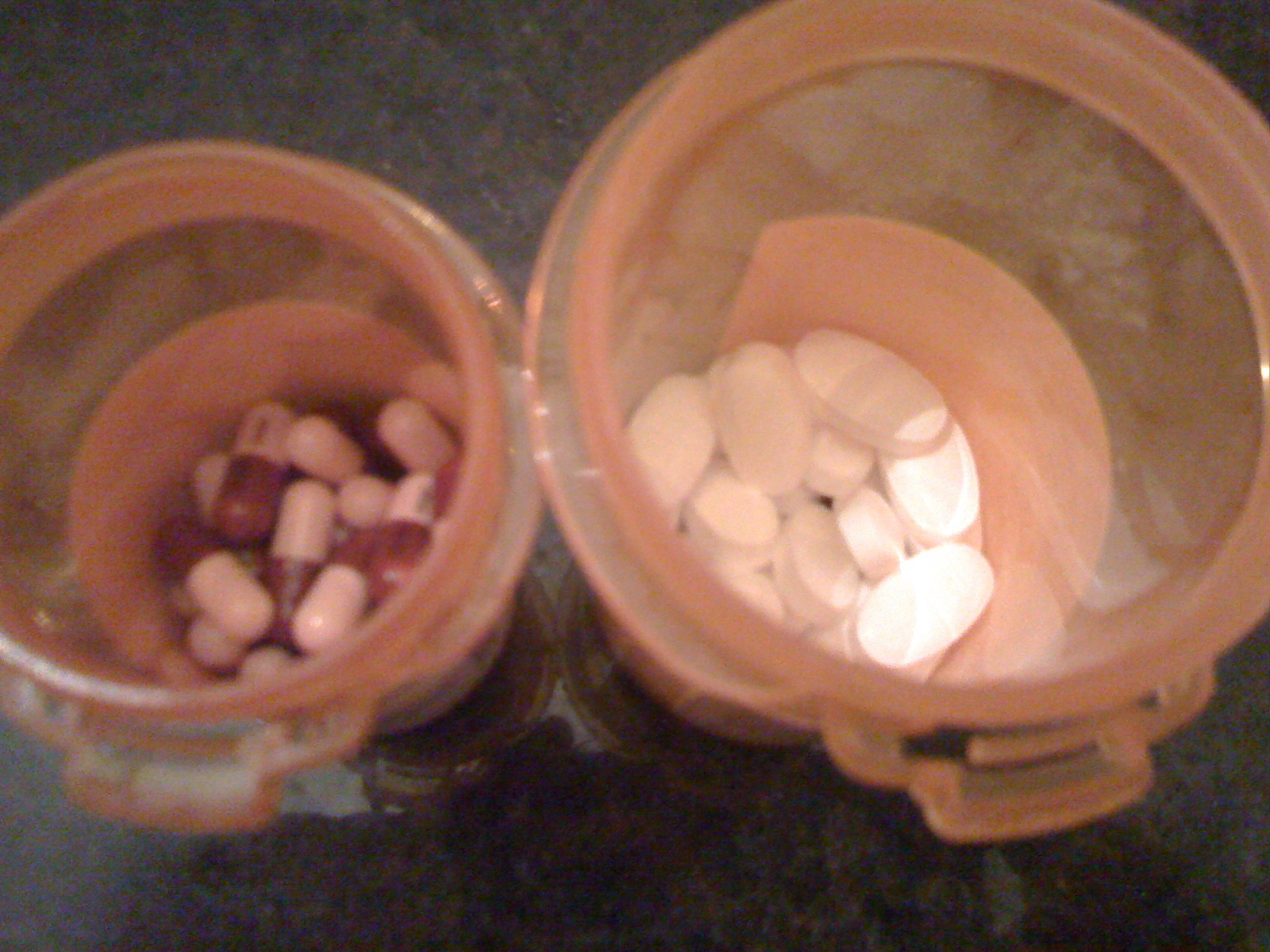 So my doc asked me the other day if I’m still taking my antibiotics.
Really?
Did those words really come out of his mouth? Why, I oughtta…
Yes, I’m overly sensitive about this issue, because I hate the antibiotics so much. Love that they’re killing the infection, but hate them nonetheless.
Yes, I am still taking my antibiotics. Twice a day, every day. With no end in sight. I haven’t missed a dose, I say proudly, although no one seems to think this is a worthy feat. Sometimes people need a quick left jab, right to the kisser.
Not that I’m complaining. Really, I’m not. I’m glad that I have these drugs in my life. Who knows where I’d be (or whether I’d be here at all) without them. I’ve been on some form of antibiotics since May 13, with just one week off.
There was the precautionary IV dose during and after the mastectomy. Then an oral course at home for the first 10 days out of the hospital. Once I started feeling better, an additional course seemed superfluous. Wasn’t I healing like a rock star, even ahead of schedule in my typical impatient, over-achieving way?
Uh, yeah. So much for that.
Infection: enter stage right and become the star of the show.
Damned mycobaterium has become the bane of my existence. I hate it like I hate Sarah Palin. I wish she would have gotten the myco instead of me. Surely she could have picked it up in one of those mountain streams she claims to ford as she’s impaling innocent salmon. I’d like to see her be all cocky and try to “reload” in the midst of the myco.
But again, I digress.
That happens a lot.
I can’t blame it on “chemo brain,” but I’m going to blame it on “abx brain.” Surely the continual supply of Bactrim and Minocycline in my body all day every day for the last 169 days qualifies me for that small disability.
Yes, that’s right, I counted the days. I like to know just exactly how long I’ve been taking these two drugs, twice a day every day. I also take a dose of Florastor probiotic twice a day every day. The few times I’ve been lazy or resistant to shoving yet another pill down my throat and skipped it, I’ve been sorry. I owe a big debt of gratitude to Susan C. for recommending the Florastor, and if you’re they type who gets an upset tummy while on your week’s worth of Amoxicillin, you should take it too. I typically have a cast-iron stomach, but the 169 days of oral drugs combined with the myriad variations in the hospital, then shaken not stirred with the little bits of good drugs (e.g., Vicodin) thrown in for grins has given rise to a need for Florastor. 
Here’s the cast of characters now: the blushing beauty in the bi-colored pink is Minocycline. It’s a member of the tetracycline family, which a lot of people–mostly teens, I guess–take for acne. In fact, one of the many Walgreens pharmacists I’ve gotten to know asked me if I take it for acne. I chuckled and said no, why? And she said, “because your skin is really clear, so I thought it must be working.” I may suffer from hot flashes, mood swings and brittle hair but by golly my skin is clear. I like that pharmacist a lot.
I’ve been trying to be very vigilant about taking my meds properly, rather than tossing them back and washing them down with a flute of champagne. Or two. Or three. Hypothetically speaking, that is. I’d never do that for real.
I’ve even read the literature that comes with the drugs from the pharmacy. Talk about a giant mess of C.Y.A. Take this little gem for the Minocycline: “Take this medicine with a full glass (8 oz/240 ml) of water” (not champagne?). I like the idea of 240 ml of bubbly. “DO NOT LIE DOWN for 30 minutes after taking this medicine.”
Well, I admit it’s been a while since I’ve read this info. Like 169 days, probably. And in my “abx brain” haze, I didn’t remember the DO NOT LIE DOWN part. Every night, I mean every single night, I gulp down the drugs with a sip or two of water, which is by my bedside, then I promptly LIE DOWN AND GO TO SLEEP. Oops. If my failure to NOT LIE DOWN means the Minocycline isn’t working, I’m going to be really mad.
This part of the Minocycline’s instructions is particularly vexing: “DO NOT TAKE THIS MEDICINE with food or milk unless otherwise directed. This medicine is sometimes taken with food or milk, however, certain medicines, food and milk may bind with Minocycline, preventing its full absorption.”
What’s a girl to do — take it with food or milk, or not? I don’t like instructions that include “sometimes.” I prefer black & white directions.
Here’s one part of the Minocycline instructions I can willfully and completely ignore, though: “THIS MEDICINE IS EXCRETED IN BREAST MILK. DO NOT BREAST-FEED while taking this medicine.” Ok, I won’t. I promise.
After you’ve finished laughing uproariously, as I did when I read this, let’s move on to the second antibiotic, Bactrim. This big guy is a member of the sulfameth family. Sadly it has none of the desirable characteristics of meth-derived drugs like increased energy, decreased appetite, effortless weight loss and eternal youth. 
It’s just a big, nasty, chalky pill.
Here’s a handy little graphic to show you just how big and just how nasty it is.
Twice a day, every day. For 169 days and counting.
It’s not without its humor, though. An excerpt from Bactrim’s monograph made me laugh again: “DO NOT STOP OR START any medicine without doctor or pharmacist approval. Inform your doctor of any other medical conditions including liver or kidney problems, blood problems, asthma, HIV, allergies, pregnancy or breast-feeding.”
Those last two made me chuckle, and I felt safe in crossing those off my list of things to worry about. Onward.
Bactrim, too, is picky about how you take it, and the monograph advises taking it not only with a full glass (8 oz) of water, but to also drink several additional glasses of water daily. No indication of how many ounces those glasses should be, though, and not a mention of milliliters to be found. Curious. I’m just glad it doesn’t yell at me to AVOID TAKING THIS MEDICINE WITH A FLUTE OF CHAMPAGNE. That would be depressing.
Here’s the best part of the nitty-gritty details of Bactrim, and I quote, “LONG-TERM OR REPEATED USE of this medicine may cause a second infection.”
Pardon me?
Did that really mention a second infection?
Excuse me while I go get some champagne.
This caught my eye
Posted: January 17, 2011 Filed under: breast cancer | Tags: breast cancer, champagne, crystal light, fountain, Houston, infection, lemonade, Mom, real world, reconstruction, recovery, yellow sundress 3 CommentsI was flipping through a magazine at my Aunt Sophia’s house last night and an ad for Crystal Light caught my eye. I like Crystal Light, especially the orange and the pink lemonade. I don’t drink a lot of it, though, because I’ve always assumed that it’s full of chemicals, and someone in my shoes needs to avoid all those multi-syllabic chemical compounds found on ingredients lists.
But if I am going to splurge on something chemical-y, Crystal Light is top of my list. Even more so now that I saw this ad. 
What first caught my eye was the communicated bliss of the woman drinking from the lemonade fountain, and my first thought was how much I’d love to have a champagne fountain like that. Mmmmm.
My bliss would be endless. Limitless. Bottomless, as all good champagne fountains should be.
I also noticed the woman’s dress. I never really liked yellow, but it was my mom’s favorite color, and now that she’s gone, yellow reminds me of her. Very fitting, as she was a sunny, warm kind of person.
So this ad is pleasing to me for several reasons, but the most important one is something you may not have even noticed. Or maybe you did. It took me a sec, but once I noticed it I had to look closer to see if what I thought I was seeing was really there.
Or not there, as the case may be. Look closer: 
Notice anything about her chest? Like the fact that it’s flat? Really flat.
I like this gal, a lot.
And I really like a company that is bold enough to feature an ad showing a woman with a flat chest. A really flat chest. Like mine.
I’m guessing the woman in the ad didn’t come by her flat chest in the same manner I did, i.e., I bet she didn’t have a double mastectomy. Mainly because mastectomied women aren’t in real high demand for ad campaigns. But maybe Crystal Light is changing that. Slowly but surely chipping away at societal ideals of what a model looks like.
Real-life women come in all shapes & sizes. It sure was nice to see a woman in an ad who does, too. I think I’ll go whip up a big pitcher of Crystal Light.
Healer
Posted: January 7, 2011 Filed under: breast cancer, literature | Tags: blog, body, book review, books, bra, breast cancer, Carol Cassella, champagne, DCIS, healing, hospital, infection, invasive, mastectomy, miracle, post-mastectomy, reconstruction, recovery, survival, Texas 4 CommentsThe body is a miracle, the way it heals. A factory of survival and self-repair. As soon as flesh is cut, cells spontaneously begin to divide and knit themselves into a protective scar. A million new organic bonds bridge the broken space, with no judgment passed on the method of injury.
Wow. That’s pretty prose. I wish I had written it.
I’d love to claim it as my own, but that would be wrong, and Lord knows I need the great karma wheel to turn my way. I can’t afford to tempt the gods of fate, as they seem to like toying with me.
Carol Cassella wrote that prose. If you’re a fiction fan and don’t know her work, I encourage you to get her books sooner rather than later. Whether you run to the bookstore or download onto your e-reader, get on it. You won’t be sorry. She’s an anesthesiologist-turned-author whose first book, Oxygen, is one of my all-time favorites. Her second book, Healer, wasn’t quite as good but I gobbled it up in hopes that it would be. I liked her right off the bat, because she’s a Texas native and a Duke graduate. A girl after my own heart. She’s also the mother of two sets of twins (!) and how she got anything done, much less wrote 2 bestsellers, is a mystery to me.
I read Healer this summer, while I was trying to heal. I was struck by the passage above, and loved how dramatically it introduces the book. From the very first sentence, I was hooked. While I certainly didn’t set out to turn this blog into a space for book reviews, sometimes things happen that way, and I’m an equal-opportunity blogger, so there we are.
As a physician, Cassella understands the intricacies and magic of the human body. As an author, she’s able to capture that and express it so that someone like me, an impatient patient, can read it and say, yeah, that’s right–the body is a miracle!
I needed that reminder. I was so focused on wanting my healing to occur faster, I didn’t realize that the fact that it was happening at all was amazing.
Equally amazing is the education this experience (e.g., the “cancer journey”) has provided. I’ve learned a bunch of lessons I never wanted to learn, such as how utterly unfair life can be. I’ve acquired skills I never thought I could and hope to never have to use again. Anything involving packing a wound or administering IV drugs at home falls into that category.
I’ve certainly learned a new vocabulary. Not just the new definition of “normal,” either. Things like nosocomial (originating in a hospital, as in a nosocomial infection). Like debridement (removal of foreign material or dead tissue from a wound in order to promote healing). Like aromatase inhibitors (drugs like Tamoxifen that lower estrogen levels in the body by blocking aromatase, an enzyme that converts other hormones into estrogen). Like oophorectomy (surgical removal of the ovaries).
I’ve learned how to get a good night’s sleep in a noisy hospital. I’ve learned the difference between DCIS (ductal carcinoma in situ) and invasive breast cancer, and that they’re both plenty scary. I’ve learned that an injection can leave a bruise for close to 3 months. I’ve learned that the practice of medicine is both a science and an art. And I’ve completely forgotten what it feels like to wear a bra.
Dear Santa,
Posted: December 22, 2010 Filed under: breast cancer, cancer fatigue, drugs, food, infection, kids | Tags: Bactrim, baseball, Biaxin, bloodwork, bone scan, BRAC, breast cancer, cancer diagnosis, Cefapime, champagne, Christmas, Christmas list, Cipro, collection agency, CT scan, dogs, ER positive, flat chest, genomic testing, good girl, health insurance, HER2 negative, home health, hospital, Houston, infection, infectious disease, injections, IV antibiotics, kids, L-Dex, lymph nodes, mastectomy, minocycline, MRI, PET scan, plastic surgery, post-mastectomy, PR positive, Santa, survivor, tamoxifen, Vancomycin, wound care, wound vac, x-ray, Zyvox 4 Comments I’ve been a pretty good girl this year. I’ve smiled at fussy babies in checkout lines at HEB. I did my time at the grade-school class parties (not my scene, to say the least). I called the collection agency back — yes, I really did — when they left me a message saying I owed money on a past-due hospital bill that my insurance company says has been paid. I donated nearly-new clothes & home goods to charities multiple times. I helped out with the school fundraiser, even though I really, really, didn’t want to. I’ve said please and thank you and bring my own bags. I was a big girl and good sport about all the trips and baseball games I missed this past summer.
And while we’re on the topic of this past summer, dear Santa, do ya remember all the hell I went through? It all started on April 27, 2010, when I was diagnosed with breast cancer. Talk about an “aha” moment. The timeline quickly unfolded like this: the rest of April and first part of May were consumed with tests, tests, and more tests: BRAC analysis, CT scans, x-rays, PET scan, bone scans and MRI. In case that’s not enough acronyms for ya, there was also the L-Dex and then the genomic typing of ER/PR positive and HER2 negative. More injections and blood draws than my poor left arm’s veins could keep up with (literally; there’s a permanent knot in the big vein). Countless appointments with the breast surgeon (Dr Dempsey, who is on the “nice” list) and plastic surgeon (Dr S, who may be on the naughty list), and 3 different oncologists.
Meanwhile, there was research to be done and crushing decisions to be made as I prepared for surgery. The phrase “life and death” took on a whole new meaning, sweet Santa. There’s a strange juxtaposition between packing school lunches and signing field trip permission slips while also filling out my medical directive and living will. I learned pretty fast how to act normal when everything around me had been turned upside down. I think, dear Santa, I also did a pretty good job of adjusting and adapting to the new normal. I think, fat man, I’m still doing a damn fine job of that. One quick look at my profile tells you that there most definitely is a new normal around here.
Santa baby, I was a good girl after the double mastectomy and the lymph node removal that left me battle-scarred and weary. I was an especially good girl in the face of the plethora of prescription drugs I could have used & abused. I was a diligent girl when it came to choosing green drink over Diet Coke, all-natural hormone-free yogurt over Blue Bell.
Santa, I was a brave and good girl when the nasty infection set up shop in my still-raw chest wall. I endured the 103-degree fevers, 22 days in the hospital, multiple tissue excisions and untold poking & prodding without much complaint. I missed the comforts of home, my dogs & my kids more than words can say, but I only cried twice. And even then, it was when no one else was around to see.
We don’t even need to recount the 18 days during which I was attached to the wound vac 24-7. I would really like, dear Santa, to permanently erase that memory from my grey matter, por favor. But I would like to remind you that I was a trouper during the home health days, and all those hours that were consumed with wound care and the administration of IV antibiotics. And while I’m at it, can I get a little shout-out for not killing Dr S, even though he probably deserved it?
Oh Santa, I do crave some credit for all the antibiotics I’ve endured — and continue to endure. From the Vancomycin to Cefapim, from the Cipro to the Zyvox, from the Biaxin to the Bactrim and Minocycline. Those last two will be part of my daily routine for a few months yet, but I’m already looking forward to the day in which I don’t have them on my kitchen counter anymore.
So Santa, how about we make a deal? I’ll set out all the milk & cookies you want in exchange for one little thing. All I want for Christmas is to have it easy for awhile.

 The Pink Underbelly