I’m expecting a big fat “rejected!” notice
Posted: September 21, 2011 Filed under: breast cancer, cancer fatigue | Tags: cancer diagnosis, life after breast cancer, life insurance and cancer, mastectomy, post-mastectomy infection, psychological effects of breast cancer, young women with breast cancer 9 Comments Trevor is trying to get life insurance on me. I’m sure that should make me nervous on some level; however, I think he knows that even on my worst day, his life is a bit easier with me in it. Right?? Right??
Here’s what’s funny: I had to fill out a bunch of online forms, knowing I don’t have a snowball’s chance in hell of being accepted. It’s ok, I have really thick skin. I don’t worry too much about rejection.
The online application has a big section on heath issues, conveniently divided up into categories: physical exam; common conditions; skin, hair & nails; musculoskeletal; women’s health; and “other.”
I’m sure I would pass the physical exam, as long as they give partial credit for having partially finalized body parts. The common conditions section included questions on whether one has had problems with things like colds, flu, allergies, as well as kidney stones and appendicitis. Since when did the latter two become common? I hope I never have either.
The skin, hair & nails section sadly had nothing to do with how fastidiously or fashionably maintained one is. I would pass with flying colors on exfoliated, moisturized, and sunblocked skin, as well as highlighted hair and a nice mani-pedi. But no, they want to know about boring stuff like shingles and psoriasis.
Musculoskeltal was a little more interesting with queries about back pain, bone spurs, fractures, and plantar fasciitis. No, yes, yes, and yes. That was easy.
Women’s health dealt with exactly what I’d expect: birth control, menopause, hormone replacement therapy. In other words, some of the most depressing topics on the website. No need for birth control when you’ve been thrown into early menopause. The baby-making department has not only been downsized but is out of business and closed for good. Menopause? Yep, in spades. Every symptom under the ‘pause banner got a big, thick checkmark from me. Hormone replacement therapy? No chance. The damn hormones fed my cancer machine, so there’s no way I’m going to replace them. Not even if they begged me to come back. 
The “other” section inquired about a smorgasboard of topics: concussions, cycts, hernias, and plastic surgery. Hmmm, seems strange to throw the plastic surgery one in there. I can’t wait to tell Dr S that his exalted specialty is lumped in with such ordinary things. 
After checking the boxes and reading the laundry list of symptoms and conditions, I had to give specific detail about any “health concerns.” This is where I’m expecting the giant red “rejection” stamp to hit. The questions:
“#1. During the past three years, have you for any reason consulted a physician(s) or other health care provider(s), or been hospitalized? #2. Have you ever had, or been treated for, any of the following: heart, lung, kidney, liver, nervous system, or mental disorder; high blood pressure; stroke; diabetes; cancer or tumor; drug or alcohol abuse including addiction?”
No amount of creative writing or playing fast & loose with the facts is going to help me here. During the past three years, I have indeed consulted a physician(s) or other health care provider(s) and been hospitalized. Further, I have indeed been treated for cancer or tumor; the jury is still out on the mental disorder and the drug/alcohol abuse issues. I’m thinking those could go either way. 
The phoenix
Posted: September 15, 2011 Filed under: breast cancer, cancer fatigue | Tags: body image after breast cancer, cancer fatigue, DIEP flap, psychological effects of breast cancer, reconstruction, revisions to breast reconstruction, uniboob, young women and breast cacner 10 CommentsYesterday’s visit to the doctor was the usual highlight of my day. We laughed, we sparred, we talked about my new Fiat, and I once again stood buck-naked in front of his omnipotent eyes for my three-week post-op checkup. Here’s where it got interesting: I told him that while I appreciate his valiant efforts in the OR, I’m not happy w the results. Shape, size, asymmetry, bumpiness…. I’m sure I wounded him deeply, but had to get it out there. And of course, it goes without saying that I’m not dissatisfied with his work, quite the opposite, but with the ongoing, multi-step drudge that is reconstruction.
I asked about options if the fat transfer doesn’t yield good results. It’s a relatively new procedure and data is scarce, so it’s hard to predict the final results. But I need options. Can he suck out the fat he’s transferred? Can I go back to being totally flat-chested? Because honestly, I’d rather be flat as a board than have an elliptical uniboob. The cleavage line looks great, but only from a distance, and I’d sacrifice it to get back to the point of being satisfied with my chest.

photobucket.com
I know it’s hard for a plastic surgeon to grasp that a woman in the USA doesn’t want the biggest knockers she can possibly get, but I keep hammering away at the fact that I am indeed that woman. I’m all for a curvy silhouette but do not want big boobs.
To fix the aspects I’m dissatisfied with, we need to inject more fat, which results in a bigger bust. I don’t want that. I’ve said from Day One that I don’t want that. In fact, I think my exact words to the doc in my consultation right after diagnosis were “If I wake up from surgery with DDs I will kick your teeth in.” Direct quote. In fact, I need to get him a little pillow for his office couch with that message needle-pointed on it. That, and my other recurring message to him, also uttered at that first meeting: I know I’m not your only patient, but I’m your most important patient. I have threatened to get that needle-pointed for him, too.

 All this talk we Cancerchicks hear about how lucky we are to get new boobs is utter horseshit. I’m on the record saying that is a humongous load of crap. I was perfectly satisfied with my pre-cancer body, and there’s not one thing I can name that is better now. Ok, except for the absence of the tumors that would have eventually spread and killed me. That part is definitely better. And I’m no longer afraid of needles. Having been poked and shot up more times that I could ever count, and with a boatload of port flushes and blood draws and monthly B12 shots and quarterly Lupron shots and injections for scans ahead of me, I don’t even flinch anymore. Not even the thought of a 20-gauge needle piercing my skin and extracting my lifeblood scares me anymore. But conquering the fear of needles doesn’t really count as a way in which my body is better after my cancer “journey.”


Pink ribbon club, celebrity style
Posted: September 13, 2011 Filed under: breast cancer | Tags: Andrea Mitchell, cancer battle, cancer diagnosis, celebrities with breast cancer, John Lennon, psychological effects of breast cancer 9 CommentsNBC Chief Foreign Affairs Correspondent Andrea Mitchell is the latest public figure to share the dreaded news with the world: she’s been diagnosed with breast cancer. She announced her diagnosis and her “terrific prognosis” on the air last week.
Mitchell no doubt shocked her viewers when she said, “I had planned to be hiking in Wyoming last week, but instead discovered that I am now among the one in eight women in this country–incredibly, one in eight–who have had breast cancer.”
She seemed to stumble a bit on the words “who have had breast cancer,” perhaps because the news is relatively new for her and like most people who receive such a shocking diagnosis, her brain was still working hard to process the reality.
I’m not going to comment on the verbage she chose and my objection to the past-tense idea that she had breast cancer. My Cancerchick blogger friends have covered it more succinctly than I could, and while I think Mitchell is a little kookoo for assuming her cancer “journey” is over so soon after it began, one thing I’ve learned on my own long, involved “journey” is not to judge a fellow Cancerchick. Just as I learned firsthand that no one has a right to tell anyone else how to grieve (and if you try it, I will punch you in the brain), I believe that every Cancerchick has the right to conduct her “journey” however she sees fit.
Some of us are loud & proud with the disease and want everyone to know about every twist, turn, and detour on the “journey.” Some are guardedly private and keep everything quiet. Some go kicking and screaming into the OR, radiation suite, and infusion room. Some arm themselves with all the latest research and become fonts of useful information for other Cancerchicks. It’s very personal, and as varied as cancer’s victims are, so too are their responses to it.
I admit that as much as I hate to hear about one more woman joining the pink ribbon club, part of me feels a little less than compassionate toward Mitchell and her diagnosis. She’s 64 years old — more than 20 years older than I was when diagnosed. As far as I can tell, she has no kids — and if she does, they’re old enough to understand this breast cancer mess. I’m pretty sure she’s not juggling homework and the care & feeding of young kids while also battling the beast.
As for Mitchell’s other plans, to be hiking instead of hearing words that will forever change her life, I have one piece of advice: get used to it. As the sage John Lennon said, “Life is what happens while we’re busing making other plans,” and cancer has a crafty and crappy way of infringing on those plans.
Me, I was busy living an ordinary suburban life, packing lunches, driving carpool, and running my kids to baseball and tennis when I wasn’t on the tennis court myself. I admit I had no aspirations to hike in Wyoming. I’d spent many an hour volunteering at our elementary school and was contemplating other ways to give back to my community. A perfectly ordinary life, some days better than others but most filled with laughter, good friends, and happy times.
Once cancer picked me in the great genetic lottery, much of that perfectly ordinary life changed. All of my brain power was rerouted to disseminating this terrible information, researching options, facing the hard truths, and making a plan to conquer this vicious beast. I started a Caring Bridge journal to keep my friends & family informed, and remember writing this one week after my diagnosis:
“Today the exhaustion has set in, and the strain of keeping up with my regular life and taking on this new job of facing cancer has hit me hard. Nothing a cold bottle of Piper Sonoma can’t fix, but I truly feel like I’ve been hit by a truck. I’m fixin’ to get into my jammies and climb into bed. Today is one week to the day of diagnosis, and it feels like I’ve run a marathon. Maybe two.”
I hope Andrea Mitchell has a good pair of running shoes. Even in her caught-it-early optimism about the battle that is breast cancer, even with “a terrific prognosis,” the race is long. I do hope that Mitchell is correct in her prediction and that she’s able to get rid of her cancer “in one fowl swoop” as my sweet friend Paula’s 12-year-old son Boyd said about my cancer. But I also hope she knows that in this cancer “journey” there are lots of twists & turns along with many, many detours that test one’s patience, zaps one’s strength, exhaust one’s resources, maim one’s body, and stress one to the max.
Sausage casing
Posted: September 8, 2011 Filed under: breast cancer, cancer fatigue | Tags: breast cancer in young women, breast cancer reconstruction revision, Medena compression garment, psychological effects of breast cancer, side effects of reconstruction 6 CommentsIt’s been 2 weeks since my revision surgery; the good news is I’m healing. The bruising that I subjected y’all to seeing is much, much better thanks mostly to my stellar lymphedema and massage specialist, Tammy. She did some manual lymph drainage on my bruised areas Friday, and by Sunday the bruising was almost gone. For real. The bad news is that the healing is ongoing. Why is that bad news? Because I’m impatient, man, and I’m ready to be done with this stage so I can get back to my regular life — albeit temporarily, in between revisions — and pretend to be a normal person who’s not affected by cancer.
Yes, I know, I’m far from normal. And yes, I know I’m waaaaaay affected by cancer. And furthermore, I know it’s never over. But I’m impatient nonetheless.
In addition to being an impatient patient in general, I’m so super ready to be done with this latest round of healing for two rather large reasons: it’s perfect weather for tennis, yet I can’t play; and I’m sick to death of the compression garment.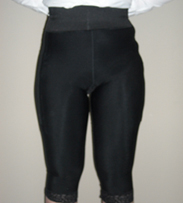
This is what mine looks like — although that’s not me in the photo; it’s someone from googleimages. My garment, which I refer to as sausage casing, comes up higher beyond my waist and goes down lower. It’s basically a thick fabric (mostly spandex but way thicker than workout clothes) with a 4-inch-wide waistband that sits just under my newly plumped breasts and ends mid-calf. It has a zipper on each leg that extends from mid-thigh to the top of the waistband, and multiple hook & eye closures under the zipper. Lovely, huh? I’m not sure which is worse, the fact that it is HOT or the fact that I have to wear it 24/7. It’s still summertime in Houston, with highs in the mid-90s. The sausage casing is not a warm-weather accessory. Both of those facts are sucky to the nth degree.
What’s the purpose of the sausage casing, besides an instrument of cruel & unusual punishment for the unlucky recipient of random gene mutation that causes breast cancer in an otherwise healthy 40-year-old woman? That’s a question I’ve pondered a lot over the last 14 days. The last LONG 14 days.
The theory is that the sausage casing reduces movement of the skin that’s been traumatized/sliced & diced/sucked out/reallocated, et al. Ideally, the skin needs to stay in a compressed state and it needs to avoid any unnecessarily movements, because unnecessary movements can affect internal wounds and get in the way of healing. The garment also decreases swelling and promotes the flow of blood and lymph fluids, working to move the yucky stuff (blood from the massive bruising and other toxins) out of the body.
That’s all well and good, but let me tell you people, the sausage casing is not comfortable. Not one bit. It’s HOT (did I mention that??) and while the spandex helps it look and feel sleek and soft, it’s still thick and tight. It also irritates the back of my knees when they bend, and sometimes it bunches up like old-lady pantyhose and has to be yanked and tugged back into place. I try not to do that in public, but sometimes I can’t stand it. The damned thing is snug enough that one spot on my right hip is caved in (see the right hip area in the photo above). Yep, caved in. And yes, it can be permanent. Dr S was a little concerned about it during my visit yesterday, and if he’s concerned, so am I. He had a solution, of course, but I’m still a bit concerned. His solution? Extra padding, because the sausage casing isn’t enough to deal with. So now, in addition to the sausage casing and its bulky zippers, I have a wad of soft cotton stuffed in the casing, between my caved-in skin and the second-skin of my garment. The wad of cotton shifts around a bit, so I’m constantly having to adjust it to make sure it stays between me and the point of the garment that is caving me in. This means that I’m not only yanking and tugging the sausage casing, I’m reaching in over the waistband to rearrange the wad of cotton. I know, it’s mesmerizingly attractive, right? Stop the ride, I want to get off. Enough already.
I guess it could be worse — I could have the sausage casing on my face:
The penguin and the polar bear
Posted: September 2, 2011 Filed under: breast cancer, cancer fatigue | Tags: cancer battle, courage, e.e. cummings, Mary Ann Radmacher, psychological effects of breast cancer, young moms with breast cancer 8 Comments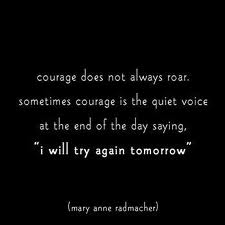 Someone very nice sent me a card with this message a while back. I enjoyed the simplicity of the words: matter-of-fact and purposeful without being overly froufy or cheesy. I wasn’t familiar with Mary Anne Radmacher but liked her message enough to find out if she was someone with whom I should be familiar.
She and I have something in common: we love words. On her website, she says: “i have a history of fascination with words, starting from a very young age. my writing reflects philosophies inherent to my being. these include: a commitment to passionate, intentional living; valuing wellness; and embracing the moment.” (she also writes in all lower-case letter, like one of my favorite poets, e.e. cummings.)
I was afraid she was going to get all touchy-feely on me — something I really don’t like, but she reigned it in. I’m so glad. Because I really like her statement on courage, and it’s something I’ve been thinking about a lot lately during recovery mode. This last surgery was harder than I expected, and the recovery has been way more arduous than I imagined. Knowing that this surgery isn’t the last one is rough as well, but I’m trying to be a brave little soldier.
I’ve always equated courage with bravery. To me they go hand-in-hand and seem like very good friends, and they also seem like something one is born with but can develop. Being diagnosed with cancer at a young-ish age is a challenge that draws on all of one’s resources, and courage is at the top of that list. During this “cancer journey” I’ve had a lot of people say things like “You’re so strong,” and “I don’t know how you do this,” and “I’m not sure I could do it.” While I’m very appreciative of the support, being strong or being able to “do this” isn’t for me an acquired skill or a specific endeavour. It comes down to a very simple fact: whether you’re strong or weak doesn’t matter much in a cancer battle. The cancer will do what it’s going to do, and curling up into a little ball isn’t going to make it stop.
Courage, however, does play a role. Not so much in the facing the bad news or dealing with the endless heaps of unpleasantness that comprise a cancer battle; that’s more a question of strength and endurance. Research. Appointments. Decisions. Testing. Pain. Fear. Worry. Medical bills. The heaps are indeed endless. While it certainly does take strength to face a diagnosis, the fact of the matter is that you will hear the doctor’s words and you will see the summary on the pathology report whether you do so with eyes wide open or while sobbing uncontrollably. You will deliver the most unwelcome of news to your circle of friends and family the same way: with a quiet strength or in hysterics. The message you hear and relay — that you have cancer — is the same regardless of how strong you are. While curling up into the fetal position upon diagnosis definitely is an option, it doesn’t change the message. Perhaps it buys you some time, but the message remains the same. Living with that message and putting its effects into play takes courage.
Fever-free, finally?
Posted: August 31, 2011 Filed under: breast cancer, cancer fatigue, drugs, infection | Tags: Houston medical center, infectious disease, long-term antibiotics, Maria Pace-Wynters, post-mastectomy infection, psychological effects of breast cancer 7 CommentsYesterday was the first day since my surgery–exactly one week ago–that I didn’t have a fever for most of the day. I wasn’t exactly fever-free, as my temp peaked at bedtime, but that’s the best it’s been for one very long week, so I’m claiming it. After coming this close to needing IV antibiotics — again — I’m beyond thrilled to have been (mostly) fever-free yesterday. I’m guessing that the docs in my life would laugh a little, shake their heads, and maybe massage their temples a bit at me claiming yesterday as fever-free. I’m guessing my friends in the white coats would consider my being almost fever-free akin to being a little bit pregnant–it’s an all-or-nothing condition. That’s fine. They can chuckle and shake their heads at me, I’m still claiming it as a victory.
See, fever can indicate infection, and after my surgery last week, the fear of recurrent or new infection abounded. That fear was thick in the OR and it was pervasive in the days after surgery as we waited to see what would happen. It’s still lingering, in the back of my mind and on the fringes of my daily activities. I’m not a big fan of that loss of control. We did increase my course of oral antibiotics — both in duration of course and milligrams per dose. The usual suspects in the roster of awful side effects are back, but that tells me the abx are working. If there was a niggling infection trying to re-establish itself, the mounds of abx I’ve been taking for the last 7 days have contained it. I’m almost afraid to say this out loud, but I think I’m out of the woods.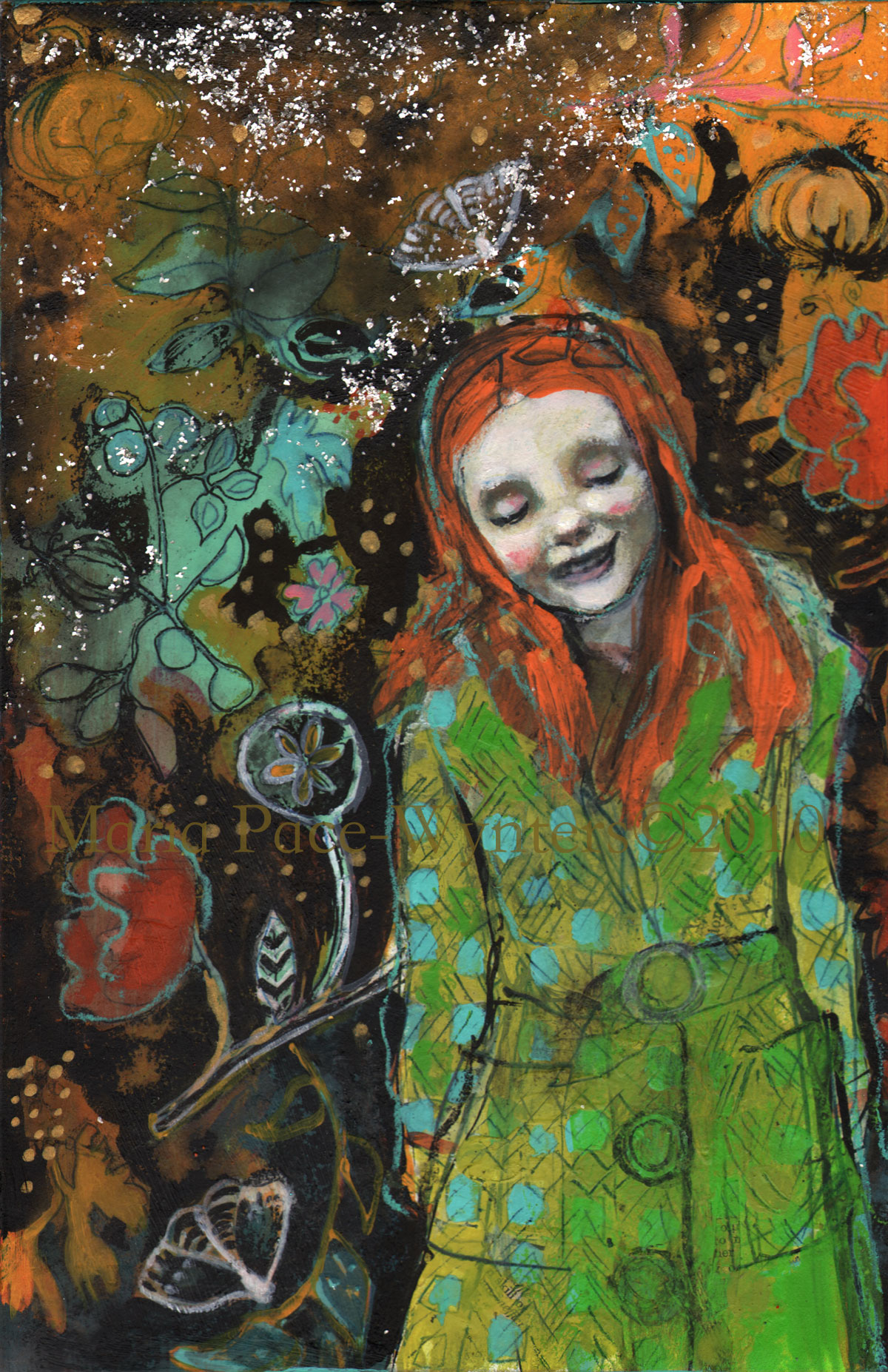
Can it be? Like the joyous girl in the gorgeous Maria Pace-Wynters art, coincidentally titled “Out of the Woods,” I want to smile big and enjoy the view of the woods from the other side. I want to feel the relief that washes over me as I realize that the 6-day fever has broken, the pain & redness & swelling in the original infection site have abated, and I may be able to breathe easily now.
My infection-induced PTSD makes me wonder if I really can believe that the tide is turning, that I may be out of the woods. It’s been a long, long haul. A super-long haul. Reflecting back on the havoc that the post-mastectomy infection has wrought makes me very uncomfortable. I’m not yet in that happy place, and the calamity is not far enough in the rear-view mirror yet. Instead of feeling enormous pride, accomplishment, gratitude and general kick-ass-itude that it’s over, I’m gun-shy and untrusting.
This time last year, I was fresh out of the hospital, having just served day 27 of intermittent, back & forth hospital stays and at-home IV antibiotics. The last hospital stay to treat the infection was at Methodist in the Med Center, so I’d served time in 3 different hospitals–Memorial Hermann Southwest, Methodist Sugar Land, and Methodist Med Center–which allowed me to sample Houston’s best. I recall the direct-admit to the Med Center for the last stay, late on a Sunday night just before school started. Sweet Dr S had handled the details for me so I had a “fast pass” to get admitted quick, which allowed me to circumvent the circus that is a Med Center ER on a weekend night. Dr S and I were texting back & forth during the speedier-yet-still-complicated process so he would know that I was in the room before he had to get up and leave his family to come see me and get all of our ducks in a row.
I remember being furious about having to go back into the hospital. At that point last year, I’d been on antibiotics all summer, oral and IV, in every imaginable combination. Biaxin. Cipro. Minocycline. Zyvox. Vancomycin. Cefapim. Doxcycline. Bactrim.Vancanese. Levaquin. We were on the cusp of finding the magic bullets that would target the slow-growing and slow-to-kill infection (Bactrim & Minocycline), but it would take time to decimate the wily bacteria, so the infection still had the upper hand. As I settled into my room after navigating the maze that is Methodist Med Center, I was completely and utterly pissed at the ugly-ass artwork in my room. The shoddy impressionist landscape was hideous, the colors were barf-inducing, and the mere site of it reminded me that I was once again a prisoner — of my failing body and of yet another hospital. I couldn’t avoid that uproariously unpleasing “artwork” because it was in my face and I had nowhere to go to avoid it. That framed print became a symbol, a poster-child if you will, for all that had gone wrong last summer, and I was stuck staring at it. If I hadn’t been so ticked and so upset, I would have taken a picture of that “artwork,” and one day it will make me laugh instead of making me want to punch someone. But not yet.
Here’s what I wrote upon settling into that room; note the frustration surrounding the words that described the room but actually meant a whole lot more:
So I got through the masses in the ER pretty quickly and got into my room and thought, yuck, this place is a dump compared to my lovely one-bedroom suite at Methodist Sugar Land. Call me a snob, but I like those hardwood floors and new, unchipped paint. I don’t really need the laminated sign on the wall here reminding me not to leave my dentures on my lunch tray. The view out my dirty window is of a wall, with patient rooms too far away to spy into [one of my pastimes at Methodist Sugar Land]. The chair I’m sitting in to type this is vinyl, and there is a lovely faux-cherry-wood desk with ornate colonial drawer pulls. I could sit there, but the desk chair is super scratched with dingy upholstery on the seat cover. And don’t even get me started on the artwork on the wall across from the 20-year-old bed covered in ultra-scratchy sheets. No wonder people get sick in hospitals. It’s from the decor as much as the bacteria.
I was one unhappy girl.
I was coming to terms with the fact that the infection superseded the cancer in every way. For a while, that was a good thing — being so focused on the infection kept me from thinking about the fact that I was a 41-year-old mother of 2 young kids battling cancer. The cancer was easy compared to the infection. While a cancer diagnosis is one of the scariest things ever, the treatment for and eradication of that cancer was, for me, much more logical and linear than the infection. The cancer left me flat-chested, but once the tumors were removed and the lymph nodes declared clear, it was done. My game plan was defined: a 5-year course of Tamoxifen for adjuvant therapy along with hormone suppression to snuff the cancer’s fuel. The cancer battle was over and the treatment had begun, but the infection war hadn’t even revved up yet. Little did I know that more than a year later, I’d still be fighting that war, and that sometimes the infection would gain ground and force me to retreat.
The infection left me with a hole in my newly flat chest — literally. The excised tissue created a wound that measured 5.6 cm long and 3 cm wide. Grab yourself a ruler and feast your eyes on those dimensions. That bad boy took 8 weeks to heal, almost double the healing time required by my bilateral mastectomy. I’d faced my diagnosis, done my research, made the hard decisions, endured the systematic removal of both breasts, and was still standing. The infection, however, was a whole ‘nother ball game. There was no logic and nothing was linear — it was a guessing game. Educated guesses by a crack team of infectious disease docs, but a guessing game nonetheless. Will this combo of antibiotics work? How long will I need to stay on them? How will we know if they’re working? What are the side-effects of long-term abx therapy? Will I ever get my normal life back? The questions were many, the answers were few. I wrote this after one particularly frustrating day in the infection war:
All this talk you hear about being a pro-active patient, being your own advocate, researching and digging up as much info as you can and thinking for yourself — forget it. Today is one of those days that makes me wish I was a sheep. I just want to follow along and do what I was told. Except I can’t. It’s not how I’m made. So I continue to ask questions and solicit advice, all the while feeling like I don’t have all the puzzle pieces. Sometimes there are a few pieces missing, or you have to wait a while for them to fall into place. You can’t force it, although I want to. I am impatient and a forcer. An impatient forcer.
And I’m still waiting for the pieces to fall into place.
Meanwhile, I will feast my eyes on another gorgeous piece from Maria Pace-Wynters’s collection. This one is titled “Unseen Beauty,” and my eyes are open. 
Post-surgery, day 2
Posted: August 26, 2011 Filed under: breast cancer, Surgery | Tags: fat transfer, psychological effects of breast cancer, reconstruction, Versed 11 CommentsI sure would like to say that today is a lot better than yesterday, but I’d be lying. I’m still very, very sore, and moving around is pretty uncomfortable. I can’t see how bruised I am on my legs because I’m snugly encased in a compression garment. I joked with my doc yesterday that he and I know each other on a whole new level now, with the pre-op business. He looked slightly confused and I was greatly comforted to think that the “new depths of indignities” as Trevor put it, didn’t seem to register with the good doctor. I know now that when he sees a body, splayed out and nekkid, he’s seeing just that — a body. Not mine or yours or anyone’s specifically, just a body.
Whew. That’s a good thing, because he saw every bit of mine. Up close and in his face. Yikes. I thought we had plumbed the depths of indignities before, with the “grab the fat” games and the up-close examinations of the fattiest regions to determine where best to cull from in the reallocation surgery. Ha. That was amateur night compared to the real deal on the big day. Anyone who’s been thinking I am lucky to get “free lipo” may well reconsider after reading this. Do I need to deliver my lecture on opportunity cost, again?
Getting marked up for surgery is not new to me. Baring my chest for the doctors is old hat, as is the alcohol-y smell of the Sharpie markers they use to draw the roadmap for cutting and stitching, as well as the feel of the Sharpie sliding over bare skin. Lest this sounds like a Nora Roberts novel’s love scene, let me assure you there’s nothing sexy or sensual about it — if a doctor is drawing on your bare skin with a Sharpie, it means you’re in trouble. The kind of trouble that can only be fixed by scalpels and sutures. There’s nothing romantic about that.
So getting marked up Wednesday for my revision surgery should have been no big deal; been there, done that. Except this time it wasn’t just my upper body that needed to be bared, it was the whole thing. Since my doc was going to be extracting fat & skin from my hips and legs, he had to well, mark up my hips and legs.
Did I mention that the surgery center is under construction, and that as I went from my suite–where I changed into the gown, compression hose, and shower cap–to the triage room–where I would get my pulse and blood pressure taken and get a needle shoved into a vein in my hand to start an IV–that I had to walk down a hallway with my surgical gown tied not so securely in the back, with construction workers all up and down the hallway? I’m pretty sure part of my backside was hanging out, but really, at this point in my “cancer journey,” I can’t be bothered with such an insignificant concern.
I can, however, be very bothered by the utter horror of standing buck-naked in front of my good friend and beloved surgeon while he maps out his surgery plan via Sharpie. Always the jokester, I tried to keep the mood light and make jokes, but if I had access to an open bottle of vodka I would have chugged like a girl in the desert. Anything to ease the embarrassment of that moment.
After I stood up for the Sharpie fest, my doc wanted me to lie down so he and Katie the surgical nurse could check that the lines were even or whatever they check for. They did their checking and calculating, and my doc left me to go scrub in. The surgery was about to begin. Katie covered my nakedness with a gown and a blanket and went to scrub in herself.
Note I have not yet mentioned the “cocktail” that the anesthesiologist provides to relax the patient before administering the hard-core anesthesia to knock one out for hours at a time. I had of course inquired about my “cocktail,” multiple times during the Sharpie fest, in fact, and was told that I would get it in the OR because they needed to prep me for surgery standing up.
Pardon me?
Prep me standing up? As in, I’ll be awake for that part? I’ve envisioned the prepping required for all my surgeries, and before too many thoughts of my leaden, sleeping body being manipulated and scrubbed down enter my head, I quickly chase those thoughts off with thoughts of puppies and bunny rabbits instead.
This time, I was to be stone-cold sober and awake for that particular horror show.
Oh, the depths of indignities just keep on getting deeper.
Once everyone was scrubbed in, someone came to collect me. I walked from my cozy suite to the OR, probably with my ass hanging out for all the construction workers to see, and entered the last level of humiliation. In Dante’s Inferno, there is no mention of the level of hell that is being prepped for surgery while wide awake, but there certainly should be. There should also be some sort of extra prize for someone with a reconstructed body — full of scars and mess and reminders of the impossibly hard road that’s been traveled — who has to display that body in the presence of strangers in order to try and reclaim some semblance of normalcy. The two males in the room, besides my doc, did a good job of averting their eyes from the trainwreck that is my body while they counted scalpels and readied surgery supplies.
I was instructed to drop my gown and stand — buck naked — with arms and legs spread wide. Not sure what the yoga pose is but I’m going to call it shamefaced patient. Two nurses, Katie & Mary, and my doc himself, scrubbed me down with betadine swabs. Katie was nice enough to warm them first, and that small kindness went a long way toward soothing my jangled nerves. My favorite doc was on high-alert against any possibility of infection. Much discussion ensued between the 3 health-care providers about who was swabbing which area of my body, and let me tell you they were quite thorough in getting all the nooks & crannies. Once I’m finally allowed to take a shower I may be scrubbing for days. There were a few commands of “turn this way,” “raise your arm higher,” and ahem, “spread your legs a bit wider, please” as they doused me with the foul-smelling but surprisingly tan-enhancing liquid. I may be splayed out like a deboned chicken (again) for all the room to see, but at least I was golden brown.
Once they had slathered me in the betadine, it was time to get on the OR table. For every one of my previous surgeries, I’ve already been in la-la land when it was time to get on the table. I don’t know how they got me onto the table in the past, but I expect someone lifted me, because the anesthesiologist had mixed and administered the “cocktail”and I was out like a light. This time, I had to be wide awake and fully cognizant of the humiliation that had ensued.
That OR table is narrow, people, and the last thing I needed after my abject embarrassment was to slip off it, all goopy with betadine. My doc was very, very specific about the sterility of the room, the people, and the table, and insisted that Mary and Katie hold my hands as I got onto the table so I didn’t touch anything. The table is high and I am, well, not tall, so we had to use a stool. I managed to haul my carcass onto that high table without touching anything or falling off and was quite pleased with my effort when the anesthesiologist said I needed to scooch down closer to her, at the head of the table. Egads. More maneuvering and cussing on my part, then I was able to settle.
At last, the sweet relief from this latest horror show came in the form of the anesthesiologist finally giving me some Versed. I asked her to also give me something to make me forget all that had just transpired. Whatever form of mind-altering, memory-erasing drug will work, just give me plenty of it.
The Versed worked swiftly and completely, and I don’t recall a single thing beyond that point. I woke up in the recovery room, somehow stuffed into a compression garment but blissfully unaware of how that happened. I was released from the surgery center and delivered home, to bed, where I could pretend that this was all a bad dream.
All aboard the freak-out train
Posted: August 24, 2011 Filed under: breast cancer, Surgery | Tags: anxiety before surgery, DIEP, fat transfer breast reconstruction, liposuction, moms of young kids with breast cancer, psychological effects of breast cancer, the Big Dig 15 CommentsI’ve been slowly but surely freaking out about this surgery. I was all ready for it this time last week, but it was not to be. Having to wait a week because of pokey construction at the surgical center didn’t make me happy; I don’t like to wait in general, and on something this big and this important, even less. If there’s more than one person in line ahead of me at the grocery store, I consider that a long wait, so imagine what waiting a week has been like.
The wait is over and the day is here. I’m ready.
I prepared in numerous ways, including waking up multiple times each night; making myself half crazy with worry; imagining every possible way the dreaded infection could sneak back into my life; going overboard on stocking the house with groceries; meeting myself coming and going with laundry and errands; and cooking meals that my children won’t eat.
I also did the one things I really should not have done, and that I also did the night before The Big Dig, aka reconstruction: I watched the surgery on youtube.
No wonder I can’t sleep at night.
Why do I do this to myself? I know full good and well that watching that stuff is going to creep me out. Picturing my beloved doc doing those things while I’m sawing logs really creeps me out. I trust him with my life but hate to think of what he’ll be doing to me this morning. I’m gonna be one sore chica.
I scrubbed myself with Hibiclens this morning, to kill off any friendly or hostile bacteria living on my skin. You know your life has changed — and not for the better — when you have a bottle of the Hib in your shower (insert sad face here). 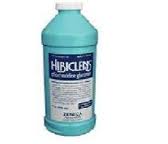
Here’s the game plan: I’ll show up at the surgery center at 8 a.m. without having had my daily cup of coffee or one bite of food since bedtime (I’m not very pleasant when I’m hungry; I’ll be the first to say it. And BTW, packing my kids’ lunches without being able to have one bite of food myself is cruel. There’s not much in their lunches I would eat anyway, but still). I’ll put on the hospital gown and shower cap, and possibly the compression hose. I’ll get marked up by my doc, which involves standing naked in a small room while he peers at and examines up-close the fattiest parts of my body; he’ll use a Sharpie to annotate the choice cuts that he’ll be removing, and I’ll try to slink into the OR with my dignity intact. I’ll endure the inevitable digging by the anesthesiologist and/or nurse anesthetist in a fruitless attempt to find a vein that doesn’t roll over and play dead; this usually involves multiple pokes and results in a giant bruise. I’ll watch the clock and wonder how much longer until they give me the shot that makes none of this hardship matter as I drift off into a heavy-limbed, blissful sleep. I’ll endure who-knows-what kind of horror show as my doc and his team manipulate and position my sleeping carcass to extract maximum fattiness. Some he will keep, and some he will throw away. The fattiness he keeps will be spun in a centrifuge to extract all the liquid. Then the liquid-free, pure fattiness will be injected into my sunken chest. I’ll wake up in the recovery room several hours later, trying not to barf and thinking how good it will feel to get home and leave the hospital stink behind. I’ll hope that I get home before my kids’ school day ends, and will hopefully, fingers crossed, please, please, please be one step closer to reaching the finish line and being done with the aftermath of breast cancer.
Fingers crossed.
Vaca starts today!
Posted: July 31, 2011 Filed under: breast cancer | Tags: cancer and young kids, cocktails on the beach, family vacation, Markey's lobster pound, psychological effects of breast cancer, Salisbury Beach 8 CommentsThis is it. Today’s the day. I’m leaving the heat & humidity of Houston behind for 2 weeks of balmy-but-not-hot weather and cool ocean breezes. My right-brained son pointed out a few days ago that I haven’t been to Salisbury Beach in 2 years. Duh. Of course I knew I missed the trip last year — was painfully aware in fact — but hadn’t thought about it in those terms. So it goes without saying that I have a lot of making up to do. A serious re-do is in order, and it starts today.
We’ve been making this trip for a lot of years. My kids looked like this when we started:
 We were much more bogged down with bulging carry-on bags to entertain these little guys on the 4-hour flight. Lugging diapers and endless snacks, as well as car seats, across the country while fretting about how to keep them still during the travel time.
Nowadays they’re much simpler (and thankfully out of diapers). They’re entertained by their iTouch or iPhone and can even load their own devices with songs and TV shows from iTunes. Now that’s progress!
We’ve been talking for days about hitting all our favorite haunts: Markey’s lobster pound, Dunlap’s ice cream shop, Willie’s candy store, the arcade, and of course Blink’s for fried dough.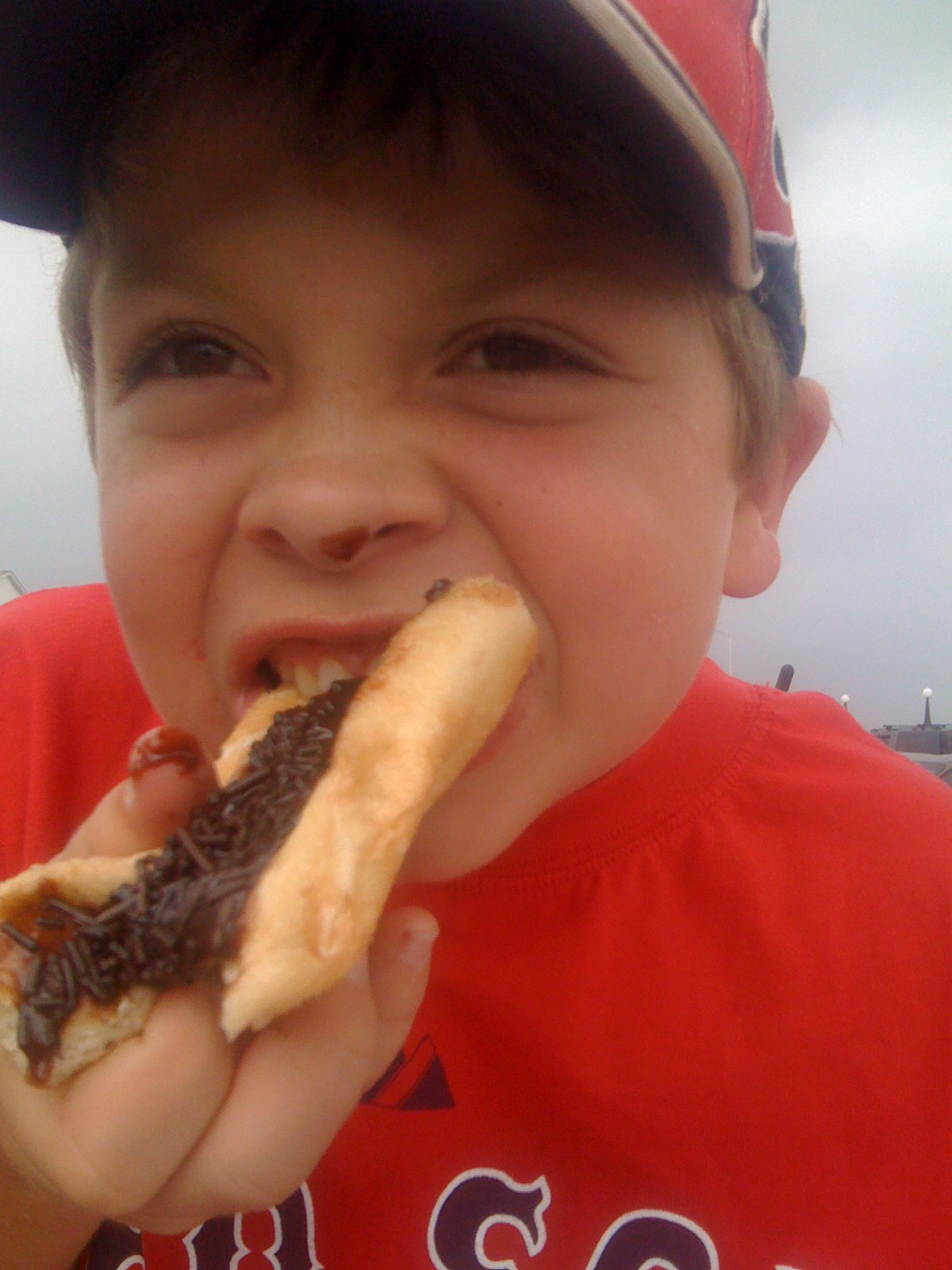 The order is always the same at Blink’s — chocolate frosting with chocolate jimmies. I try to talk the kids into sharing a piece every year, and every year they insist they need their own. Because fried dough hot out of the fryer and covered in frosting and sprinkles is a tradition at the beach, they win that debate. They’ll burn off the junk-food calories chasing waves in the ocean. The water’s a bit cool for this Texas girl to frolic, but it will make me happy to watch my kids battle the waves in giant tubes.
My heart is full as I gather my last-minute things and zip my suitcase. This time last year, I was learning the ins & outs of home health care and lugging a wound vacuum around while my kids flew across the country without me. I was learning just how insidious cancer is and the many ways in which it disrupts one’s life. I had wrapped my head around my diagnosis, endured endless testing, made heart-wrenching decisions, and faced a nasty surgery and long recovery. All of that was bad, no doubt, but the worst was putting my kids on a plane to go to our beloved beach without me. This time last year I wrote about it on my Caring Bridge page:
“The kids are excited, and they’ll have a fantastic time. I can heal in peace for 12 days with no one to think about but myself. That’s bizarre to me. After spending the last decade-plus taking care of my kids every day, minus a few days every year for a girls’ weekend, that’s kind of weird. If I miss them too much, I can always flip on SportsCenter of Disney Channel and leave a trail of dirty clothes around.”
No need to do that this year — I’ll be right there with ’em. Macy reminded me that we’ll be watching the sunset on the beach tonight. I might even get myself a piece of fried dough.
I’m definitely taking the advice of a very wise friend, who said “Drink cocktails. Eat lobster. Love life.”
Victory after tragedy
Posted: July 19, 2011 Filed under: breast cancer, kids | Tags: breast cancer, breast cancer and loss, breast cancer recurrence, British Open, Darren Clarke, Heather Clarke, kids and breast cancer, psychological effects of breast cancer, young women with breast cancer 6 Comments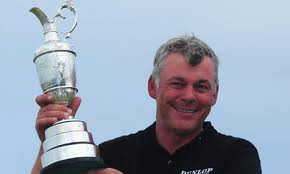 I wanted to post something about British Open champion Darren Clarke on Sunday, when he won the tournament, but have been consumed with tournaments and champions in a different sport, so here I am.
I’m not much for watching golf on TV. It’s slow and to me, boring. I consider it an activity, not a sport, and I say that knowing full well I’m torquing a lot of golf fans by doing so. I don’t quibble with the skill involved, but to me if you don’t get sweaty & out of breath doing it, it’s not a sport.
Anyhoo, back to Clarke.
I didn’t pay him or any of the golfers one lick of attention over the weekend. If Freddy Couples isn’t playing, I can’t be bothered. 
Then Trevor told me that Clarke’s wife, Heather, had died from breast cancer. That got my attention. Heather Clarke died in 2006 at age 39 after a recurrence. Her boys were 8 and 5 years old when she died. 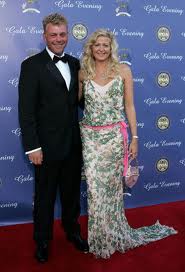
That is my biggest nightmare. And I imagine it’s the biggest nightmare of every mother of young kids who is diagnosed with this damned disease. Recurrence is enough of a nightmare, but dying from BC with young kids at home is even more terrifying. Being diagnosed with cancer at a young age, with young kids still to raise, is hard enough. Worrying about and fearing recurrence adds to the terror that comprises this disease. I don’t care that my odds of avoiding recurrence are good, or that I’m doing all the right things to ensure that this cancer does not return. I was doing all the right things before cancer became the pile of poo in my path, and it still infiltrated my life. So while the numbers and statistics are in my favor, the fear is always in my heart.
During her battles with BC, Darren said of his wife, “My wife is a battler. She fights it so hard and I have so much admiration for her.” He too is a battler, having played in the Davis Cup 6 weeks after Heather died, and winning all 3 of his matches.
At Heather’s funeral on August 17, 2006, the minister remembered Heather as “an unpretentious, lovely girl, who was full of character” and said “that day in March 1996 when you married her here in this church, Darren, you really won the greatest trophy of your life.” The reverend made everyone smile by recalling how she loved to shop while her husband played golf. My kind of girl.
After accepting the British Open trophy on Sunday, Darren Clarke said, “It’s been a long and bumpy road, I have had some good things happen to me and some bad things, but I’ve had so much support from an awful lot of people.” He credited Heather with watching him “from up above” and said, “In terms of what’s going through my heart there’s obviously somebody who is watching down from up above. I know she’d be very proud of me. She’d probably be saying ‘I told you so’. But I think she’d be more proud of my two boys. It’s been a long journey.”
He seems like a really cool guy. He likes to lift a pint or two, and he’s been known to enjoy a cigar after a round of golf. 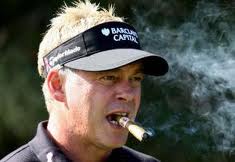 After winning on Sunday, he partied all night, and he started that party during the post-match press conference by drinking a pint of Guinness while being interviewed. I really like this guy. Being a good father is important to him (take a lesson, Tiger). In an interview with Golf Magazine, he was asked how long it took to return to normal after Heather died. His reply is so honest. Instead of platitudes and false courage, he says:
“Well, what’s normal? It’s still not normal. It can’t be normal when you haven’t got the mother of your kids and my wife at home. I was starting to get back to an even keel probably at the start of this year [2009]. It was a long time. There were some dark moments. God knows things have been difficult for me, but it has been even harder for the boys. It has been tough having to deal with things. And tough being thrown in to being 100 percent responsible for my two kids. I had to start making the decisions for everything for the boys. Making the day-to-day decisions for the boys has been a shock to the system. You don’t realize how much wives have got to do until you’ve got to do it yourself.”
When asked in the same interview if he felt angry about her death, he again answered honestly: “Probably. I’m sure anybody would. You know, Why Heather? Why? Why? Why? There are no answers to that.”
No, there are no answers to that.

 The Pink Underbelly