Tyler, day 1
Posted: July 23, 2011 Filed under: baseball, breast cancer | Tags: First Colony Little League, kids and cancer, Little League, psychological effects of cancer, young moms with cancer, youth baseball 2 CommentsWe arrived in Tyler safe & sound yesterday, just in time to have dinner with a couple of families from the team at Chili’s. Payton & I had lunch at Chili’s while we waited for Trevor to wrap up some business before hitting the road, so it was deja vu at dinner. I did not get my baby back ribs, as I eschew all foods from the mammalian category, but I did rock out on some guacamole and a cold Dos Equis.
Dawn broke clear, bright, and hot on Tyler, TX today–it’s currently 103 degrees. Gotta love July in the great state of Texas. Certain members of my family laughed at me for toting my Keurig coffeemaker all the way to Tyler, but as we enjoyed robust & delicious coffee in the room first thing this morning, there were no snickers from the peanut gallery. I have been pondering today the beauty that lies in having kids old enough to mainly fend for themselves. As Payton roamed the hotel with teammates, room key & iPhone safely tucked in his pocket, Macy and her two darling friends Mallory and Maddy swam in the pool with minimal supervision. I read my book while inhaling copious amount of chlorine fumes from the indoor pool and recollected on the events at this time last year.
I was not in the garden spot of Tyler TX in this great state’s piney woods, festively observing my firstborn’s maiden voyage of State Championship baseball. I was not languidly enjoying the comfy offerings of the Tyler Marriott, nor partaking of the fellowship of this fine team’s families. No, I was stuck in a hospital bed at the Methodist Sugar Land Hospital, enduring another round of battles vs the wily and energetic post-mastectomy infection. I was unlucky in that sense, but very fortunate indeed in that I had the intrepid Dr S caring for me all weekend, and my partner in crime Amy Hoover looking after me in the hospital. At this time last year, I was recovering from a nasty procedure to excise the infected tissue from my hollowed-out chest wall, along with an epic battle vs the morphine and barfiness that accompanied my formerly favorite pain reliever.
It was the beginning of a long and ugly stretch of history involving a lot of narcotics, a wound vacuum, and seemingly endless struggle. It did not involve watching my favorite boy do that thing he does best alongside the upper echelon of 10-year-old All Star baseball teams.
This time last year, I was going through a particularly challenging version of hell. Receiving a cancer diagnosis at the tender age of 40, with two children aged 8 and 10 and long memories of losing my sweet mama to the big C, was bad. Really bad. But I confronted the beast and did all the right things–schedule and endure all the testing, make the hard decisions, go through the surgery, and face the long, painful recovery. Being slapped with a nosocomial infection added insult to injury, for sure. Being slapped with a difficult-to-diagnose nosocomial infection was even worse, but missing Payton’s trip to the State Championship was the worst part of all.
All of that is behind us now, and I am here. “Here” in the sense of being present, and “here” in the sense of soaking up every second of the experience. Last year I was a distant spectator, following along with the games in a narcotic-induced haze. I was a long way from present, physically and psychologically. This year is a whole new ball game. I’m here, and I’m present in every sense of the word. It’s hot, it’s crowded, and there’s a lot of pressure on our team, but it’s all good. Last year the stakes were high: the boys wore their pink wrist bands in honor of me, and they wanted to win it all. Coming home with 2nd place was an honor to most but considered a failure to my kid. Seeing him walk through the door of my hospital room the day after they lost the championship was sweet for him and for me, but I could feel the weight of his disappointment. He wanted to bring the title home, and storm the hospital bathed in pride. Last summer was hard for all of us. Games were played, battles were fought, and lessons were learned.
This summer it’s all good.
No autographs, please
Posted: July 11, 2011 Filed under: baseball, breast cancer, infection | Tags: baseball, breast cancer, cancer battle, First Colony Little League, hospital, infection, infectious disease, IV antibiotics, Little League All Stars, mastectomy, post-mastectomy, psychological effects of cancer, recovery, summer camp, Vancomycin 4 CommentsToday is a very good day, for 3 reasons, maybe more. #1: Macy started two weeks of Fine Arts camp, which she loves (and I’m rather fond of having a few hours to myself while she’s off doing fun projects that someone else cleans up, and by “someone else” I mean anyone but me). While she hasn’t gotten quite this messy in a while, she’s definitely still got it in ‘er. 
#2: I did push-ups at the gym this morning. It’s been a long time since I’ve been able to do them, and there’s a bit of pride on the line since I was working out with my 12-year-old son. I wasn’t about to let him see me doing “girlie” push-ups with bent knees, so I tried the real thing, and while it didn’t feel great, I did it. Pre-cancer, pre-mastectomy, and pre-infection, I used to be able to do 50 push-ups like it was nothing, and while I’m not there yet, I’m getting closer.
#3: The article for which Payton and I were interviewed was published in our community newspaper. Corey the reporter was nice, and I think he’s a good writer. He has covered the district All Star games for all the ages, and he’s made the games come alive in his stories. P really enjoyed being interviewed; I like the drama of the article, especially the part in which I’m portrayed as “fighting for my life” (cue the dramatic music here).
It’s a good reminder to be careful what you say, too, because I joked with Corey about P having gotten his mad baseball skills from my side of the family. While it’s true–my dad’s baseball career started with PeeWee ball in 1948 and ended with him playing for the University of Tulsa–I was being smart-aleky, and Corey not only took it seriously but also included that in the article! I certainly don’t want to sound like one of “those” baseball moms. I think my kid is a good player who happens to have some natural athletic ability and a body built for taking some hard knocks. However, I’m under no illusion that he’s going to play ball for a living when he grows up, and his *$#& most definitely stinks.
While I can take or leave the publicity, reading the latest article did make me realize that a whole lot has changed since this time last year. And most of that change has been good. Really good.
This time last year, Payton’s All Star team was preparing for the sectional tournament, which they totally dominated, BTW. But I was fighting another battle against that damned nosocomial infection and was back in the hospital. Again. So after P’s team swept the sectional tourney, they were preparing to go to the State Championship in the lovely Tyler, TX. I remember thinking on that Monday, the day I was admitted to the hospital–again–that we’d get the infection under control, pump in some more vancomycin and I’d be on my way to Tyler.
Yes, I was that delusional.
Instead of the scenario playing out the way I’d envisioned, it went something like this: I was admitted on a Monday and didn’t get out until Thursday. An area that started as a red, streaky site on the mastectomied right chest wall had to be opened up, drained, excised, and packed with gauze. Repeatedly. The packing part was particularly brutal. See, there was a bunch of fluid inside my chest wall from the infection. Dr S cut a track–sans anesthesia, I recall–to open and elongate the drain hole, to let the fluid out. Once the track was there, though, it had to be packed with gauze to soak up all the nasty fluid. It wasn’t a quick process, because the hole and the track were small but had to be completely filled with gauze, for maximum soaking. Thus, a lot of shoving in an already sore, infected, and aggravated area was required. As was a lot of xanax. At one point, after Dr S shoved the gauze into the open wound, my blood pressure was 212/65. That’s a little high for me.
I survived 4 days of intense wound-packing and hard-core IV antibiotics. But just barely. I missed the entire State Championship experience, then put my kids on a plane for summer vacation, that I didn’t get to attend. I did manage to stay out of the hospital for 2 and a half weeks, but had IV antibiotics at home and a home health care nurse packing that wound. I was hoping to have turned a corner after all that (and more than once wondered what it would take to finally kick that infection) but was back in the hospital again the week before school started.
It was not a good summer, to say the least. This one has been much, much better. While the bar wasn’t exactly set very high after last summer, this one is pretty sweet.
R.I.P, Betty Ford
Posted: July 9, 2011 Filed under: breast cancer | Tags: Betty Ford, Betty Ford Center, breast cancer, cancer battle, cancer diagnosis, Elizabeth Edwards, Equal Rights Amendment, Gerald Ford, JFK assassination, Martha Graham Company, moms with cancer, psychological effects of cancer, radical mastectomy, Richard Nixon, Spiro Agnew, survivor, young children and cancer 8 Comments Betty Ford died yesterday at age 93. I’m so glad it wasn’t the breast cancer that killed her. As a young(ish) cancer-chick myself, it’s depressing as all get-out, not to mention terrifying, to learn of other women’s death from the disease we share. When this damned BC menace claimed Elizabeth Edwards, I was saddened and more than a little sick to my stomach at the stark realization that this disease does kill, young or old, healthy or not. The fact that this dreaded disease claims some 40,000 women a year brings into sharp focus the loss of maternal love that comes with each BC casualty. Knowing how much I miss my own sweet mama, the idea of the motherless Edwards children weighed heavily on my heart for weeks after her death.
I was a kid when Betty Ford was in the White House, so I don’t have much of a reference point for her. I do recall a grade-school chant of “Ford, Ford, he’s our man; Carter belongs in the garbage can” during Ford’s bid for re-election, but like the other kids on the playground, I chanted that with virtually no knowledge of politics. I’m sure I knew that Richard Nixon had been president, but was much too busy riding my bike and playing cul-de-sac games to realize that Gerald Ford became president in August of 1974, taking the place of a disgraced Richard Nixon. Now I know that Ford had been vice president less than a year before being “called up”; he’d been chosen to succeed Spiro Agnew, who also left office in disgrace amidst accusations of tax evasion.
I’m sure I didn’t realize that Betty Ford went from a “regular person” to wife of a Congress member fast. Really fast. She married Gerald Ford a month before he was elected to Congress; in fact, he was late to their wedding because he was campaigning up to the last minute. When JFK was president, the Fords became friends with the Kennedys and attended several parties at the White House. When JFK was assassinated in 1963, Betty Ford lingered at the burial and was the last woman at the gravesite. Two years later, Ford was elected minority leader of the House, and was away from home a lot. That’s when her heavy drinking began, and it continued for more than a decade before her family intervened. After she conquered her addiction to alcohol and pain pills, she founded the Betty Ford Center, which opened in October 1982. Since then, some 27,000 people have been treated there, including celebs like Elizabeth Taylor, Mary Tyler Moore, and Mickey Mantle.
I didn’t think much about Betty Ford once I was an adult, either, since her time in the spotlight had more or less passed and she endeavored to live as a private citizen. She apparently shunned the spotlight yet was returned to it in December 2006 when the country entered a 6-day mourning period upon the death of President Ford.
Even then, I didn’t think much about her, until I was diagnosed with breast cancer.
See, Betty Ford was a member of the pink ribbon sisterhood, and she blazed a trail that has significantly benefited subsequent generations of women. Women like me.
I was 6 years old when Mrs Ford was diagnosed with breast cancer in her right breast. She learned the bad news on September 26, 1974, according to the First Ladies’ biographies website. Two days later, she underwent a radical mastectomy. She’d been the First Lady for a matter of weeks when she was diagnosed. She faced the situation with the candor for which she’d become known: she announced her diagnosis and surgery publicly and even invited the media into her hospital room and posed for photos. Here she is, reading a get-well card signed by Congress.

AP file photo
I have no idea if she realized how much of a trailblazer she was. It’s probably just how she was, and to her, being outspoken and honest about her “cancer journey” is “just what you do.” I can relate to that. I hope Mrs Ford realized the impact she had on breast cancer awareness, which is safe to say was nonexistent in the early 1970s. I think she must have, based on this quote: “Before I was ever out of the hospital, there were, on television, women checking in to have mammograms,” Ford said at the Gerald Ford Museum in May 2001. “It was kind of like, if the first lady can have breast cancer, anyone can have breast cancer.”
Mrs Ford underwent two years of chemo, and in the fall of 1976 her doctors declared her cancer-free. Someone once asked her if she felt sorry for herself after losing her breasts. I absolutely adore her reply:
“No! Oh no — heavens no. I’ve heard women say they would rather lose their right arm, and I can’t even imagine it. It’s so stupid.”
She believed that women facing breast cancer should “go as quickly as possible and [get the surgery] done. Once it’s done, put it behind you and go on with your life.”
It’s safe to say that Mrs Ford paved the way for countless women–including yours truly– who were diagnosed after her. She removed the stigma from cancer, and breast cancer in particular. Before she piped up, there was no breast cancer awareness, no public discussion, and certainly no pink-ribbon culture. Barbara Brenner, former executive director at Breast Cancer Action said that Ford “showed people that you can live with cancer, that it’s not a death sentence.” The Komen organization has similar respect for Mrs Ford. Their official statement says “Betty Ford opened the door for millions of women when she candidly acknowledged her breast cancer diagnosis at a time when we didn’t talk about this disease and untold numbers of women suffered in silence. She showed the world that breast cancer could be faced with courage, with humor and with great dignity.”
It’s also safe to say that Mrs Ford would likely be quite pleased with the advances that have been made in breast cancer treatment. Ironically, in the same year she was diagnosed, Tamoxifen was showing itself to be a wonder drug in decreasing breast cancer recurrence. Now it’s become a household name in the BC community, and it’s a daily part of my life.
I think I would have really liked Betty Ford. Not just because we’re both members of the dreaded pink ribbon club, either. Because she was smart, sassy, outspoken, and real. She was a survivor, in every sense of the word. She was beloved as First Lady, and used her role as a platform to educate the American public on controversial subjects such as abortion, marijuana use, and the Equal Rights Amendment. She made it clear that she and President Ford would share a bed in the White House (something not previously publicized, apparently), and when someone asked her about sleeping with the president, she said “I do–every chance I get.”
She was perhaps unconventional as First Lady, and I like how she shook things up a bit. I love this story about her, told by White House photographer David Kennerly. On her last day as First Lady, Betty Ford walked by the empty Cabinet Room and told Kennerly, “You know, I’ve always wanted to dance on the cabinet room table.” Kennerly said, “Well, nobody’s around.” Opportunity knocked, and the plucky First Lady took advantage.
Kennerly says she took off her shoes, hopped up there, and struck a pose. “She’s a tiny woman, really, in very good shape. Very graceful, as a former dancer with the Martha Graham company. She got up there.”
Speculating on why Mrs Ford would be compelled to dance on the table, formally set with notepads and ashtrays (yes, ashtrays!), Kennerly realized that very few women have had a seat at that table. “I bet you could count them on one hand at that point, and knowing her support for the Equal Rights Amendment”—she endorsed it—”she was tap-dancing in the middle of this male bastion. She was storming the walls of the gray suits and gray-haired eminences.”
“It was a wonderful and whimsical ending,” Betty Ford wrote, “to that magical time I spent as first lady.”
R.I.P, Betty Ford.
Ice, ice baby
Posted: July 6, 2011 Filed under: breast cancer | Tags: A Charlie Brown Christmas, anemia, aquaphobia, cancer battle, claustrophobia, Ferrex, getting back to normal after cancer, Hoshizaka ice maker, ice chewing, iron supplement, Lucy Van Pelt, mycobacterium, pagophagia, pica, post-mastectomy, psychological effects of cancer, Sonic ice, South Padre Island, Tervis tumbler, vegetarians, vegetarians and anemia, young women with breast cancer 8 CommentsPagophagia sounds like one of those words Lucy spouted off in A Charlie Brown Christmas. You remember the scene, in which Charlie Brown pays a call to Lucy’s psychiatric booth (The Doctor Is Way In), and she confronts him about his prospective phobias. “Perhaps you have hycangeophobia; the fear of responsibility. Or maybe ailurophobia — the fear of cats. Or climocophobia — the fear of staircases. Or thalassophobia — the fear of the ocean.”
I remember those long, complicated names for the phobias because I played Lucy in my 5th grade production of A Charlie Brown Christmas. I remember the blue pinafore dress that was my costume, and I remember that it was kinda hard to pronounce and memorize the long words that marked the phobias from which Charlie Brown might well have suffered. Little did I know that as an adult, I myself would suffer from claustrophobia and aquaphobia. How ironic.
So the first time I heard the word agophagia I figured it must be a phobia. Nope, it’s a disorder. And I have it.
Agophagia is a form of the disorder pica, in which a person craves and is driven to ingest non-nutritious substances, usually because of a vitamin or mineral deficiency. People with pica tend to eat all kinds of weird things, from paint to dirt to chalk, and it can get really weird with people trying to eat things like batteries and feces. Gross. I must be pretty mild on the agophagia spectrum, because the idea of eating any of those things is not just weird but disgusting.
No, for me the agophagia manifests in a powerful addiction to ice. 
Yes, that’s right, ice.
Not even ice that’s surrounded by a good cocktail, either, but ice. Just plain ice.
I am addicted to ice.
Hello, my name is Nancy and I’m an ice-a-holic. I’m an agophagiac.
I didn’t think much of it at first, but just chomped away happily at the ice that was left in the bottom of my water glass, or the cubes that collected once my iced tea was gone.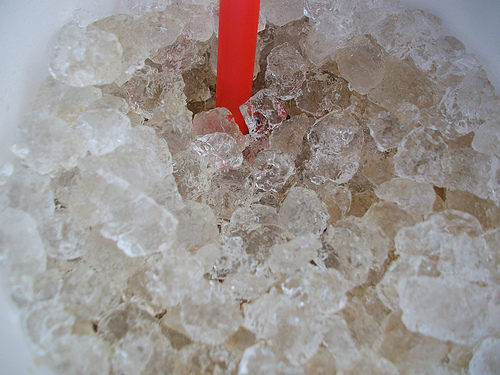 Sonic ice left me positively swooning, but I didn’t realize I had a problem until I was going through the drive-thru just for a cup of ice. Route 44 size, please. Feeling a bit self-conscious about my addiction, I did a little research and learned I am not alone. Sonic ice has a Facebook page with more than 218,000 fans.
Excessive ice chewing is a symptom of an iron deficiency. Guess what I have? Yep, an iron deficiency. I am definitely anemic. I’ve been on a prescription iron supplement, but once I started feeling so puny from the long-term antibiotic I had to take, I stopped taking the iron pills. Not a good idea.
My cutie-pie oncologist likes to blame my iron deficiency on the fact that I don’t eat meat, but the fact of the matter is that it’s yet another fallout from the nasty-ass infection I contracted after my bilateral mastectomy. I was vegetarian long before cancer dive-bombed my house, and never had a problem with anemia. Once the mycobacterium set up shop, though, the anemia gained a foothold, and the ice obsession began for real. That dadgum myco caused a whole lot of problems, of which the anemia was the least of my worries. Once diagnosed with that wretched, wily infection, one of the many sites I consulted for research stopped me dead in my tracks with this: “Disease typically chronic, progressive; rare spontaneous resolution has been reported.”
Guess that means my ice-chewing obsession would be around a while. 
Like most addicts, I was the last one to notice that I had a problem. My girlfriends would giggle at me when my input on where to go to lunch after tennis revolved exclusively on which places had the best ice. Yes, I have them categorized much as my dear friend Amy Hoover knows which places serve the best iced tea. Some places use the same filter for the flavored and unflavored tea, ya know.
 We have an ice machine outside, in the outdoor kitchen. It makes these groovy mushroom-shaped ice cubes that I adore. Not as much as Sonic ice, of course, but they’re pretty darn good. In the height of my addiction, I would consume 3 or 4 rounds of a 24-oz Tervis tumbler full of ice. Sometimes I wondered if the chomp-chomp-chomping sound was disruptive to those around me. Most times, though, I chomp-chomp-chomped away anyway, blissful in my puffy little cloud of addiction.
I’m not one bit ashamed to admit that I’ve been known to dig through the Hoshizaka to find the choicest bits of ice. Some cubes are more delectable than others; it’s a fact. And those are the very cubes most desirable to an ice-chomping addict.
However, I did start to suspect I had a problem when the only thing I wanted to pack for a long evening at the baseball field in 98-degree heat was ice. No water, just ice. And when the only thing I purchased at the baseball field concession stands was ice. Again, no water, just ice.
The pivotal moment in my addiction came a couple of weeks ago, when I was on my girls’ trip with my Duke friends. When it came time for the beverage service on the plane en route to the beach, I requested ice. No water, just ice. And more than one cup, please. Once at the beach, I realized the ice-cube trays in the freezer of our condo would not suffice, so I had to run out and get a cup of ice. Every day. I got smart and ordered 2 cups so I could put one in the condo’s freezer (alongside the worthless ice) for later. Each night at dinner, I asked for a to-go cup of ice. In the past I’ve been known to request a to-go cup, but I can assure you it wasn’t just ice. These were unchartered waters I had entered.
After becoming seriously worried that I was going to crack my teeth on all the ice I was consuming, I decided it was time to start taking that prescription iron supplement again. Within days, my ice obsession had waned. Weird.
While I still covet really good ice and will still pick through my ice machine for the best cubes, I’m not driven to chomp cup after cup of it. In fact, I realized this week that I’d gone 2 whole days without chomping any ice. Today while watching Macy’s tennis lesson, I got a cup of iced tea (extra ice, natch) and actually left most of the ice in the cup.
I’d like to think that my waning obsession with ice is a harbinger of my return to normal life, after a protracted cancer battle. I’ve had my share of complications on this “cancer journey,” and the idea of things turning around for real is pretty sweet. I relish the thought of being able to put that “cancer journey” on ice and getting on with my life.
The much-anticipated results of last night’s game
Posted: July 1, 2011 Filed under: baseball, breast cancer | Tags: All Stars, baseball, breast cancer, cancer battle, First Colony Little League, kids and cancer, Little League, moms with cancer, post-mastectomy, psychological effects of cancer, West University Little League 4 CommentsIt was do-or-die for the mighty First Colony Red Raiders last night, and the cause of my nervous stomach all day yesterday. I would love to keep everyone in suspense about the outcome, and bury it at the bottom of a long, blabbedy-blab post, but that would be mean, and while I’m not above being mean, I do believe in the great karma wheel and want it to spin my way.
So, without further ado….RAIDERS WIN!!!
The stands were packed, the tension was high, and the mighty Raiders were pumped. Lots of non-Raider First Colony families turned out to support the boys in red. That’s one of the great things about our league (besides our utter dominance thus far in the All Star tournament, with the American League 9, 10, and 11-year-old teams winning district); we support each other. We hear comments from teams we pummel into the ground about our league having a “A” team and a “B” team, but it’s just not true. Nothing but sour grapes. Our league is divided into an American and a National league based on geography, pure & simple. Where a player lives in relation to the dividing line determines whether he (or she) is on an American or National team. No gerrymandering at FCLL.
And now, back to the game…
We had our starting pitcher on the mound, fresh after a day of rest and reset pitch count. The West U team did not. We faced the same pitcher who started for the boys in green on Monday, in which we delivered a 7-4 victory.
Our starting line-up remained unchanged: Max, Cody, Payton, Mark–ready to slug it out. Then comes Gus, Kyle, Camden, Taylor, and Carl. Cooper and Anthony are ready to assist at a moment’s notice. The bats were hot and the Raiders took an early 5-0 lead. No sloppy errors last night, as our boys delivered some first-class fielding and shut the West U team down seamlessly.
Final score: 12-2 in a run-rule (for the uninitiated, in this tournament, it’s considered a run-rule if one team leads by 10 runs after the 4th inning. What it means is the other team can’t catch up, so the game ends early. It’s rather demoralizing for the team who is behind, and exhilarating for the team with the big lead).
Celebration abounded as the Raiders and their parents whooped with joy at the victory. If the baseball gods had not smiled upon us, we’d be done with All Stars for the summer, and a certain gamer at my house would be in a foul mood for the rest of the summer. All Star families pretty much plan our summers around the idea of going all the way in the tournament, which means daily practice from the first week of June to the State Championship at the end of July. I am so very glad I don’t have the entire month of July to fill. It will be baseball, baseball, and more baseball — just the way we like it.
Apologies for the crummy photo quality — the iPhone is a wonderful device, but even with all the improvements the camera still doesn’t handle motion well. You get the gist, though, even with less-than-stellar pics.
Payton receiving his district pin from the league pooh-bah (in the black shorts).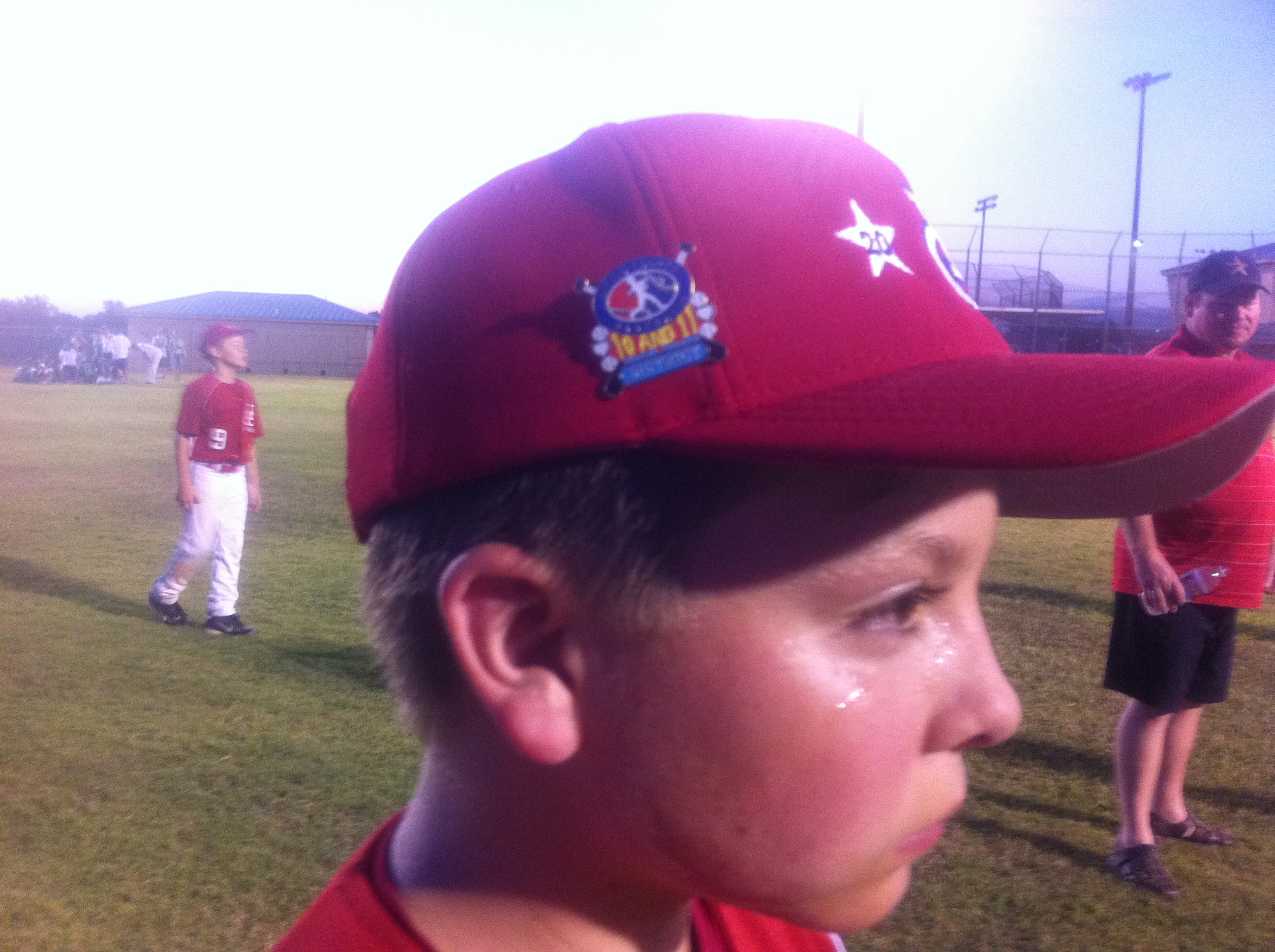
Close-up of the district pin, which is quite an honor to wear. And a mighty fine profile, if I do say so myself!

Getting congrats from the West U team and coaches (who were very nice throughout, by the way, and that’s not always the case with opposing teams. A couple of their players cried in the field when they realized their run to State was ending, but the parents and coaches were quite civil). 
The ceremonial dousing of the coach with the water cooler. Craig is a very good sport. 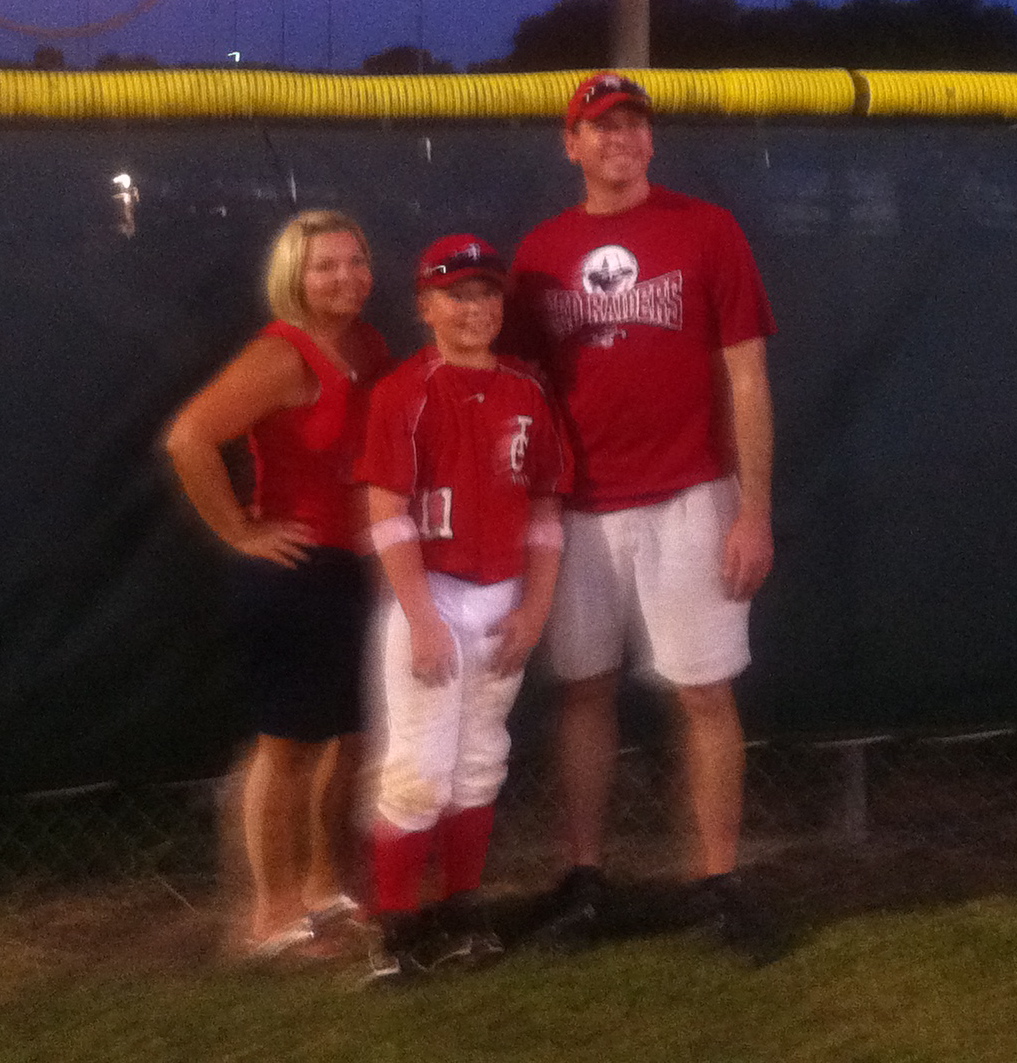
One of my favorite family shots — with a victorious boy under the scoreboard (which I cropped out because the glare off the board was heinous).
Payton being interviewed by a local sports reporter. And yes, of course I will link to the story when it comes out. See this, though, for a previous game’s story. 
Proudly displaying the district banner, which will be on display at our home field, hopefully surrounded by that of the sectional tournament and finally, the State Championship!
A whole new ball game
Posted: June 30, 2011 Filed under: baseball, breast cancer | Tags: All Stars, baseball, cancer and young kids, cancer battle, First Colony Little League, hospital, infection, infectious disease, Ipad apps, Little League, moms with cancer, post-mastectomy, psychological effects of cancer, recovery, Salisbury Beach, West University Houston 9 CommentsI’m as nervous as a cat. On a hot tin roof.
Payton’s All Star team was one game away from being district champions last night, and they went down in flames. We’d already beaten the West University team but they came back with a vengeance (and their best pitcher). As a seasoned baseball mom who’s used to watching a confident & uber-talented team, I can usually get a read on the game and have a sense of how it’s going to end. Last night I didn’t have my usual “sixth sense” before the game, and even when our boys launched 2 homers in their first at-bat to take a 3-0 lead, I didn’t settle in with my usual feel-good feeling about the outcome.
My kid got hit by a pitch during his first at-bat. Not a wimpy pitch, either, but a smokin’ fastball. That fastball thumped his thigh, just above the knee, quite audibly. My mama- bear instinct kicked in and I was on my feet, wondering if my boy would crumple in a heap on top of home plate. Then my rational brain kicked in and reminded me that my boy is tough as nails and meaner than a red hog on the field. He takes pain like it’s a cool summer breeze, as if it’s a “woonty” on the shore of Salisbury Beach. His pain tolerance is incredible, and yes, he gets that from me. He’s the ideal football player — a coach’s dream — because he’d rather take a beating than admit he’s hurt. Most kids take a “test jog” down the right-field line after being hit by a pitch, to make sure they can still run without a hitch in their giddy-up. Not my kid. After being pounded, my kid just casually tossed his bat and trotted to first base. Not a wince or a whimper from him.
Here’s the after-effect. I expect it to become much more colorful in the coming days. 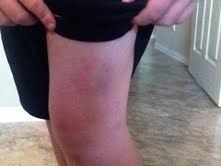
Payton’s teammate Gus responded to the bean-ball by hitting a homer off the pitcher who pegged my kid. Way to go, Gus!
Sadly, the First Colony bats weren’t as hot for the rest of the game, and we came up short. Errors in the field added insult to injury, and the boys in red got a long, stern talking-to from their coaches instead of a celebratory toast at the local pizza joint.
We face West U again tonight, and will likely bring a renewed vigor for victory. It’s winner take all tonight, so the stakes are high. Whichever team goes home tonight with a victory moves on to the sectional tournament, with hopes of progressing through that and onto the State Championship. Last year, that team was ours, and we’re all hoping for a repeat performance.
No one wants this more than me, since I missed every bit of it last summer. Thanks to a post-mastectomy infection, I was in the hospital instead of in the stands. The team honored me by wearing pink sweatbands throughout the summer, and Payton still wears his. 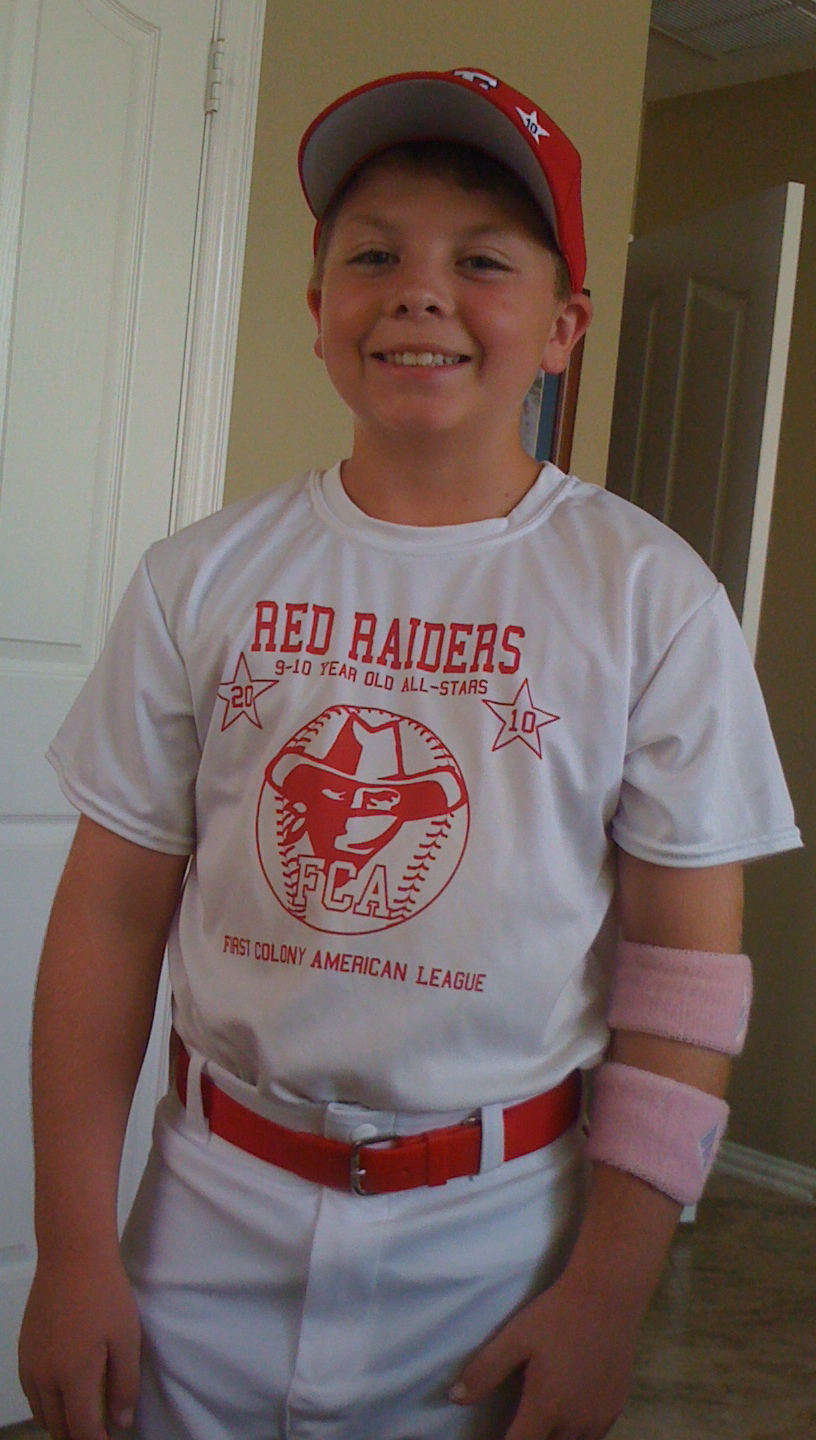 We had to get a new pair, though, because the original pair was filthy. The kind of filth that repeated washings and soakings and pre-treating can’t remove. Lots of sweat but no tears last summer.
Apparently I’m a bit nervous , as I was awake at 4:20 a.m. thinking about tonight’s game. Someone asked me at the gym the other day if I’m one of “those baseball moms.” I wasn’t sure what she meant — the kind of baseball mom who attends all the games and cheers for everyone on the team? Or the kind of baseball mom who gripes at the coach and yells at the umpire about being unfair toward her baby? I’ve seen both kinds. I like to think of myself as the former, but I have been known to yell at an ump a time or two over a particularly egregious call. I am the kind of baseball mom who wears my kid’s jersey to the games, proudly displaying #11 on my back just as my kid does. I am the kind of baseball mom who decorates the car windows, as is tradition around here, so that everyone on the road and in the parking lot know that there’s an All Star on board. 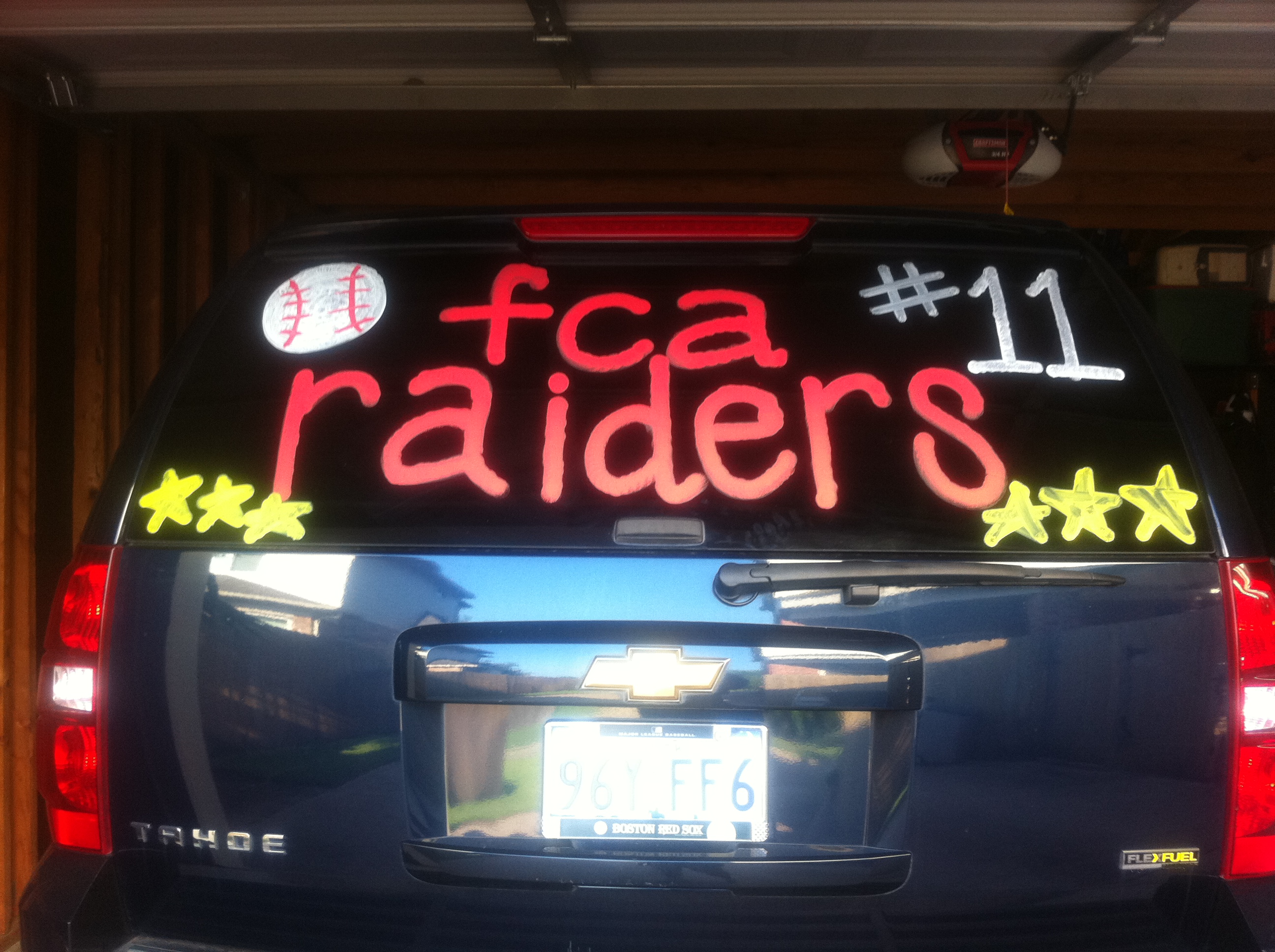

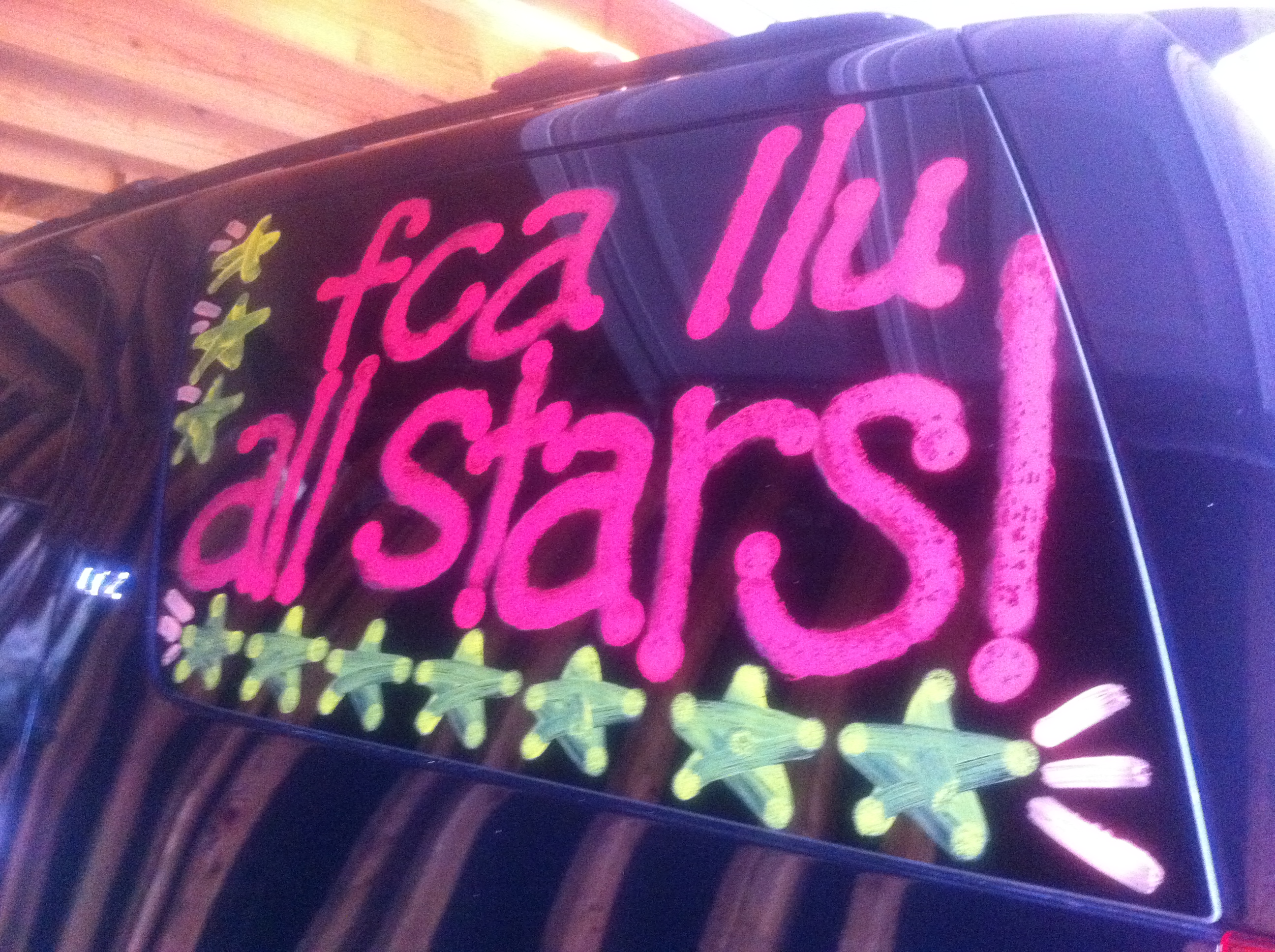
I am the kind of baseball mom who feels deep pride at my kid being selected for All Stars. 20 players are chosen, then that group is whittled down to 11 or 12 for the traveling team. Lots of players — and lots of moms — would give their eye teeth to be a part of this team. Missing the games and the camaraderie last summer was hard. Really hard.  I was able to follow along with the games via an iPad app that allows a user at the game to enter the pitch-by-pitch action so a user on the other end can follow the play-by-play. One of the moms asked me last night if it’s more nerve-wracking to follow along or to watch the game live. I said watching live is way more nerve-wracking. Sitting in a hospital bed staring at the iPad screen isn’t nearly as complete an experience as being in the stands, in the heat, with the roar of the crowd and the sounds of the game. I do have fond memories, though, of the nurses who were constantly in and out of my room getting involved and asking for updates on the game. And I distinctly remember forgoing pain medicine so I could be lucid enough to follow the game. This summer is a whole new ball game, for me.
At the ballpark, again
Posted: June 22, 2011 Filed under: baseball, breast cancer | Tags: baseball, breast cancer, cancer battle, cancer diagnosis, family, First Colony All Stars, gratitude after cancer, hospital, infection, infectious disease, life after cancer, Little League, mycobacterium, nosocomial infection, post-mastectomy infection, psychological effects of cancer, survivor, young kids and cancer 5 CommentsLast summer was pretty bad for me and my family. It started innocently enough, with a bilateral mastectomy at age 40 on May 13th, and while I healed quickly and nicely from that, it all went downhill fast.
Just after my 41st birthday, I got a nasty post-surgery infection. No one saw it coming, and to say it took us all by surprise would be a gross understatement. The odds of contracting a nosocomial infection are not small, but my infection is somewhat rare, quite wily, and super slow to treat. In the scope of inconvenient infections, I won the lottery.
Last night was the first game of the All Star tournament for Payton’s team–something I missed entirely last summer. Being present last night to watch my boy do what he does best with his team of like-minded and uber-talented buddies was one of the simplest yet deepest thrills of all time. We take a lot of things for granted in this life of ours, and being able to sit on metal bleachers in the Texas heat in June to watch youth baseball is one of those things. I’ve sat through thousands of games for my little ball player, and hardly thought twice about it beyond the random, mundane thoughts associated with this endeavor: who are we “versing” (as our catcher, #10 Carl says)? Where is Payton in the line-up? Are we on the shady side of the field? Did I remember my stadium seat? How many times will Macy hit the concession stand? How many pieces of bubble gum does Pay have in his mouth at once?
Those are the thoughts that traverse my brain during a game, along with the usual baseball stuff: What’s the run rule in this tournament?; How did we fare against this team last time we met? If the ball hits the bat then hits the batter, he’s out, right? Rules and regulations course through my head as I follow the many games my boy has played.
Last night was different, though. As I was ready to walk out the door, our bestie Ed reminded me that I’ve come a long way since this time last year. Several of the parents on our team remarked at the park that it’s nice to have me there this year. A couple of the coaches said something about having missed me and my big mouth last summer; once a cheerleader, always a cheerleader.
I have come a long way since last summer, and watching my kid play ball is something to be savored, something to most definitely not take for granted. The metal bleachers, the roar of the crowd, the (gross) smell of hot dogs, the infield dirt blowing in my eyes…every bit of it is special to me on a whole ‘nother level.
Last night also marked the first time a newspaper reporter has covered the game, and seeing my boy’s name in print in association with his rock-star team’s blowout and his personal success is something I’ll be savoring for a while. Before cancer came into my life, I would have enjoyed reading the article, and likely would have forwarded it to our nearest & dearest, but this time, I’m carrying the feeling of that article along with me, inside my heart, in that little space where the gratitude lies.
I was flipping through my old Caring Bridge blog, and happened upon this entry, which seems even more prescient a year later. I wrote this on the morning of my mastectomy, before leaving for the hospital. No doubt I was antsy, preoccupied, and ready to get the show on the road that morning. It seems appropriate to reprint it today, in light of the theme of today’s blog.
I realize that when cancer comes into one’s life it disrupts everything and changes “the normal” forever. Dr Dempsey, my superstar breast surgeon, told me you no longer schedule cancer around your life, you schedule your life around your cancer. Life takes a backseat to war.
With cancer, I join a club that I never signed up for and for which I never wanted to become a member.
No matter, I now have a new normal. The new normal is all about taking care of what’s most important. We hear this all the time, but when you really put it into play in your own life, you know exactly what it means. For me, it means facing this beast head on and telling the bastard repeatedly that it doesn’t stand a chance. It means never once, not even once, considering that this cancer will win. It’s not even in the game.
It also means all the pithy stuff you hear about, like savor every day, make the most our of whatever you’ve got. That’s also true. For me it means truly embracing and enjoying my kids and my family, and letting my friends into my life — warts & all — on a whole new level. Y’all may well see my house a mess, which doesn’t happen much. You may see me in a grumpy mood (ok, you’ve seen that, esp on the tennis court!). You may see me just a teensy bit vulnerable, but only for a short time so don’t expect a repeat performance. No matter what, there is a new normal, and I’m all over it.
A victory for all the bald girls out there
Posted: June 15, 2011 Filed under: breast cancer | Tags: Adam Levine, bald girls, Blake Shelton, CeeLo Green, Christina Aguillara, Maroon 5, psychological effects of cancer, The Voice 6 Comments
nbc.com
If you watch The Voice, you’re familiar with Beverly and Frenchie, the two members of Christina Aguillara’s team who are still alive in the competition. If you’re not familiar with the show, click on the link and get to know more about it. It’s entertaining.
Basic premise is similar to American Idol but the judges don’t get to see the contestants and have to choose them based solely on their voice. 
CeeLo Green, Christina, Adam, and Blake Shelton are the judges, and they each have a team of singers. They coach their singers and have a lot of fun while honing their voices. My little girl loves this show, and I have no trouble watching it with her simply because of the presence of Adam Levine. After seeing him and Maroon 5 live in October, I love him even more than I did before. And that’s all I’m going to say about that. 
Yvonne, I sure hope you’re reading this right now. Adam is the cure for all the problems in the world.
And he’s on TV every week.
How sweet is that??
Ok, back to Frenchie and Beverly.
There’s something unusual and cool about them. Yes, they both have great singing voices and stage presence (Frenchie, especially), and they seem to possess a wisdom and maturity that the other contestants do not. I happen to love the fact that Beverly lives an alternative lifestyle and is embraced nonetheless; makes me think and hope that progress has been made in the acceptance department.
The fact that two mature (read: older) women who don’t have conventional looks won out over the two younger, more traditionally attractive girls fills my heart with happiness.
Here’s the team Christina started with:

nbc.com
And here’s who’s left:

 As far as I know, neither Frenchie nor Beverly has cancer or has endured chemo. My assumption is that they eschew hair on purpose, and for all my cancerchick friends out there in blogland, I’m calling this a victory for bald girls everywhere.
As if the tornado wasn’t bad enough…
Posted: June 14, 2011 Filed under: breast cancer, infection | Tags: AL East, Alex Rogriguez, Antibiotics, Dustin Pedroia, Freeman Hospital, fungus, hurricane categories, infection, infectious disease, Jacoby Ellsbury, Joplin tornado, mucormycosis, mycobacterium, psychological effects of cancer, PTSD, recovery, Red Sox Nation, survivor, tornado EF-5 1 CommentI feel a weird dichotomy of emotion when a friend hears about a rare and hard-to-treat infection and thinks of me. On one hand, it’s nice that my friends are the sort of people who know what’s going on in my life (I guess being a blabbermouth and having a blog help). On the other hand, it’s a weird feeling to be the one associated with the rare and hard-to-treat infection.
No matter, the horse is out of the barn, and the fact of the matter is that I did indeed have a rare and hard-to-treat infection, I am a blabbermouth, I do have a blog, and my friends rock.
So when the news broke that several people in the wake of last month’s giant killer tornado in Joplin, Missouri, have contracted a rare and hard-to-treat infection, my name came to mind. Perhaps this provides a bit of perspective for me. On many levels. It reminds me that while I’ve been through a lot, I also have a lot for which to be grateful. Namely things like this: #1, I wasn’t involved in the devastation of that giant killer tornado. #2, my rare infection was hard to diagnose but not especially hard to treat; just a giant pain in the ass. #3, my rare infection wasn’t deadly, as the one in Joplin is. #4, my rare infection is gone, baby gone. And, because I like odd numbers in lists, #5, I’m done with the 267-day course of oral antibiotics needed to treat my rare, pain-in-the-ass infection. Oh, if only I got paid extra for using hyphens in my modifiers.

cbsnews.com
The giant tornado last month in Joplin stirred up a lot of soil in its destructive path, and it uncovered mucormycosis, a deadly fungus among us. Like most bacteria and fungus, mucormycosis is all around us but only affects people who are already limping along with weakened immunity. The proverbial kicking a man who’s already down. It seems to prey upon people with diabetes, leukemia, lymphoma, and AIDS as well as those who have had an organ transplant and those who engage in chronic steroid use (Alex Rodriguez, you better be careful).
I must digress here for a moment about the mighty A-Rod. We don’t like him much in our house (understatement of the year, right there). Not just because we are die-hard, hard-core Red Sox fans and he’s on that other AL East team. You know, the one that wears those gawd-awful pinstripes. Ick. Well, A-Rod, in our opinion, typifies everything that’s wrong with pro sports: the drugs, the attitude, the disdain for the very fans who provide him job security. Imagine our surprise and delight when we found this yesterday: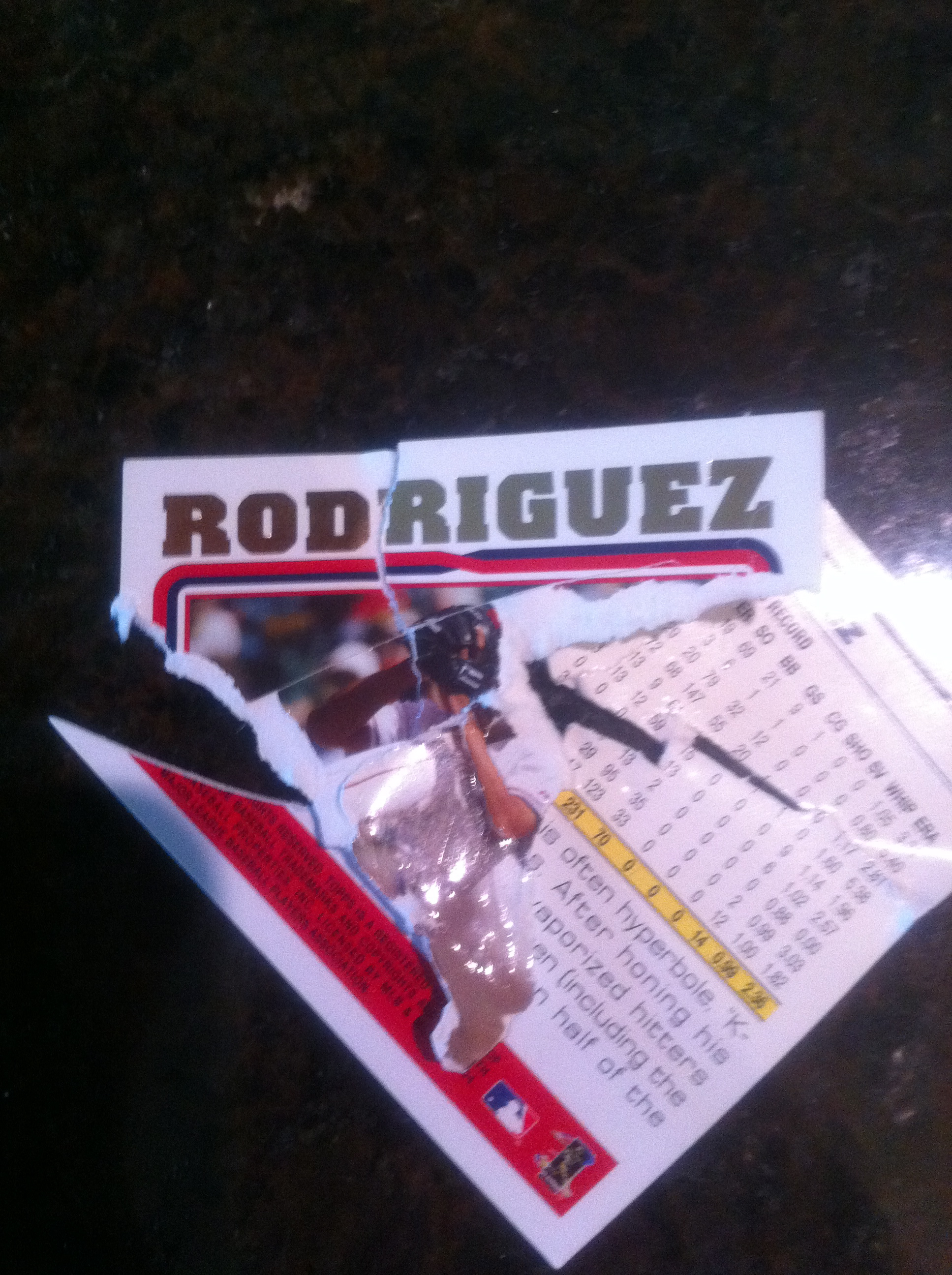
An A-Rod baseball card, chewed to bits by our little dog Pedey. I love it! It’s even funnier because that little dog is named for Payton’s favorite Red Sox player, Dustin Pedroia. The idea of Pedey going after A-Rod fills my heart with pride. I’ve said before that Pedey is not much like his namesake: he’s lazy and clumsy with a ball, but in this case, Pedroia would be proud of this little dog for pouncing on A-Rod and tearing him to bits!
As long as we’re digressing for baseball-related ramblings, I might as well post a pic of my boy-crush, Jacoby Ellsbury. It’s been a while, and I know my loyal readers have missed him. Here ya go.
You’re welcome.
Ok, back to the Joplin tornado and its unwelcome sidekick. The tornado was a big one. An EF-5 to be precise. The EF scale refers to the Enhanced Fujita scale, which was developed at the Wind Science and Engineering Research Center at Texas Tech University. Yay Red Raiders. I don’t know much about the tornado scale, being a bit more familiar in this neck of the woods with the Saffir-Simpson Hurricane scale, but a quick peek on Wikipedia tells me that an EF-5 tornado means the storm has winds in excess of 200 mph. A bad-ass, scary storm, to be precise.
The May 22nd tornado cut the city of Joplin roughly in half with an estimated 7-mile-long by 1-mile-wide swath. It moved slowly and stayed on the ground rather than touching down and moving back up. All of these factors combined equal untold destruction, a death toll of 151 people, and the unleashing of a nasty fungus.
Eight tornado victims have contracted the mucormycosis, although public health officials won’t make an official link between the fungus and the tornado. Four of the people who tested positive for mucormycosis have died. It’s a nasty bug that spreads fast and can invade the blood supply of its victims, who typically have injuries and secondary wound infections. Sound familiar? Ugh. The rush of feelings and memories this topic evokes roars in my head much like a tornado. I think my PTSD is showing.
The mycormycosis fungus is usually found in soil and wood and enters the body either through a puncture wound or when a person breathes in mold spores. The dirt or vegetation becomes embedded under the skin, and mold is actually found in the wounds of people who have this bug. In some cases, wounds that had been stitched up after the tornado had to be reopened to clean out the contamination. Again, sound familiar? The incubation period is a little shorter on the fungus compared to the mycobacterium, and hopefully the fungus presents itself faster than the myco; both times I’ve been tested for that damn myco it took 6 weeks to present itself.
People with weakened immune systems who come into contact with this fungus have a mortality rate as high as 90 percent. Yes, you read that right: 90 percent.

wikipedia.com
It’s strange how the spores of this fungus look almost artistic under the microscope, yet can wreak unimaginable havoc on the human body. Compare that to my bacteria’s photo and you can see how vastly different these bugs appear under the microscope and why I have enormous respect for my sweet infectious disease doc. You rock, Dr Grimes! 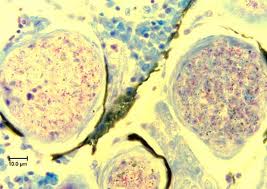
Because the mucormycosis fungus is so rare, medical research is limited, and treatment is simple but fraught with complications. Treating it sounds eerily familiar to me: confirm the bug, excise the affected tissue via surgery, and administer long-term and powerful antibiotics. Same plan I followed for the mycobacterium.
The Centers for Disease Control and Prevention said Friday that it is conducting tests to help investigate the infections, which are so uncommon that even the nation’s largest hospitals might see only one or two cases a year. In fact, Dr Ewe Schmidt, infectious disease specialist at Joplin’s Freeman Hospital, said that in 30 years of practice, he’s seen 2 cases of mucormycosis, both of which occurred in patients who had untreated diabetes.
“To my knowledge, a cluster like this [several cases of the fungus] has not been reported before,” said Dr. Benjamin Park, head of the CDC team that investigates fungal diseases. “This is a very rare fungus. And for people who do get the disease, it can be extremely severe.”
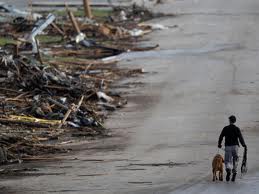
I’m so glad my rare infection wasn’t this deadly fungus. I’m even more glad that my rare infection is gone. And I’m so glad this guy and his dog survived the storm and the deadly fungus.
cbsnews.com
Shut up about the small stuff
Posted: May 31, 2011 Filed under: breast cancer, kids | Tags: breast cancer, cancer battle, cancer diagnosis, Don't Sweat the Small Stuff, kids dealing with mom's cancer, post-mastectomy, psychological effects of cancer, PTSD, reconstruction, recovery, Richard Carlton, survivor 7 Comments
amazon.com
Remember the book Don’t Sweat the Small Stuff? I have a copy, somewhere. Or did at some point. I read it, too, thinking it would be good for someone like me: impatient, intolerant of idiots, and in turmoil over all that I couldn’t control.
The book was on the best-seller list for more than 2 years. Richard Carlson went on to write some 20 books in this series, from Don’t Sweat the Small Stuff in Love and Don’t Sweat the Small Stuff for Women. I think I had the original copy, and knowing me, might not have made it through the entire book. Too impatient for that.
I do recall a few ideas Carlson presented in the book, such as “live in the present” and “become more patient.” Not sure I managed either, since I’m always in a hurry, usually thinking about what needs to be done next, and am most definitely not patient. It’s hard to become “more” of something when you’re not really “any” of that thing.
“Life isn’t an emergency” is another one of Carlson’s anti-sweat-isms. I’m not even sure what that means, but I can tell you for certain that it does not apply to cancer patients. Life most certainly is an emergency when you’re dealing with diagnosis, research, treatment options, doctor’s visits, prescription drugs, mounting medical bills, surgery, hospitalizations, and the like.
Carlson also encouraged us to “get comfortable with the not knowing.” I feel pretty confident saying that this will never happen. Never. Ever. I most definitely will not get comfortable with not knowing what happens next, where this “journey” is going, or what the future holds. Hopefully Carlson took his own advice, as he died from “an illness” in 2006 at age 45. That’s 3 years older that I am now (well, I will be on Wednesday), and 45 is too young to die, IMHO.
I wonder if Carlson would have had the same attitude if he too had been facing cancer. Maybe he would have sweat for a little bit, then invoked his ant-sweat-isms to conquer all of the “small stuff” that invades ones life along with a diagnosis of cancer.
My blog friend Lauren wrote yet another stellar post about this very subject. Every time I read one of her blog posts, I’m hard-pressed to say which part I like most, which idea resonates the loudest, which anecdote finds me nodding my head in agreement, or which passage has the power to make me misty-eyed. This week, it’s this passage that stands out:
“There are no small things in cancer. There are no ridiculous things. People like to tell us not to sweat the small stuff, but there is no small stuff in cancer. There is no such thing as a small assault on our feelings/psyche. Sometimes, the tiniest pebble in our shoe is the one that will make us most weary; indeed, the smallest of stones can derail a train.”
I now feel as if I have permission to sweat the small stuff.
As if I needed anyone else’s permission.
A whole lot of the cancer thing is indeed big stuff. Not to imply that my “journey” is harder than anyone else’s, but I would respectfully submit that being young-ish with dependent kids at home makes for more sweat-worthy stuff along the way. Laura, another blog friend painted a vivid picture of battling cancer while raising young kids when she wondered how to hold back tears when her 6-year-old said, “I forget what you looked like before the cancer when you had long hair.” Tell me how to not sweat that. Please. It reminds me of my own struggle to remember what my mom looked like before cancer. I was 36 at the time. I still have to work to hear her real voice and not her “sick” voice, and I was a grown woman at the time of her battle. Laura also remarked upon the depression and guilt she felt as her 8-year-old son helped his little brother pack his lunch for school while she lay on the couch motionless. That makes me sweaty just reading about it.
Lauren also covered a topic in her post that I recently experienced myself. It involves Press ‘n Seal. 
You know, the stuff in your kitchen that you use to cover food.
While Press ‘n Seal has many domestic uses, it has a medical use too: covering one’s port while said port is slathered in numbing cream, before facing the 20-gauge needle used to puncture the skin and the port membrane to deliver drugs.
Last week I went for my regular port maintenance, in which I have to have the oncology nurses access the port (poke the big-ass needle through it) to flush it. This needs to be done every 4 to 6 weeks to avoid a blog clot. The port is tied into the jugular vein, remember, and I do not want to mess with that big dog.
Before my port maintenance, I use the numbing cream (when I remember) so the needle stick isn’t quite so traumatic. Needles have always been rather sweat-inducing for me. I don’t care what Richard Carlson would have told me, I have never liked needles and they’ve always given me that sweaty-palmed, slightly nauseated feeling.
The day of my most recent port maintenance, I was going from the gym to the oncologist’s office. I told my Runnin’ Buddy to remind me about halfway through to use the numbing cream. I was pretty proud of myself for remembering the cream and the Press ‘n Seal, along with a hypodermic needle from my stash at home and my teeny little vial of B12 that my sweet oncologist prescribed for me. I get a B12 shot once a month, and it was time. I figured since I’d be there, why not ask the oncology nurse to give me the jabful of B12?
Any shot at resuming normal life is gone, baby gone as soon as you realize you have prescription Lidocaine, B12, a needle, and Press ‘n Seal in your purse. Any attempt to seem like a normal person is duly shattered by that paraphernalia in one’s pocketbook.
So at the appointed time, I stood up against the wall of mirrors in the gym, pulled my shirt to the side and slapped a thick layer of cream on my port. Then I cut a small piece of Press ‘n Seal and covered the cream so it wouldn’t sploosh all over my shirt. While I finished my workout, the cream slid around a bit, and the Press ‘n Seal crinkled with each movement, and the curious onlookers were probably wondering what in the world they just witnessed.
Here’s what Lauren had to say about our ol’ friend Press ‘n Seal:
“In all my years of reading on PTSD and grief and trauma with breast cancer, not once have I seen a section on dealing with the emotional trauma of how dehumanizing it is to put Press N’ Seal on your body. Not once have I seen a section on how deeply humiliated you feel when you are made to walk half-naked through hallways on the way to an MRI, where then, in front of the room full of techs, you must disrobe and awkwardly lay on your stomach and hang your breasts through two holes in a plank. There is nothing in any book about how violating it feels having a breast written on in sharpie, and that the last time you see it in your life, it has a doctors intials on it. There is nothing in chapter 3 of any book that discusses the indignity of having our bodies being measured with trigonometry like a drafting project as we lay there naked, and get tattooed by nurses for radiation, especially when you are one who doesn’t like the thought of ink in your skin. There is nothing, nothing about the angst of a port sticking out of your body, or how impersonal it feels having your body lifted and shifted by nurses until you are lined up just right for radiation.”
I can’t speak to the parts about radiation, but on all the other stuff I say yep, that’s right. How strange it is when things like Press ‘n Seal on your body become part of your life. How sad when experiences like the ones Lauren describes become lasting memories, and not in the warm & fuzzy way. How terrible its is when you realize that there’s “nothing in any book about how to come to terms with the death of control over your body and life,” as Lauren so aptly puts it.
I’ve learned, just as Lauren and Laura and millions of other cancer patients have learned, that the small stuff becomes big stuff, and the death of control over our bodies and lives is just one of the many casualties in the “cancer journey.” The PTSD in one’s daily life also chips away at the idea of normalcy, signaling the death of innocence, the end of easy. It may or may not be well-documented, but it’s there. And as Lauren says, “Just because it is not said or written about, doesn’t make it less real. It does not make our feelings about many of these more ambiguous losses less valid, less deserving of mention. It does not make the trauma less valid, it does not make us whiners about small stuff.”
She notes that “we will suffer many more deaths on the cancer journey. Some by things taken from us, and some by things given/done to us. There will be a thousand deaths in cancer, and then a thousand more.”
And so I will indeed sweat the small stuff. Anytime I want.

 The Pink Underbelly