Nice try, NFL
Posted: October 16, 2012 Filed under: breast cancer, cancer fatigue | Tags: A Crucial Catch, body image after breast cancer, NFL goes pink, Peter King, pinktober, pinkwashing, psychological effects of breast cancer 37 Comments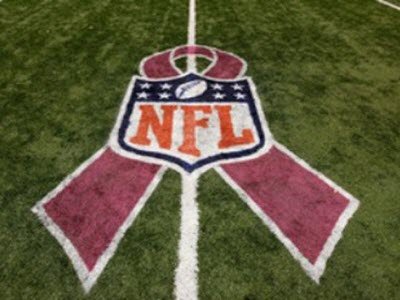
rantsports.com
A woman I know from the gym told me that when she saw that the NFL has gone pink for Breast Cancer “Awareness” Month, she thought of me. I smiled politely and said thanks; she’s about the age my mom would have been had she lived, so I want to be respectful. I’m never quite sure how to handle this. On one hand, I don’t want to be the poster girl for breast cancer. On the other hand, I don’t want to seem ungrateful for an acquaintance’s goodwill and kind thoughts. I always limp along in such encounters, then I flee the scene wondering if I reacted in an acceptable way. But, like so much associated with the cancer “journey,” there’s no road map, no guidebook, no real clue on how to handle this stuff.
At first blush, the NFL going pink to support breast cancer seems like a pretty cool thing. I wrote about it last year, and my first impression was how cute! NFL players in pink cleats, gloves, chin guards, skull caps, and sweatbands was so cute! I took it at face value, not being much of a football fan, and I wasn’t bothered by the coaches’ pink ribbons or pink caps, nor by the refs’ pink whistles or the pink tees on the field. However, another year wiser about the pinkwashing phenomenon and another year exhausted by the “awareness” campaign, I’m thinking it’s not so cute. Some of the players have personal ties to breast cancer, having lost a loved one to or had someone they love affected by the dreaded disease. I give them a pass. Guys like Ravens’ wide receiver Jacoby Jones, who has two aunts who have survived breast cancer. He says that wearing pink shoes and pink gloves “means something. For my aunts to fight through that and beat it, that’s some strong women. So I’ll wear it for them.” Another wide receiver, Kyle Williams of the 49ers, will put on the pink for game days in honor of his grandmother, who died from breast cancer in 2005.
If it were just about the National Football League’s largesse and compassion toward a disease that kills nearly 40,000 women in this country every year, I’d say, that’s cool. If it were about players showing their love and admiration for friends and family members who’ve battled breast cancer, I’d be behind them. Even if it were about the NFL designating breast cancer as the charity du jour and earmarking some of the $9.5 million dollars earned in revenue last year, I’m good with that.
However, it’s never that simple, and because breast cancer is the “sexy” cancer, the “glamour” disease, there’s something inherently rotten in the pink plethora splattered all over pro football stadiums across the country. Because breast cancer involves well, yeah, breasts, it easily grabs everyone’s attention, and like so many other things that have been pinkwashed in the name of “awareness,” it means a breast cancer patient or survivor can’t even watch a football game without being smacked in the face, yet again, with the reminder of this damned disease.
I. am.so.ready.for.October.to.be.over.
In trying to nail down exactly what it is about the pinkwashing of the NFL that bugs me, I came up with this. First and foremost is the emphasis on breast cancer “awareness.” Perhaps the Vikings cheerleader pictured below wants and/or needs everyone to be “aware” of her breasts (BTW, the Denver Broncos cheerleaders are sponsored by Dr Ben Lee, a plastic surgeon who specializes in breast augmentation, and Laura Vikmanis, a Cincinnati Bengals cheerleader, says in her memoir that at least half of the 36 cheerleaders have implants, and a third of those without are planning to get them, and that there was much dissension in the cheerleaders’ locker room between the haves vs the have nots. A Philadelphia plastic surgeon cited Vikmanis’s book on his website in relation to the Philidelphia Eagles cheerleader tryouts. He commented on the rigors of NFL cheerleading: “Twice-a-week weigh ins and the grueling conditioning routines make it hard for women to maintain adequate fat reserves to have proportionate and shapely breasts, so breast implants are often the only way for women on the squad to remain both fit and feminine.” Breast implants are the only way for an NFL cheerleader to look fit and feminine? Wow. We certainly wouldn’t want women out there running around with disproportionate and unshapely breasts, would we?)

The NFL’s “A Crucial Catch” program aims to increase breast cancer “awareness” but I can’t help but ask why we’re so fixated on awareness, when being aware of the disease does nothing to cure it. Why does the program exhort women older than 40 to get an annual mammogram, when mammograms don’t save lives? Does anyone really find the “early detection” message touted by programs such as this to be effective? Sports Illustrated writer Peter King is of like mind, and after he tweeted “Please. Not pink for a month, NFL. A week, great. But a month?” he found himself on the receiving end of a lot of criticism, with people responding outright hatefully. Writer Mary Elizabeth Williams came to King’s defense on salon.com. She pointed out that it’s possible to hate the disease as well as the commodification. And, as she astutely points out, “because if we didn’t see pink on the football field throughout October, how else would any of us know that it’s breast cancer awareness month? How would we be aware?” Breast Cancer Action executive director Karuna Jaggar adds “We don’t need more awareness; we need solutions. We’re looking for progress that makes a difference in addressing and ending this breast cancer epidemic.” Does anything about A Crucial Catch speak to the breast cancer epidemic?
Secondly, show me the money. Several groups have had a little look-see into the NFL’s A Crucial Catch program and found that while it may be eye-catching, all that pink isn’t doing all that much good for the actual disease or the people suffering from it. Proceeds from the NFL pinking it up go to The American Cancer Society, which sounds pretty good, but Business Week discovered that just 5 percentage of sales will make its way to the ACS. According to Business Week, for every $100 in sales of pink products, $3.54 goes toward research while the NFL keeps approximately $45. Considering the NFL’s healthy revenue last year, and the crazy salaries NFL employees make, this seems particularly stingy. An NFL spokesperson countered the Business Week report by saying that while the league does not dispute the numbers above, it does not profit from the sale of pink merchandise, but that whatever money isn’t donated to the ACS is spent covering the cost of the Crucial Catch program, which is designed to increase “awareness.” Ah yes, the same type of accounting that caused the Susan G Komen for the Cure to fall out of favor with the very women it’s supposed to be helping. Spending such a disproportional amount of money on “awareness” instead of research is nothing short of irresponsible.
My third issue with the NFL going pink may be unpopular, but the fact is, the NFL doesn’t seem overly concerned with women’s issues or our bodies. Exhibit A: the cheerleaders. What exactly does a bunch of tarted-up, implant-sporting women gyrating on the sidelines have to do with the game? Do the fans in the stadium need to be encouraged to cheer for their team? Do the viewers at home require a bit of eye candy to break up the monotony of seeing big, sweaty men up close and in high def? More importantly, did anyone from the NFL think about how breast cancer survivors might feel seeing the NFL cheerleaders decked out in pink boy shorts and itty bitty tshirts that can barely contain all the breastly goodness of those augmented cheerleaders? Does the NFL think that breast cancer survivors need yet another hit to their flagging body images and fledgling self-esteem after radiation mutilates our breasts and surgeries remove them altogether?

Exhibit B: the league is historically soft on players who’ve been charged with crimes against women. Columnist Maura Kelly wrote about this for the New York Daily News, citing cases such as the one against Hall of Famer Lawrence Taylor, in which he admitted to raping a 16-year-old girl in 2010. And that of famed quarterback Brett Favre being accused by more than one woman of sexual harassment. And that of Steelers quarterback Ben Roethlisberger being accused of sexual assault by two different women. Defensive tackle Albert Haynesworth got handsy with a waitress last year and pleaded no contest to her charges of sexual assault. None of these players received more than a slap on the wrist from the National Football League. Yet, during the month of October, the league wants me to believe that it cares about me and million of women across the country? Throw a bunch of pink on the field and call it good?
Nice try, NFL, but I’m not buying it. It’s going to take more than pink accessories and lip service about the importance of screening to convince me that the league really cares about women.
How many more days until October ends?
I want my mommy!
Posted: October 13, 2012 Filed under: cancer fatigue | Tags: cancer and loss, Caroline Kennedy, cooking with mom's recipes, Jacqueline Kennedy, Jacqueline Kennedy: Historic Conversations on Life with John F. Kennedy, losing a parent to cancer, missing mom, Motherless Daughters, psychological effects of cancer, pumpkin bread 24 CommentsOctober 13. The day my mom died. It’s here again, and 7 years later, it still sucks.
They say time heals all wounds, but I say “heals” is a bit of a stretch. It’s more like time puts a too-small and not-so-sticky band-aid over the gaping wound where your heart used to be. They also say that you never get over such a loss, you just get through it. Whoever “they” are, they got it right that time.
I still miss her every single day, in one way or another. Her big, genuine laugh. The way she fretted incessantly. Her habit of always taking my kids’ side, even when they were naughty and unruly. The daily phone call, even when she had nothing much to report. Her ability to worm her way into anyone’s heart. Watching her in the kitchen, and marveling at how she knew how to get everything just right.
The list goes on.
I’ve written a lot in this little blog about how much I miss my sweet mama. I’ve read a lot about losing one’s mother. I’d like to think it helps, that it’s somehow therapeutic to get it out, to empty my heart and head onto the screen. When I come across a particularly interesting or helpful tidbit on the subject of mothers and/or loss, I jot them down. I usually forget to include the attribution, as I did here:
Motherhood isn’t a test but a religion, a covenant entered into, a promise to be kept.
No idea who wrote that or where I came across it, but I like it, and my sweet mama definitely embodies those ideals.
This one was in O Magazine, and again, I neglected to give credit where credit is due. To the author of these wise words, I apologize, but please know that your words moved me enough to pull out my iPhone, tap on the Notes icon, and copy the passage for quiet reflection at a later date:
You never get over what you lost. You always carry it with you, stitched to you like Peter Pan’s shadow. And you never wanted to get over it, because who wanted to forget a time that had been so important? No, the truth was, you wanted to remember it always.
I guess I’d say that it’s impossible to forget something (someone) so important. I do carry her with me, and I will never get over the loss of her. If I’m half as important to my two kids, a fraction as beloved, I will consider my life a great success.
I read a book review a while back about Caroline Kennedy’s book Jacqueline Kennedy: Historic Conversations on Life with John F Kennedy. (Whew, long title.) In the review, Caroline talked about how at age 53, accomplished and well-educated, she still referred to Jackie O as “mummy.” We never get over losing our mothers.
She went on to talk about the qualities she most admired in her mom, which she wanted to highlight in the book: the sense of strength, her passion for reading, and her will to move forward despite the pain that had come her way.
I can relate to that. My mom was amazingly strong, but in a quiet and gentle way. She loved to read and was a middle school English teacher in her life before becoming a full-time mother. And she had seen her share of pain: losing her own mother at age 13, raising her younger sister, losing that sister to pancreatic cancer, then enduring her own protracted and awful cancer battle.
I can relate to everything Caroline Kennedy says. My mom wasn’t as glamorous as Jackie, and I didn’t grow up in Camelot. I do have a brother named John, though; however my mama wouldn’t let anyone call him John-John or Johnny. Our neighbor across the street tried to call him Johnny, but my determined mama nipped that in the bud. She named him John after my dad’s uncle who immigrated from Greece. His name was John and she insisted that he be called John.
When Caroline Kennedy listened to the 8 hours of interviews between Mrs Kennedy and Arthur Schlesinger, which Caroline used to make up the book, she had a strong reaction. She says, “I read them right after mum died and had the sense she was speaking to me again. I could hear her saying what I was reading (smiles).”
What a precious gift. To hear my sweet mama again would be such a treasure. I have to work hard to remember what her voice sounded like. The more time that passes, the harder it gets. The more years that roll by without her, the less I feel like I know her. She seems to be fading from me.
I still call upon her a lot, especially in the kitchen. Just the other day, I was helping my favorite girl in the kitchen. She’s doing an ongoing bake sale to raise money for her class trip to Washington, D.C. and was baking my mom’s pumpkin bread. The house smelled sweet and spicy, the cinnamon, allspice, cloves and nutmeg redolent of fall (even though it was 90 degrees outside). Watching my girl take on a task (raising money for her trip), executing her plan, and carrying on my mom’s fine tradition of expressing her love through food made me proud. And sad. Because I knew how much my mom would love to see my girl doing her thing. She would fret over my girl, telling her to scoop the flour lightly, without packing it down. She’d say, fold the dry ingredients gently into the pumpkin mixture so the bread will come out light and fluffy instead of dense. She’d tell my girl to clean up as she went along, so that there won’t be a giant mess at the end. And she’d scold my girl for wanting to taste the batter; my mom grew up on a farm with chickens and was always leery of eating raw eggs.
I needed my mama that day in the kitchen with my hard-working girl. After the pumpkin bread baked and we let the loaves rest in the pan for 10 minutes, we knew to turn them out onto a rack to cool. But the still-warm bread was so moist it was very soft on the bottom, and I didn’t want the rack to make marks, or even worse, for the bread to stick to the rack. If we turned the loaves upside down, to rest on their tops, would the racks still make marks? What to do? Mom’s recipe didn’t address this important question, and although I’d seen her make pumpkin bread countless times, I couldn’t for the life of me remember what she did with the cooling loaves. And I sure couldn’t just call her up and ask her.
My mom and my girl didn’t get to spend much time together, because cancer stole YaYa from my girl when she was just 3 years old. No fair.

My sweet mama and my favorite girl, at home the day after my girl was born
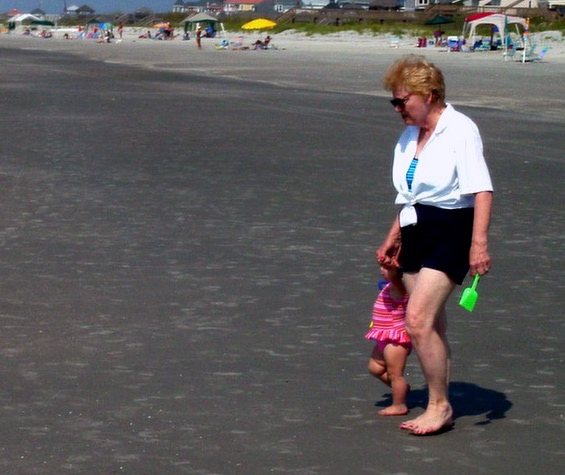

They didn’t have a lot of time together, but they made the most of it.
Read more about my sweet mama:
Cancer is such a bitch
Posted: October 10, 2012 Filed under: breast cancer, cancer fatigue | Tags: breast cancer awareness, cancer fatigue, I hate October, pinktober, pinkwashing, psychological effects of cancer, think before you pink 22 CommentsYesterday I was picking up a prescription at Walgreens — finally one that has nothing to do with breast cancer or the post-mastectomy infection that plagued me for more than a year — and I smiled to myself as I waited in line behind the senior citizens getting their Lipitor and the mom with 3 small kids getting her flu shot (good idea, with those little snot machines attached to her every appendage, said the germophobe in me). I smiled to myself despite the fact that as soon as I walked in the door I was confronted by the display of “pink ribbon products” designed to “raise breast cancer awareness” and “help save a life.” Quotation marks very definitely mine, and intended to convey the maximum amount of snark possible.
I smiled in spite of having passed the pinked-up display of nail polish, glittery lip gloss, pink-ribbon bedecked emery boards, and “hope, faith, and a cure” shower caps (how in the world have I managed without one of those?). I smiled to myself because I was upright, in line at Walgreens under my own steam, having driven myself on a brilliantly sunny day without help from anyone. While my knee is still in recovery mode from the most recent repair, I’m for the most part healthy and able-bodied.
I’m healthy and able-bodied and going about my routine on a very ordinary day with no surprises like finding infection-riddled, 3-inch blisters that were hanging from my mastectomy scars like stalactites hanging from a cave wall. Like the sharp pain that literally felt like a knife blade stabbing through my chest wall as the nerves tried to regenerate after being sliced & diced, post-mastectomy. Like the shock of having caught a glimpse of my new profile in the glass of a store window. Like the pulse-pounding, breath-stealing fear of recurrence that plagues me and other cancer warriors on a regular basis.
No, no surprises yesterday as I waited in line at Walgreens. Instead of surprises, I felt a sense of happiness. A sense of calm. A sense of — dare I say — normalcy. Just an ordinary woman on a routine errand to pick up an RX for low thyroid. I’m far removed from the multiple trips a week to Walgreens that were necessary during the infection phase, and now that I get my cancer-related maintenance meds through the mail, Walgreens is not a place I make an appearance on a thrice-weekly basis.
I was a happy girl as the pharmacist handed me my new prescription, which will hopefully kick-start my lazy thyroid into gear so I can manage to not collapse at 8 pm every night like a cranky toddler. I was happy and calm and normal, until I swiped my credit card and the little machine asked me if I wanted to donate to the Susan G Komen for the Cure. There was the infamous pink ribbon logo atop neat little boxes offering a $1, a $5, a $10 or a $50 option to add to my pharmacy tab.
And just like that, my ordinary day turned on me.
This, my friends, is why I hate October. This is why pinkwashing makes me see red. This is why I rant and rail in this blogspace about the messed-up system that has deemed an entire month for “awareness.”
I AM AWARE OF BREAST CANCER.
Whew, I feel a little better. I wanted to do that in Walgreens yesterday, but I did not. I did not curse, stomp my feet, smash a single thing, or whack a single person. And for that I would like a medal. Or a trophy. Or a cold beer.
I’m glad that the grand poohbahs who run the Walgreens corporation place an emphasis on charity. I like charity. I think charity is a good thing. But come on, does it have to be Komen, and does it have to be so in my face all month long?? In all fairness, it’s possible that Walgreens does shove other charities down customers’ throats in other months of the year and this particular customer hasn’t noticed. But I’ve swiped my card at the pharmacy window many, many, many times at Walgreens and never been accosted by a “donate now” screen on the little machine. I’m quite certain I was swiping my card through that same machine many times the last 2 Octobers and did not see Komen with its hand out and its “Remember you had cancer, lady” banner flying.
Trevor and I had a lively discussion last night, and again this morning, about the whole pinkwashing/Pinktober/Komen/awareness issue. The course of the conversation ran from why all the pink makes me crazy, how unfair it seems that other cancers don’t get so much attention and hype, how the awareness idea has gone wrong, and which causes are worthy of pink dollars. The consensus was this: the time for awareness has long come and gone. We are all well aware of breast cancer. Komen did great things for breast cancer, and the awareness, in the early days. Members of the pink ribbon club owe Komen a debt of gratitude, IMHO, for de-stigmatizing the disease and for making it culturally acceptable to talk about breasts in a medical context. But there are many, many other deserving and hard-working charities that do more actual good for the women and men who suffer from breast cancer. I’m happy to see that some of those causes are gaining attention and getting a piece, or a few crumbs, of the Komen pie. However, we have a long way to go, which is why I’m compelled to yell my head off in this little blog about things like how precious little of Komen’s huge budget actually goes toward research. How infuriating the pinkwashing pandemic is to those of us who’ve walked miles and miles in pink shoes. How the blatant sexualizing of breast cancer makes me want to throw up and punch someone at the same time. How seeing a grown woman in a “Save the Tatas” shirt causes me to go all Serena Williams on her in the grocery store.
This is the reality of October for breast cancer survivors/warriors/victims/patients. And it stinks. I find myself counting the days until this month ends. That it’s also the month in which my sweet mama died from the insidious ovarian cancer that stalked her for years just adds to the misery. What I wouldn’t give for one day, just one day, in which cancer didn’t smack me — and millions others like me — in the face. Even on an ordinary day, cancer has the ability to knock me senseless and dare me to right myself and keep on keepin’ on, yet again. Cancer is such a bitch.
Pinktober is making me crazy…for realz
Posted: October 5, 2012 Filed under: breast cancer, cancer fatigue | Tags: breast cancer awareness, breast reconstruction surgery, Houston Dynamo, NED, pinktober, pinkwashing, psychological effects of breast cancer, save the tatas, stage IV cancer, the Big Dig 39 CommentsIt’s not just an excuse to go postal or blow off some steam, it really is making me crazy. The prolific presence of Pinktober is making me nuts. I’m seeing red (of which pink is a derivative, I suppose). The other day, a woman in the grocery store was sporting one of the worst pink offenders, IMHO, the “Save the Tatas” shirt. I saw her and her offending shirt in the produce aisle and felt a sick feeling in my stomach. I was barely in the store and was already being thrust into the belly of the beast. Just walking in the store, I was accosted by a huge display of “awareness” crap — flower arrangements, helium-filled balloons, potholders, even pink-ribbon bedecked cakes, for cryin’ out loud. Sheesh.
Do those of us who have tangled with this damn disease really need to run the gauntlet of reminders of said disease just to get into the grocery store? Sheesh.
Maybe the display of pink junk that greeted me at the store set me up so that when I saw the “Save the Tatas” shirt, I was primed and ready for a tussle.  I tried to be respectful. I did. I entered into the conversation with every intention of getting her point of view. I’m curious, genuinely curious, as to why a grown woman would sport such a message across her chest. So I pointed to her shirt as our paths crossed by the giant pile of pumpkins (which thankfully had not been painted pink). I asked her if she’d had breast cancer. Just curious. She said no, she has not had breast cancer. Oh, so you know someone who has? I asked. No, but she bought the shirt to support breast cancer awareness.
Ah, yes, “awareness.” More “awareness.” The “awareness” we all so desperately need.
The interrogation continued as I asked her if she was aware of how buying the shirt helps, and what, in her opinion, does “awareness” even mean? She didn’t really have an answer for that. Huh.
I pressed on, like a dog with a bone, and asked if she was aware of which charity received proceeds from the purchase of that shirt. Again, no answer. At this point, she was probably wondering how to contact security in the grocery store. I concluded our little chat by telling her that I have had breast cancer, and I do know many other women who have as well, and that those of us in the pink ribbon club don’t care for those shirts because some of us were put in the unpopular position, through no fault of our own, of not being able to “Save our Tatas,” and that seeing such messages serve as a stark and unwelcome reminder of that most unpleasant fact.
She said she’d never thought about that. She was not aware of that.
Huh.
I bet she’s also not aware of the fact that once you lose your tatas, each and every glance downward or glimpse in a mirror is a smack in the face. That even after reconstruction — or multiple reconstructions — those tatas will never be the same. Some women end up with a version they like better. Some end up with a version that makes them sad each and every time they see that new, not-so-improved version.
She and I parted ways, me feeling marginally better for having unburdened myself, her probably feeling like she needed to go home and lie down. Hopefully she went home and threw that damned shirt in the garbage, where it belongs.
Then I hear that our local professional soccer team, the Houston Dynamo, is hosting an “awareness” event of their own tomorrow. The first 5,000 fans at the Breast Cancer Awareness Match will score a mini pink soccer ball. Sweet.
But this is how they choose to market the event.
Not so sweet.
Tell me, please, anyone, what the scantily-clad cheerleader in the pink attire has to do with breast cancer? Or is that what it takes to get people to attend the event? Questions, people–I have questions!
I had to dig pretty hard to find any info on the actual event. While these images are splashed all over the web, details on what the event really is all about remain elusive. The Dynamo website shows a much less exciting image:

houstondynamo.com
But when I clicked on the link to bobby boots breast cancer/Dynamo Charities, I got nowhere. The computer told me that the page I sought could not be found. Bummer. My next question: is the bobby boots breast cancer image above, with the philanthropic player (who I assume is Bobby) and the soccer-cleat-wearing pink ribbon, that much less effective than the perky cheerleader in her push-up bra? Do people really care less about this dreaded disease if it’s marketed without actual images of breasts?
I was still full of questions when I saw this on a car: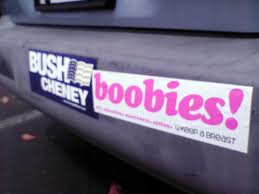
Great, here we go again.
This time, I didn’t accost the person sporting the offending message because the light turned green. But I wanted to. I wanted to say, Can you imagine in your wildest dreams putting sticker on your car that says “balls! support testicular cancer research!” Or “ovaries! egg-makers or silent killers?” No, me neither. As the shirt says, It’s all about the boobies. 
It certainly isn’t “all about the boobies” — it’s about a woman’s life, and how BC threatens and too often takes her life. I’m still waiting for an explanation of how any of this boobie culture makes any difference in the “fight” against breast cancer. If you see a guy wearing a shirt like this, does it enact any change whatsoever in the BC arena? 
I wonder how he would feel if I wore a shirt saying “PROSTATES make me happy”? I can’t even find an image of such a shirt because guess what — it doesn’t exist! No, instead the prostate cancer “awareness” shirts look like this:
and this: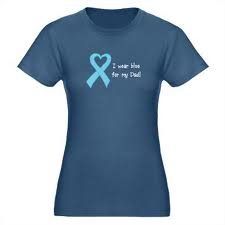
“I Wear Blue for My Dad” conveys a slightly different message than “Save Second Base.” It says the focus is on the person, not the body part. The take-away message here is that sexualizing a devastating disease does nothing for those who suffer from it.
Well, wait a sec — I take that back. Sexualizing a devastating disease does do something for those who suffer from it. It makes them feel bad. Really bad. It makes them mad. Really mad. It makes them want to accost random people in the grocery store or at the bank and set them straight. It makes them have to confront the fact that at this very moment, they may be crossing that bridge from “survivor” with NED to stage IV without a cure. I will never, ever forget the feeling of utter fear when the first oncologist I consulted said once a cancer comes back, no matter what stage it was upon original diagnosis, the recurrence sends you straight to stage IV and you’re considered incurable. Not that you’re going to die from it, as many stage IV cancers can be managed, but treatment is ongoing, as in, for the rest of your life (however long that will be).
That, my friends, is the reality of breast cancer. Not a cutesy slogan. Not a titillating (pun intended) t-shirt. Not an overtly sexual bumper sticker. It’s not about the boobies. It’s about my life.
A pretty pink piece of mail
Posted: October 2, 2012 Filed under: breast cancer, cancer fatigue | Tags: breast cancer awareness, breast cancer awareness month, DIEP flap, DIEP reconstruction, feel your boobies, mammograms, pink ribbon madness, pinktober, pinkwashing, save the tatas, sexualizing breast cancer, the Big Dig 14 CommentsBecause it’s October and we’re awash in all things pink, I got this cute little notice in the mail from my health insurance company. 
Of course it got my attention, amidst the heaps of junk mail, because it’s pink and because when I see a pink ribbon, my brain immediately goes into fight or flight mode as visions of Komen’s money-grubbing dance in my head.
Ok, that’s a bit harsh; Komen isn’t just about money-grubbing. But Pinktober does that to me. I jump to conclusions and get all snarky.
I sat down to read this pink piece of mail, expecting to roll my eyes at yet another meaningless and offensive bit of “awareness” propaganda. Plus, the headline imploring me to put myself first made me think I had free reign to be totally selfish and say, go get a mani-pedi instead of cooking dinner for my people. I had to read more!
Sucked in by the pink haze and the make-me-be-naughty headline, I read on. Page 2 asked a pressing question:

Why, yes, as a matter of fact, I did know that. I also know that mammograms aren’t all that effective at detecting a lump in one’s breast, as I’d been having a mammo every year and at various levels for 5 years before my lump was detected, and even then, it wasn’t detected by a mammo at all but rather by my uber-vigilant OB-GYN, who I credit with saving my life, or at least saving me from a much more protracted and undoubtedly less pleasant cancer “journey.”
Oh, boy, there goes the snark again.
I love the images used in this: the radiantly healthy, young, smiling patient with her gown perfectly draped around her non-cancer-infested body. The state-of-the art screening equipment. The competent and in-control technician. And last but not least, the perfectly round, plump, healthy breast on the screen.
Sigh.
Now I’ve moved straight from snarky to sad, and I’m only on page 2.
Page 3 gets a little more serious, but I’m still sad. That image of the round, healthy breast stays with me. I like that page 3 imparts a serious note, taking care to provide a few snippets of facts & figures to prod one but not scare the bejeezus out of one. The sympathetic tone of, “We know you haven’t scheduled your mammo and we understand, you’re busy taking care of everyone under the sun” is really effective. It’s also very reassuring the way the text suggests “Hey, if the worst does happen and the mammo we suggested you schedule shows that you do in fact have breast cancer, it’s ok; you’re good. We caught it early so you’ll survive.” (You’ll survive, but your life, your wallet, your mind, and most of all, your body will never be the same.)
It goes on to list the signs & symptoms of breast cancer, just in case you aren’t sure. And another suggestion to schedule that mammo today. I love the line about how it won’t cost anything but time. I guess they decided against full disclosure, and nixed mentioning that the smooshing of those nice round breasts is uncomfortable, and that the hospital smell and presence of nightmare-inducing germs everywhere may make you want to run screaming from the building, it might freak out the intended audience and one might decide to chuck the pretty pink pamphlet onto the recycle pile without a backward glance.

I did a double-take at the statistic at the bottom of the page: Did I know that BC claims last year totaled $4.3 million? No, I didn’t know that. That’s a lot of cake.
At first blush, I thought: what kind of nutter is running the accounting office, if they don’t know that I’m one of those claimants? How can they overlook the fact that I’m likely responsible for a quarter of their 2011 claims costs? I’d think that my name is at the top of the list, perhaps with a yellow highlight or maybe an alarm bell that rings, or who knows, a nuclear-reactor type meltdown when my name and ID number are associated with yet another costly claim for United Health Care and Baker Hughes. It’s been a while since I’ve kept an eye on the amount of my claims, but it’s safe to say that it’s up there. Not crazy expensive, like the dresses Ann Romney continues to wear for public appearances, seemingly clueless to the fact that this thing called the Internet exists and it’s easy to check on which designer created her frock and how much it cost, all while she and Mitten claim to be regular folks who don’t consider themselves filthy rich.
Oh good grief, the snark is back. Let me go back and look at that sweet image of the round, healthy, never-to-be-seen-again-on-my-body breast.
Ok, all better.
Thankfully, before I could call the health care PR folks and cuss them out for sending me–me, of all people–a mailing asking if I knew how much my claims had cost them, the Hubs saved me from embarrassing myself and owing a hard-working corporate soul an apology. Just as I was getting really worked up about how in blue blazes could they NOT KNOW that I’ve made hundreds of thousands of dollars in claims because of breast cancer, the Hubs reminded me that we didn’t have United Health Care during the shitstorm of mastectomy, infection, hospitalization, endless labwork, multiple stabs at diagnosing that damned infection, surgery, surgery, surgery, hospitalization, not one but two infectious-disease teams, at-home IV antibiotics, debridement, debridement, home health care, more debridement, more at-home antibiotics, wound vac, the Big Dig aka DIEP reconstruction, ICU hospitalization, more antibiotics, 2 revisions to said reconstruction, and at least 100 visits to the plastic surgeon, yadda yadda yadda.
My bad.
United Health Care got me once the bulk of my spending frenzy was done. No wonder they send me such nice, pretty mail. Whew, I am SO glad I didn’t get on the horn and issue a blistering diatribe to the first person to answer the 800 number. That would have been soooo embarrassing.
The pinky mail wraps up with one final statistic:

I guess I should be moved by the fact that United Health Care is looking out for the many women who are eligible for a smash-&-snap but who didn’t schedule one last year. And I am. Yes, I know that it’s in UHC’s best interest to have their insured women get their mammos, because screening is cheaper than mastectomies and chemo and radiation. I do like the gentle statistics employed in this publication–nothing too in-my-face, not all gloom & doom, no hint of “do this now or burn in BC hell.” I appreciate the assumption that I’m a grown woman who can decide for myself; personally I’m not one who needs to be told twice when it comes to doing something necessary but unpleasant, but I can forgive the repeated pleas to schedule that mamno now, because not everyone shares my “get ‘er done” mentality, and most women have less flexibility in their schedules than I.
This piece of mail struck the right balance of “you need to do this even thought it might uncover your biggest fear and thrust you headlong into a medical nightmare” and “that said, we’re here and are gonna take care of you.” I give high marks to the copywriters who straddled the idea of scaring us enough to schedule that mammo but not keeping us awake at night wondering what it will be like.
Before I was diagnosed, I didn’t give much thought to breast cancer. Sure, I saw the pink ribbons everywhere and thought the women whose bald heads were under cover of a pink bandana are mighty brave (I still do think that, BTW). Even when I got picked for the melanoma lottery, and even when my sweet mama died a not-so-pleasant death from a reproductive cancer at the still-too-young age of 67, I didn’t think much about breast cancer. I still didn’t think much about it when my awesome OB-GYN learned of my sweet mama’s death and said let’s go ahead and get you started with a baseline mammogram, even though you’re nearly 5 years away from the recommended screening age. Every year my mammo came back funny (not funny ha-ha but funny peculiar, because there’s not a damn thing funny about a funny mammo). I still didn’t think about breast cancer. The radiologists chalked it up to dense breast tissue and said, let’s see what’s going on next year. Then the next year, the images still looked funny, and maybe even a bit more unusual, so I saw a breast specialist and endured a series of biopsies. And still, I didn’t think about breast cancer. That breast specialist said the biopsies didn’t show anything overtly cancerous, and I was young for the cancer beast to come calling, so let’s just keep an eye on it and continue the annual screenings. Even then, I didn’t think much about breast cancer.
Fast forward to the present day, as I sit with a well-done mailing imploring me to schedule a mammogram.
Now I feel the need to call United Health Care, not to cuss anyone out, but to tell them thanks for the pretty pink mailing, but to kindly remove me from the distribution list for future mailings. See, I won’t be scheduling a mammogram this year, or any year in the future. Instead, I go see the unflappably darling Dr Dempsey twice a year for a chest and lymph node ultrasound. It’s not a breast ultrasound, because my breasts contain no breast tissue. Nope, they are made of 100 percent belly tissue, and breast tissue and belly tissue look totally different in a mammo. As far as I know, there’s not a smash-and-snap procedure for the belly. In addition to my twice-yearly screening by my favorite breast surgeon, I get to see my cutie-pie oncologist three times a year. Blood work checks my tumor markers and hormone levels, and I submit to a thorough exam and lecture about my champagne habit.
Maybe I will call United Health Care, to tell them that I appreciate them putting out such a fine piece of mail. The best part about the mail? Not once is there an image like this
ort this
or this 
or this
or this
or this
or this
or good-golly-miss-Molly this
And for that, I’m grateful.
Blog with love
Posted: October 1, 2012 Filed under: breast cancer, cancer fatigue | Tags: Army of Women, Blog with Love, breast cancer awareness, Dr Susan Love Research Foundation, HOW Study, pinktober, pinkwashing, The Rose 16 CommentsI woke up in a snit this morning. I have been dreading this day for a couple of weeks, from the first glimpse of the ubiquitous pinkwashing that occurs every October. It’s the official start of “Breast Cancer Awareness” Month — quotation marks mine, because I really can’t in all seriousness say that phrase without denoting how absurd the “awareness” idea is. I have a lot of ire toward Pinktober and the pinkwashing of everything from toilet paper to yogurt. As someone who went toe-to-toe with the dreaded disease, I find it offensive that corporations can still hock their wares under the guise of awareness. Is there really anyone on this planet not aware that breast cancer exists? Come on. Enough with the awareness. Try doing something really meaningful, like slashing the pinkwashing advertising budget and cut a check directly to a do-good organization.
I noticed the Pinktober creep starting a couple of weeks ago. As I pushed my grocery cart through the store, filling it with the provisions that keep my family up and running, I saw something awful out of the corner of my eye.

Pink-ribbon saucepans, and water bottles, and plastic containers. Oh great, here we go again. I wonder if any of that wall of pink plastic is BPA free? The studies that link BPA, a common chemical in rigid plastic, to breast cancer, are piling up at an alarming rate.

It gets worse — pink-ribbon hair brushes, so you can brush for the cure. Unless of course you’re undergoing chemo and have no hair. I’m sure the bald BC patients shopping for groceries appreciate the reminder that wait — not only do you have a scary-ass disease, you’re also bald and vulnerable and grappling with negative body image. Thanks, Revlon. This pinkwashed product seems particularly crappy. 
What about a pair of pink-ribbon socks? From the grocery store. Yeah, I bet those are soft and cozy. And how much of the $1 price tag is going toward any kind of change on the BC front?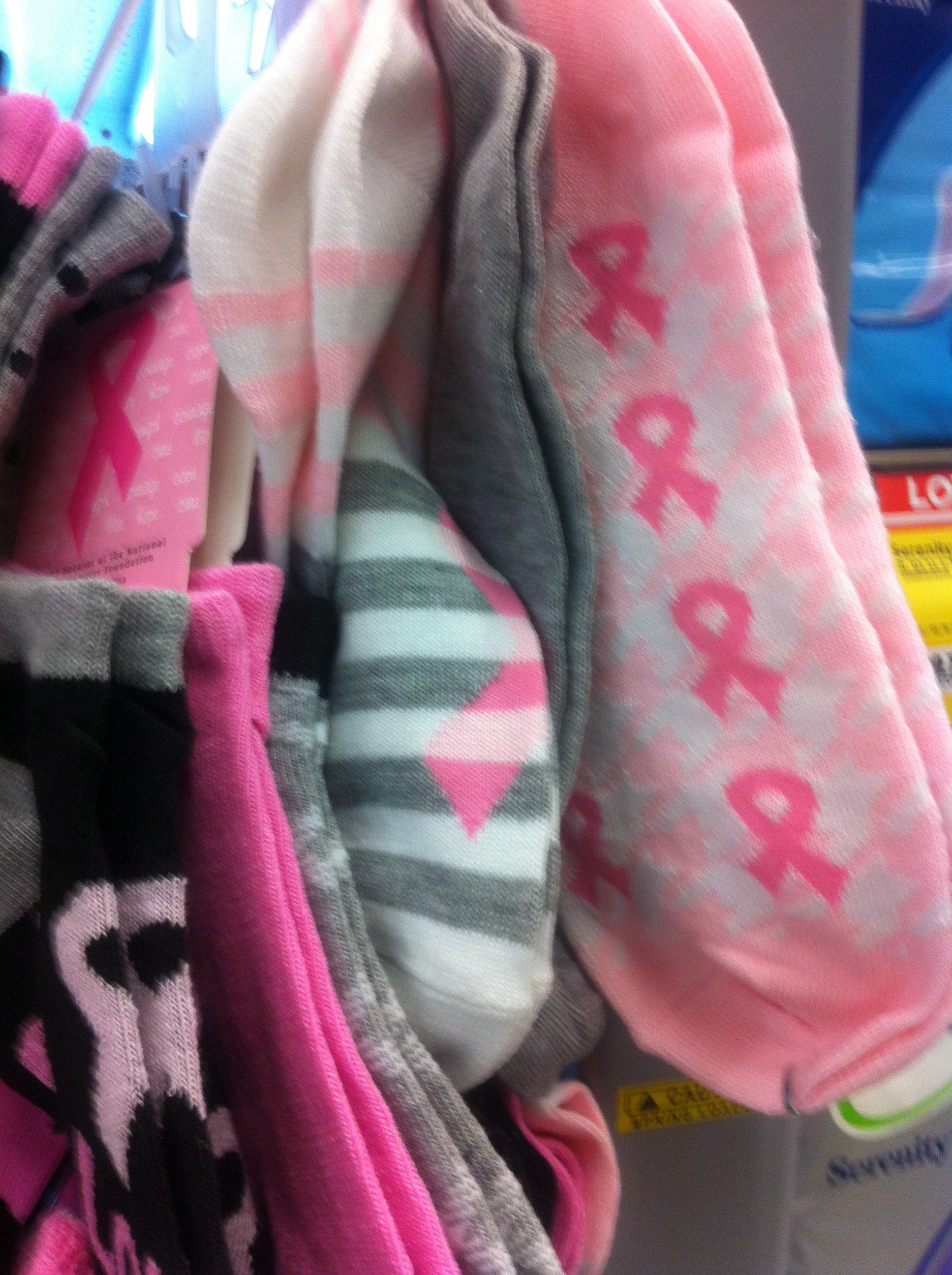
I’m lucky I didn’t throw up in my mouth at the first of this year’s crop of pinked-up junk masquerading as charitable fundraising products. I guess the junk is designed to give shoppers a warm-fuzzy feeling about doing something important for the disease that descends upon one in eight women in the U.S. every year. The products themselves make me sick, but the fact that the pinkwashing starts earlier and earlier is really disgusting. As if the Christmas Creep isn’t bad enough, we now must endure the Pinktober Creep as well. Son of a nutcracker.
If buying pinked-up products could cure breast cancer, dontcha think it would’ve by now? Why not cut out the middle-man and send your hard-earned and well-meaning money straight to an organization that can actually do something useful?
Like my friend Jen at ihavebreastcancerblog, who is also blogging about Pinktober, I wore a pink shirt today. Not because I want to commemorate “Breast Cancer Awareness Month,” but because it matched my bright blue Nike shorts with the pink & white stripes, and as I headed to the gym for another grueling post-knee-surgery PT session, I needed the lift that a well-put-together outfit can provide. The pink shirt in question happens to be my survivor shirt from last year’s Race for the Cure. My first — and only — Race for the Cure. 
After the gym, I was in the drive-through lane at the bank, and the bank teller was super chatty. I’m all for some friendly chit-chat from a service provider, as long as they can multitask. If they can talk and conduct business, fine with me, chat away. But if they have to stop to chat, uh-uh. Nope. Zip it and get your work done. I don’t want to take time to listen to idle chatter from someone with whom I’m not likely to form a relationship. Does that make me cranky? crotchety? unfriendly? mean? Maybe. But I’m honest. The last thing I want to do is listen to someone blather on while I wait for them to do the job they’re supposed to do. So when the bank teller started chirping about how it’s the perfect day for a convertible, and asking me if I’m working today or just out enjoying the day, I could feel myself getting snippy and impatient. When she asked if I had a good weekend, I was about to turn off the smile and figure out a nice way to say, “Hurry the hell up, lady. Less talking, more working.” Deep breaths, deep breaths.
She noticed my Race for the Cure t-shirt and commented on it. I haven’t worn this shirt since I learned the ugly truth about the Susan G Komen organization and how precious little SGK has done to actually look for, much less find, a cure. Once the SGK-Planned Parenthood debacle occurred, I decided that SGK would not get one dime from me, ever again. I did the Race for the Cure exactly once, to see what it was all about. It was a nice experience, but I’d rather send my $40 registration fee someplace in which it has a shot at making some real progress instead of lining SGK founder Nancy Brinker’s pockets and/or perpetuating the farce that SGK is committed to ending this wretched disease.
The chatty teller asked me if I was going to do the Race for the Cure again, and I said no. Sometimes I wonder why I’m compelled to answer so honestly rather than just tow the party line and say what people want to hear. Then I realize that wondering something like that is akin to wondering why the sky is blue instead of green, and that it’s utterly pointless to expect things like that to be different. Anyhoo, I told the teller that no, I will not be doing the Race for the Cure again, and of course I proceeded to tell her why.
She may be somewhat sorry she chose to be chatty with me today.
She got a bit of an earful. A well-reasoned and calm earful, but an earful none the less. I explained that before being inducted into the Pink Ribbon Club, I knew Susan G Komen for the Cure was the leading breast cancer organization, and that it wasn’t until I acquainted myself with more than just the superficiality of SGK and its pink-ribbon-bedecked world that I realized that the group wasn’t exactly working hard to find a cure. Silly me, I thought that if “for the Cure” was part of the group’s official name, so much so that it would sue others for harmlessly using it for their own fundraising, that the group might actually be focused on finding a cure for this disease that had so rudely interrupted my life. Not so with SGK. Instead of funneling the majority of its funds toward finding a cure, it instead chooses to focus the majority of its resources on education and “awareness.” As someone who has walked more than a mile in pink shoes, I can’t abide SGK’s priorities. As stated on its website: “In 1982, that promise [between Susan G Komen and her sister Nancy Brinker] became Susan G. Komen for the Cure® and launched the global breast cancer movement. Today, Susan G. Komen is the boldest community fueling the best science and making the biggest impact in the fight against breast cancer. Thanks to events like the Komen Race for the Cure, we have invested almost $2 billion to fulfill our promise, working to end breast cancer in the U.S. and throughout the world.”
Sounds good, right? But think about it — if SGK is the best of the boldest and has been working toward a cure since 1982, wouldn’t you expect to see more progress? Thirty years. And very little change.
In fact, The American Cancer Society says this about the incidence rate of BC:
• Between 1975 and 1980, incidence was essentially
constant.
• Between 1980 and 1987, incidence increased by 4.0%
per year.
• Between 1987 and 1994, incidence was essentially
constant.
• Between 1994 and 1999, incidence rates increased by
1.6% per year.
• Between 1999 and 2006, incidence rates decreased by
2.0% per year.
It wasn’t until 1999 that BC rates decreased — 20 years after SGK came on the scene — and even then, by 2 percent a year. Does that sound like progress? Does that sound like “for the Cure?” Not so much. I did not whip out the above statistics for the chatty bank teller (I do have some standards, after all, even when I’m ranting to a total stranger through a plexiglass window), but I did tell her that this is why I won’t do another Race for the Cure or support the Susan G Komen for the Cure. She did ask, after all.
She said she had no idea. She thought that SGK did all kinds of good things for breast cancer, and that they raised a lot of money to find a cure. I said she’s right about part of that: Komen does raise a lot of money, but precious little of it goes toward the research needed to find the cure. She asked me how much of Komen’s money goes toward research, and when I said the best estimates are no more than 19 percent, she was stunned. Perhaps I should have felt a bit badly for bursting her bubble, but instead I felt triumphant when she asked, if not Komen, then who?
Cue the choir and release the confetti bombs!
I told her that personally, I like The Rose right here in Houston, and applaud the efforts to make a real difference in the lives of women with breast cancer, especially those who are traditionally underserved by screening, prevention, and treatment. I also like Dr Susan Love’s group, the Dr Susan Love Research Foundation. The DSLRF is determined to find the cause of breast cancer, not just tie a pink ribbon around the idea of it. Dr Love has been oft quoted as saying, “The key to ending breast cancer is to learn how to stop it before it starts.” She also says:
“I have spent my whole life working in the field of breast cancer. At this point I am frustrated that we are still doing the same treatments with about the same results as when I started thirty years ago. Now that we can get to where breast cancer starts we have the opportunity to eradicate it. I am excited and impatient. The road is clear. We can go slowly or quickly, but everyday that we delay another 592 women will be diagnosed and 110 will die. The cost is too high to hesitate. This is our job not our daughters’, granddaughters’, nieces’ or nephews’. We can do it and we have to do it!”
Thanks to The DSLRF’s focus on research, we’ve moved from throwing around “for the Cure” to actually working to figure out and eliminate the disease. I like Dr Love’s idea of eradication much better than Komen’s “idea” for the cure.
Now is a great time to mention Dr Love’s latest initiative: The HOW Study. To get the word out about The HOW Study, Dr Love is encouraging us to Blog with Love.  Today’s the day for the third-annual blogger initiative, and I’m all in! The HOW Study, along with The Army of Women, is in my opinion much more viable and holds much potential to enact real change. I’ve participated in several Army of Women studies and will continue to do so every chance I get. I encourage everyone reading this to check out The Army of Women and see if there’s a study that applies to you.
The HOW Study is a ground-breaking study for women (and men) who have no history of breast cancer. See, the majority of women diagnosed with BC don’t have a family history of or clinical risk factors for the disease. Dr Love wants to figure out what causes the disease so we can figure out how to stop the disease. Dr Love’s website says that 280,000 women were diagnosed with BC last year. Of those, 40,000 women will die from the disease this year. You can help turn those numbers around by joining The HOW Study.
I’ve just decided I’m ditching my Race for the Cure shirt and am going to get this shirt instead:

zazzle.com
In the last six months…
Posted: May 24, 2012 Filed under: breast cancer, cancer fatigue | Tags: blog challenge, cancer at age 40, finding happiness after cancer, post-cancer life, psychological effects of breast cancer 21 CommentsNever one to resist a challenge, I happily undertook Jelebelle’s blog prompt this week, which was inspired by Renn’s blog prompt last week. Jelebelle took Renn’s idea and ran with it, challenging us to “post a photo or self portrait or other form of visual art … of yourself that describes who you have been within the last six months.”
Hmmmm. Interesting.
I’m especially intrigued by the “who you have been within the last six months” part. Some days I feel a little Sybil-ish, with many different versions of me. There’s the warrior girl who pummeled breast cancer, the tough-lovin’-but soft-on-the-inside mama, the relentless chaser of the next level of strength in the gym, the hard-core-run-down-every-single-ball tennis chick, the at-home mom who respects the commitment to domesticity while being bored silly by it, the bookworm who can’t dive into the latest good read until the kitchen is spotless, the voracious detail-seeker who wants to know it all yet remembers precious little.
And that’s just what comes to mind at first blush.
I spent several days pondering this idea of who I have been in the last half-year. I’d think about it while at the gym, while watering my newly planted flowers, while making yet another sack lunch for my little darlings, while driving across our sleepy suburb mid-day with the top down and the wind whipping my hair into a frenzied mess. My inner warrior wanted the answer to Jelebelle’s question to be “I’m a badass slayer of cancer and bad grammar.” The softer side of me, which I usually try to tamp down at all costs, wanted the answer to be “I’m kind and patient and willing to see the good in everyone, no matter how moronic or mean-spirited they really are.” The chaser girl wanted the answer to be “I’m a beast in the gym who can’t get enough reps and I pity the fool who gets in my way.” The tennis chick wanted the answer to be “I’m a steady player who will wear you down in a war of attrition.” The at-home mom wanted the answer to be “I’ll have to answer that question after I fold 10 loads of laundry, put a delicious & nutritious meal on the table while a homemade cake fills the kitchen with the heavenly aroma of fresh-baked love, tend to the animals, dust the ceiling fan blades, and oversee the winning science fair project.” The bookworm wanted the answer to be, “Can’t talk, reading.” And the detail-seeker wanted the answer to be widely researched, fact-checked, and methodically presented.
Rather a tall order, right?
So in the end, after much soul-searching and reviewing of the events of the last six months, my answer to Jelebelle’s question of who I have been is this:
I’ve been a happy girl who is learning to love this post-cancer life. Becoming a happy girl post-cancer has been a long time coming. Like every diagnosis, mine was hard to hear and even harder to absorb. Being handed a deadly disease at age 40 is cruel, but being mangled and diminished by the disease is even worse. Once through the hard part (whichever part that is), the kernel of fear remains firmly implanted in one’s brain, and the realization that cancer may be gone but can never be forgotten is a heavy reality. It can be hard to be happy after all the damage that cancer inflicts. 
While mine may seem a simple answer to a complex question, the simplicity of being a happy girl is actually rather complicated. There’s the strange dichotomy between being pissed off at the universe for randomly choosing me to be the one in eight women diagnosed with breast cancer, and being immensely grateful that my cancer wasn’t as awful as it could have been. There’s a continental divide between having breast cancer ruin my life and having it push me to become stronger… better…more grateful. I’m alternately wrecked by what cancer has done to my body and my psyche and determined to ensure it will not defeat me. 
My cancer “journey” has not exactly been a sensible trip from point A to point B; I rather took the scenic route. Dear Dr Dempsey, breast surgeon extraordinaire, inducted me into her “One-Percent Club,” which describes my “journey” so well: of all the women diagnosed with breast cancer in her practice, there is one percent for whom anything that can go wrong will go wrong. The select few in this club will encounter worst-case scenarios that will blow the roof off of the established medical protocol. We are the women she and her colleagues discuss in tones of “WTH???” and the women whose stories she tells to her other patients in order to reassure them that their situation really isn’t so bad. It’s a privilege and an honor to be part of the One-Percenter (yuk, yuk!). We’re committed to serving as a cautionary tale to others whose only fault in life was to be born a woman with a pair of breasts. We are a group that is small but mighty, and we are endlessly stubborn in the face of this wretched disease and its many-tentacled complications. We’ve learned the hard way that our bout with cancer may be done but it’s never over. And this One-Percenter has spent the last six months becoming happy. 
Blog Party, APA style
Posted: May 16, 2012 Filed under: cancer fatigue, drugs, menopause | Tags: American Psychological Association, antidepressants, antidepressants used for conditions other than depression, beta blockers, Dana Jennings, insulin, menopause, Oncotype DX, psychological effects of cancer, PTSD from cancer, statins, stigma and depression, tamoxifen 19 CommentsThe American Psychological Association knows how to throw a party. Well, a blog party anyway. The APA is sponsoring a Mental Health Blog Party today, and I’m happy to participate. Many thanks to Marie at JBBC for spreading the word about the MHBP. If I didn’t know better, I might think it’s an acronym party, as well.
The topic of mental health is scary, uncomfortable, and unpleasant for a lot of people. Add cancer to the discomfort of mental health and watch people run screaming from the room or back away slowly, never breaking eye contact. Perhaps that’s part of why the APA is throwing the Mental Health Blog Party; to de-stigmatize mental health issues the way pioneers such as former First Lady Betty Ford and Dr Susan Love have taken the shame out of breast cancer.
Yesterday I got a call from the nurse case manager provided to me by our health insurance company. We’ve had this particular health insurance, United Health Care, since September, but the NCM just got around to calling me. When I was first diagnosed, and under another insurance company, the NCM was fantastic. She was a great resource not only for insurance issues but also knew the medical side of my problem too. She went to bat for me and got the insurance company to pay for my Oncotype DX test, which costs a fortune but is instrumental in making a decision about treatment options.
Anyhoo, I was surprised to get a call from the United Health Care NCM out of the blue yesterday. I suppose she — or someone in her group — just noticed my unusually thick file, chock full of cancer calamities and infection ills and figured I warranted a phone.
We went through the usual laundry list of details: date of diagnosis, surgeries (yes, plural surgeries), and treatment status. Then there was the recitation of the everyday meds post-cancer: tamoxifen to prevent recurrence, Effexor for menopause symptoms, levothyroxine for sluggish thyroid, and Ambien to help my worried mind shut down and get some sleep. Oh, and don’t forget the glucosamine for my rotten joints (thanks, tamoxifen!), Ferrex iron boost for anemia (thanks, mycobacterium!), and calcium for osteopenia (thanks, menopause!). I’ve recently added an Omega fatty acids supplement too to help jump-start my addled brain (thanks, PTSD).
Although I clearly stated that the Effexor is to help manage the hot flashes, night sweats, and moodiness of menopause, the NCM asked me if it’s helping me manage the depression brought on by my cancer diagnosis.
I reiterated that I’m not taking it for depression but to get some much-needed relief from the atrocities of chemically induced menopause. I don’t think she believed one word I said. Either that or she’s hard of hearing because she again asked how I’m coping with the depression and reminded me that it’s ok and even expected to feel sad after being faced with cancer.
I finally told her in an exasperated voice that I don’t suffer from depression, and if I did, I’d have no qualms whatsoever about taking an antidepressant. To me, depression is no different from any other medical condition that requires daily medication. Where’s the stigma surrounding statins for high cholesterol? Or beta blockers for high blood pressure? Or insulin for diabetes? Why should the stigma just be attached to depression? That sweet woman got more than an earful from me. I still think she doesn’t believe me about the depression thing, and she ended our phone call by reminding me that my health insurance plan covers 8 free counseling sessions. Just in case I need some help with that depression.
I understand completely why cancer patients and cancer survivors may be prone to depression. The list is long, very long, of reasons for cancer patients and survivors to be depressed, sad, out of sorts, unmotivated, fatigued, unable to concentrate, easily confused, guilty, hopeless, worried, unable to sleep and full of chronic aches & pains.
Webmd has an entire online community devoted to cancer. From the web site:
“Depression is a comorbid disabling syndrome that affects approximately 15% to 25% of cancer patients. Depression is believed to affect men and women with cancer equally, and gender-related differences in prevalence and severity have not been adequately evaluated. Individuals and families who face a diagnosis of cancer will experience varying levels of stress and emotional upset. Depression in patients with cancer not only affects the patients themselves but also has a major negative impact on their families. A survey in England of women with breast cancer showed that among several factors, depression was the strongest predictor of emotional and behavioral problems in their children. Fear of death, disruption of life plans, changes in body image and self-esteem, changes in social role and lifestyle, and financial and legal concerns are significant issues in the life of any person with cancer, yet serious depression or anxiety is not experienced by everyone who is diagnosed with cancer.”
“It’s harder to write about the weight of depression than it is to write about prostate cancer and its physical indignities. Cancer is clear biological bad luck. But depression, no matter how much we know about it, makes part of me feel as if it’s somehow my fault, that I’m guilty of something that I can’t quite articulate.”
“Partly, I think, I’m grieving for the person I was before I learned I had cancer. Mortality is no longer abstract, and a certain innocence has been lost. And while the physical trauma is past, the stress lingers and brings with it days washed in fine shades of gray. In the same way that radiation has a half-life, stress does, too. We all ache to be the heroes of our own tales, right? Well, I’m not feeling too heroic these days. Cancer pushes lots of difficult buttons. It lays bare our basic vulnerability and underlines the uncertainty of this life. And prostate cancer attacks our culture’s ideal of manhood. The steely-eyed Marlboro Man isn’t expected to worry about incontinence and erectile dysfunction. Cancer feels bleaker than other diseases. Even though my health keeps improving, and there’s a good chance that I’m cancer free, I still feel stalked, as if the cancer were perched on my shoulder like some unrepentant imp.”
The circus may be gone, but the big top remains
Posted: May 11, 2012 Filed under: breast cancer, cancer fatigue, infection | Tags: DIEP breast reconstruction, life after breast reconstruction, mycobacterium fortuitum, nosocomial infection, post-mastectomy infection, psychological effects of breast cancer, the Big Dig 20 CommentsSaw Surgeon #2 last week about the next step in revising The Big Dig. Didn’t want to talk about it or blog about it at the time. I’m not sure why, but I suspect it has to do with Surgeon #2’s comment about me having “been to hell and back.”
Part of me thinks it should be very gratifying to hear Surgeon #2 say that. After all, I respect her immensely, and it’s quite validating to hear someone I think highly of say that I made it through a seriously trying time, and that I made it with flying colors. If there were a report card for cancer/infection/surgery progress, I think I’d have straight A’s.
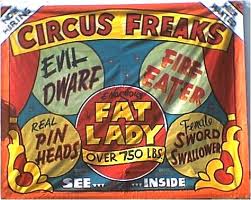
No such report card exists, however, and a 4.0 in this particular course-load is meaningless. There is no honor roll in the ranks of survivors. Instead of a gold star, I have some big-time scars across my chest and belly. I’ve gained a few hard-won wrinkles etched in my furrowed brow, too, from the worry that accompanies a cancer diagnosis, a post-mastectomy infection, 267 days of oral antibiotics, and major surgery followed by not one, not two, but multiple revisions. There’s no end in sight to this circus. The fairgrounds are quiet, but the circus tent remains. The bearded lady has gone home, and the trapeze artists have ambled along, too. The wild animals are safely ensconced in their cages, and the carnival rides are dormant. The circus, however, lives on. It seems there is no end to the drama and three-ring craziness that is life after breast cancer. I hold out hope that at some point the circus will vanish in the night, and I will awake to find sawdust, peanut shells, and the faint smell of adrenaline and cotton candy. But alas, the big top remains.
google.com
I saw Surgeon #2 last week to get her opinion on the next step on this cancer “journey.” Like a traveling circus steaming toward the next town, the cancer “journey” chugs along. I sought Surgeon #2’s expert opinion on the next phase of this “journey.” After The Big Dig and subsequent revisions to perfect what is essentially an imperfect canvas, I needed to hear her say “do this” or “don’t do that.” I needed to know whether there’s any point to pursuing yet another tweak to my restored chest.
Surgeon #2 was her usual cheery, to-the-point self. She says I’m “almost there” in the relentless pursuit of normalcy — at least on the physical side — after breast cancer and reconstruction. That’s the tactful way of saying “We can do a little more, but it’s never going to be perfect so we’re getting close to the time in which you start to accept it.”
I don’t want to accept it.
I’m still hanging onto the myth — albeit cruel and deceptive — that one can have nice boobs again after cancer. Public Service Announcement #852 from this little blog: If you hear someone say, “Bummer about the breast cancer, but at least you get new boobs,” be aware: the new boobs may not be something you actually want.
I’m still not ready to accept that ugly truth.
Surgeon #2 concluded my consultation with a little look-see at an 8 1/2 x 11 inch photo of myself pre-reconstruction. I don’t remember posing for that picture, as there have been several photo shoots associated with this cancer “journey,” but there it was, on the inside cover of my file. Surgeon #2 flashed that full-sized photo of me, with one tidy mastectomy scar on the left and one not-so-tidy scar on the right. The right side, a mess of multiple scars and tissue excisions necessitated by the nosocomial infection. I hadn’t seen or thought about that scene in many moons. I recognized the train wreck on what was formerly known as my right breast. I recognized the God-awful blue paper panties required for plastic surgery photos. I recognized my former belly button, so normal and non-Frankenstein-looking. I recognized the flabby belly that I was required to acquire so that the DIEP surgery — my only reconstruction option — could occur. That belly was flabby, but it was unblemished and absent was the 17-inch incision from hip to hip that has mellowed but will forever be a stark reminder of what the king’s horses and the king’s men did in an effort to put Humpty Dumpty back together again.
While I hadn’t seen that photo in nearly two years, I recognized every aspect of it. However, when Surgeon #2 said, “You’ve been to hell and back,” I couldn’t conjure up the specifics I expected to feel about that dark period in my cancer history. In fact, hearing her say “You’ve been to hell and back” was startling. I didn’t expect it. I didn’t know how to react to it. And days later, I still don’t know how to react to it.
I suppose I should have felt some pride and/or satisfaction at having endured that trip down the “If anything can go wrong, it will” scenario. Perhaps I should have felt a sense of accomplishment at having survived that arduous trip down the rabbit hole. I guess I should have felt happiness at having come out on the other side of such a hellish situation. But I didn’t.
Instead, I felt as if I were watching myself in a movie. I remember being there, of course, and I remember that all that happened to me. But I can’t conjure up the specific feel of the experience. I can’t visualize the ins and outs of that particular “journey.” I see myself, my physical body, in that full-size, color photo (which is not at all flattering, by the way), but it doesn’t seem like me. I see that former body through a myopic lens. The rational side of my brain knows it did indeed happen to me, but the protective side of my brain has shielded me from calling it up, in all its ugliness. Like the flash of lightning in the night sky of a summer storm, or the sharp but fleeting heat of a jalapeno pepper on the tongue, I know it’s there but once it’s gone it’s gone. For that I should be grateful.
But I’m not grateful.
I’m sad.
Really sad.
And really mad.
Maybe it’s too soon to feel triumph over the wily infection that wreaked untold havoc on my weary body. Perhaps the time is not right to celebrate how far I’ve come. Maybe I’m simply not one to say, “That was rough, but I got through it.” Apparently it’s a long way from beginning to end, if there ever is an end, and I’m not there yet. While it’s been almost exactly two years since I bid adieu to my cancer-riddled breasts, that’s not enough time to process the enormity of all that’s transpired over the last 728 days. If it were a linear path from diagnosis to mastectomy to psychological recovery, I might be in a position to expect some change, some healing, some progress to have occurred. But I was busy processing that nasty infection instead of dealing with the weight of cancer at age 40, so the change, the healing, the progress remains at a standstill.
The big top remains.

google.com

 The Pink Underbelly